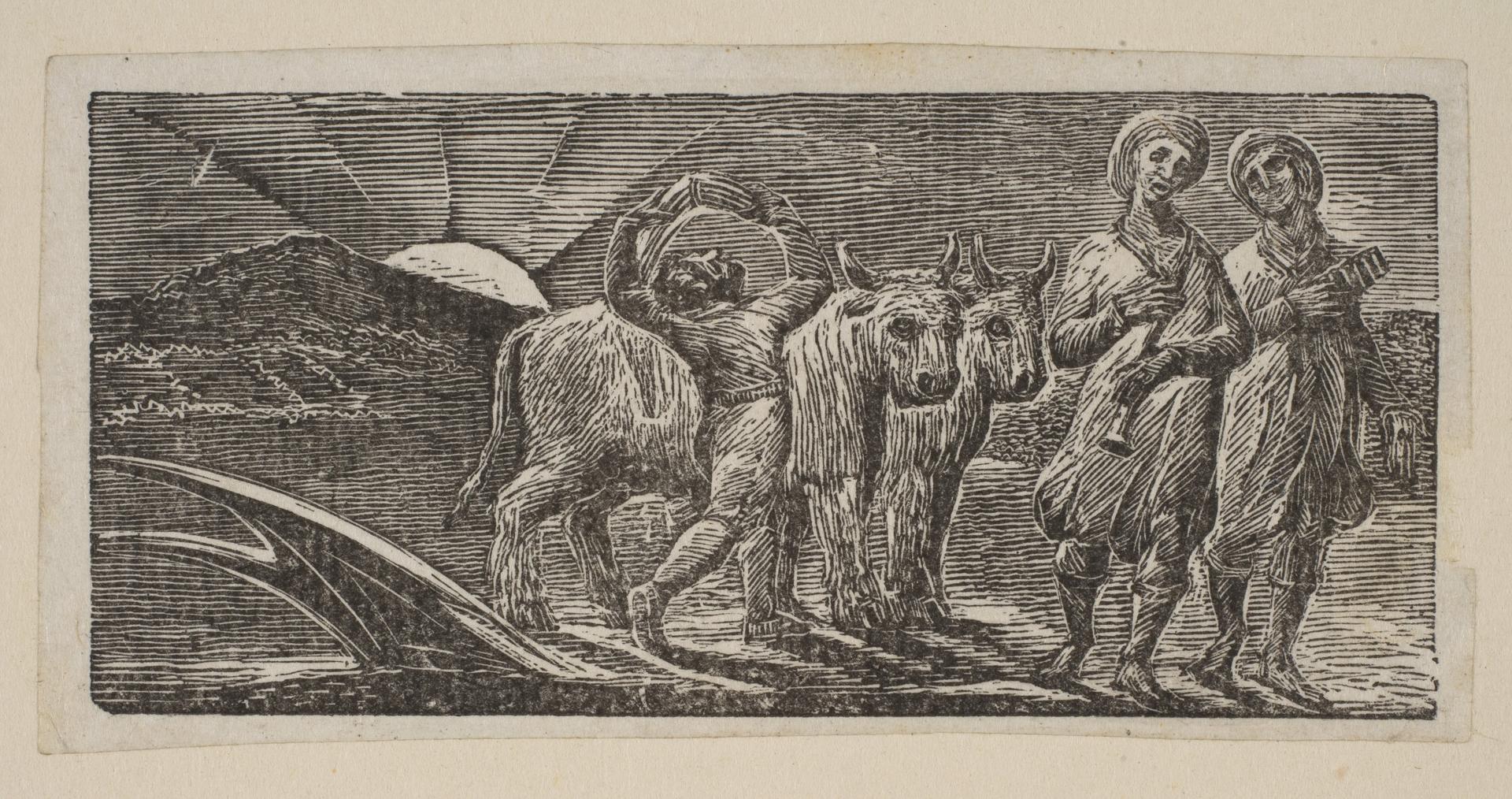
Boy Returning Joyfully, with Plough and Oxen, from Thornton's "Pastorals of Virgil" (1821, Met-Objekt 3875)
Original title: Boy Returning Joyfully, with Plough and Oxen, from Thornton's "Pastorals of Virgil"
kurzbeschreibung
A boy with two oxen heads home from field work in this small print by William Blake, part of Robert John Thornton's 'Pastorals of Virgil.' Measuring just 3.8 by 7.8 cm, the wood engraving was made in 1821, with other figures filling out the rural setting.
Description
In the foreground, a boy walks upright, leading two oxen on a rope. He wears a hat and jacket, as was usual in the countryside. Beside him stands another man holding something that could be a tool or a book. The other figures are also dressed in traditional clothing. Simple hills and a cloudless sky close the view, with light falling evenly across the surface.
Context
The illustration belongs to Robert John Thornton's fourth edition of Virgil's 'Pastorals,' published in London in 1821. Thornton commissioned nineteen wood engravings from Blake to replace expensive copperplate engravings. Since Blake was not trained as a wood engraver, the engraver John Byfield cut the designs into wood. The prints were initially criticized but are now considered outstanding examples of book illustration.
Impact
Plain forms and clear lines make the print immediately accessible. The boy's cheerful posture and the calm landscape create an idyllic mood that matches the pastoral tone of the text. The small format demands close looking and rewards with fine details.
Technique
For wood engraving, the design is cut into a wood block and then printed. This method allows only coarse lines, which suits Blake's reduced formal language. The block measures merely 3.8 by 7.8 cm, requiring precise cutting.
AI-generated description text
Source: Metropolitan Museum of Art · Public Domain (CC0 1.0)