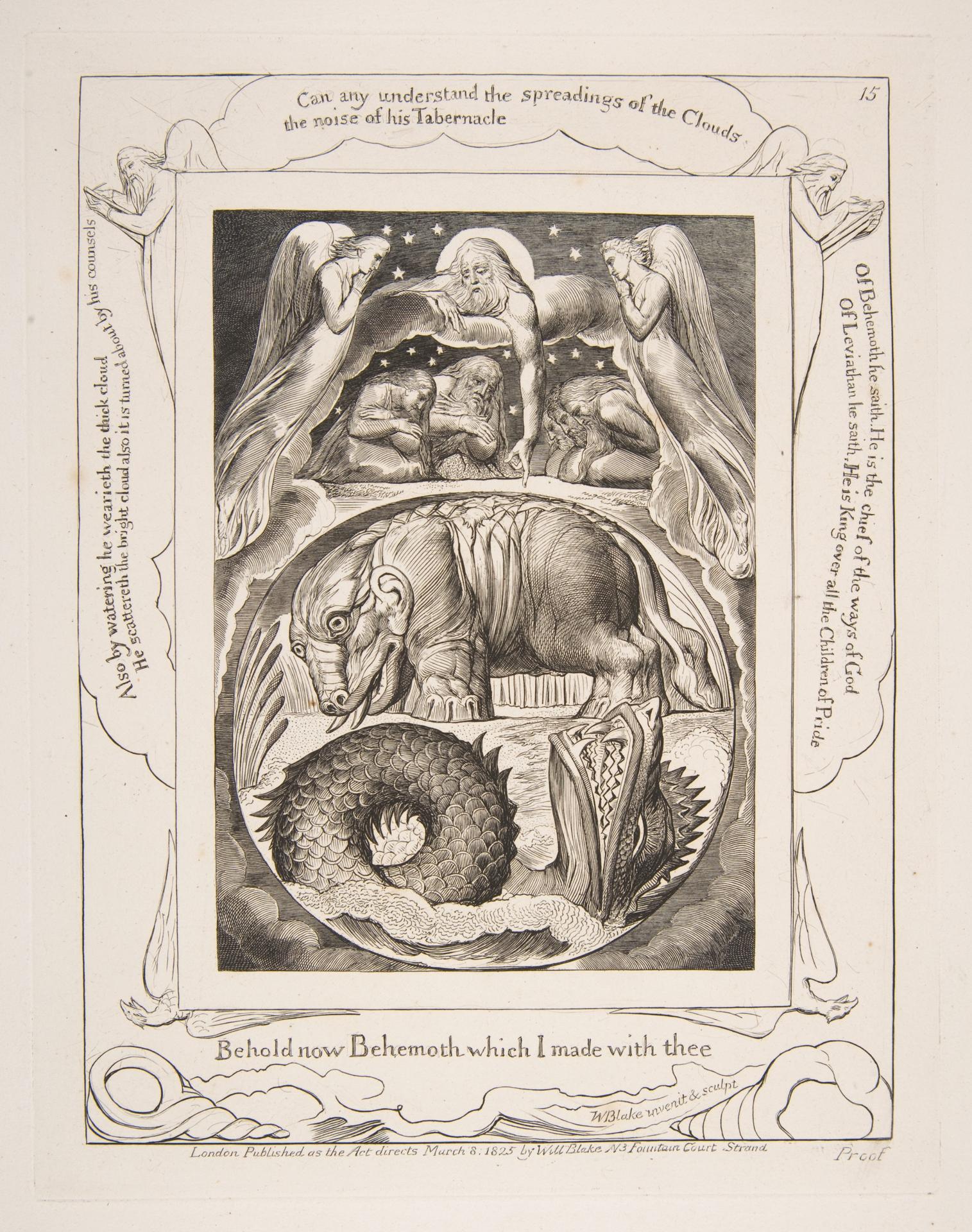
Behemoth and Leviathan
Original title: Behemoth and Leviathan
kurzbeschreibung
Made around 1825–26, William Blake's engraving 'Behemoth and Leviathan' belongs to his series illustrating the Book of Job. The two name-giving creatures appear alongside angels and a bearded, crowned figure. Biblical imagery and Blake's own mystical approach are tightly interwoven in this print.
Description
At the top, two angels arrange themselves symmetrically around a central figure with a long beard and crown, suggesting a religious or mythical authority. Below, Behemoth — a massive, bearded being with horns and a long tail — and Leviathan — a scaled dragon with a sweeping tail — take on almost combative postures. The layout is mirror-like; the animals fit into a circular frame that encloses them from top to bottom. Black and white with graded greys, emerging from the engraving's hatching, defines the sheet. Inscriptions at the margin add a literary layer.
Context
This engraving is part of Blake's Job illustrations, produced between 1825 and 1826. Job 40–41 provides the reference: there God presents Behemoth and Leviathan as signs of his power. Blake, both poet and artist, was known for strongly religious, symbolic works in which biblical subjects merge with his own mysticism. The series was suggested by his friend John Linnell; it was not completed during Blake's lifetime.
Impact
The mirror-like arrangement and the creatures rendered in every detail evoke a serious, almost devotional mood. Calm and threat stand opposed: the composed angels above, the bulky, restless animals below. This contrast speaks of the grandeur and power of divine creation. The delicate lines and grey tones give the sheet a quiet, contemplative undertone.
Technique
The technique is etching: the drawing was scratched into a waxed copper plate and then etched. With thin lines and precisely placed hatching, Blake worked out the textures and bodily forms of the figures and animals. The plate measures 21.6 x 16.8 cm, the sheet 41.1 x 27.5 cm — a format that suggests careful execution and a rather intimate scale.
AI-generated description text
Source: Metropolitan Museum of Art · Public Domain (CC0 1.0)