Songs of Experience: The Sick Rose
Original title: Songs of Experience: The Sick Rose
kurzbeschreibung
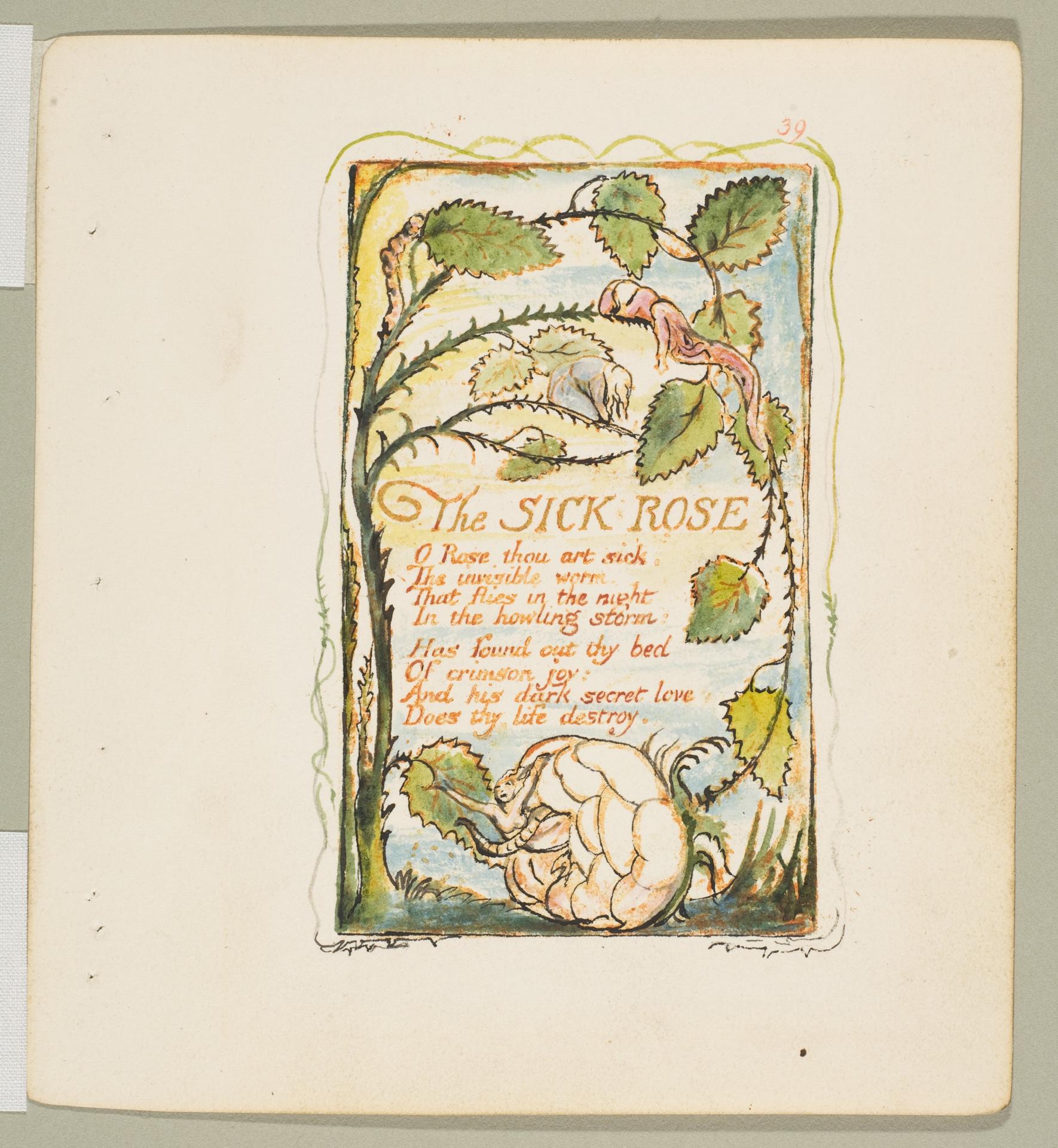
William Blake's 'The Sick Rose,' from 1794 and printed around 1825, pairs a rose entwined by a serpent with an accompanying poem in a relief etching. Watercolor and shell gold were applied by hand; the motif belongs to Blake's 'Songs of Experience.'
Description
A rose winds through the sheet, enclosed by a snake whose scales shimmer from pink to beige. Three stages of bloom appear: one fresh, one wilted, and one already held in the serpent's coils. Green leaves with lively texture surround the plant, while further branches in warm orange and brown fill the pictorial space. Light falls from above, tracing the contours of rose and snake. At the top stands the title 'The Sick Rose,' below it the poem.
Context
Created in 1794 within Blake's 'Songs of Experience,' which he conceived as a counterpart to the 'Songs of Innocence.' A late impression hand-colored around 1825 shows that the artist continued to work on the piece over many years. With his self-developed relief etching process, Blake could obtain both text and image from a single printing plate. The poem concerns the destruction of innocence by a hidden threat, a central theme of the collection.
Impact
Delicate watercolor tones meet strong contours, creating a tension between beauty and menace. Viewers sense the transience inherent in the rose's various stages of decay. Warm colors and the light falling from above give the view a quiet, almost meditative mood.
Technique
In relief etching, the printing lines remain raised while the rest is etched away. Printing was done in orange-brown ink; afterward, watercolor and shell gold were applied by hand. Thus text and image could be printed in a single pass, and each copy received its own coloring.
AI-generated description text
Source: Metropolitan Museum of Art · Public Domain (CC0 1.0)