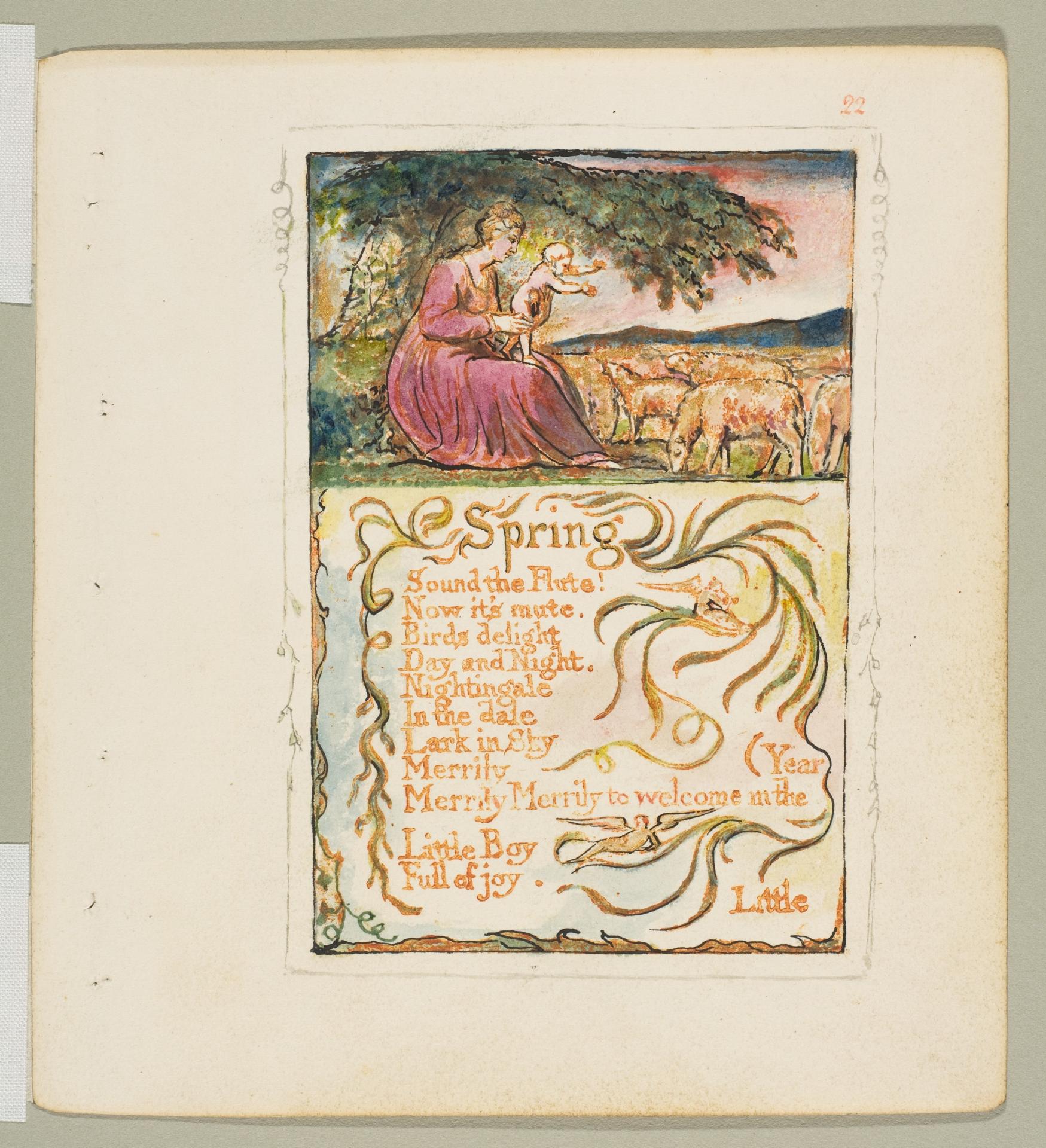
Songs of Innocence: Spring
Original title: Songs of Innocence: Spring
kurzbeschreibung
This print belongs to William Blake's illustrated poetry collection 'Songs of Innocence' of 1789, printed around 1825. It shows a woman with a child in a rural spring scene with sheep and trees, and below it the poem 'Spring'. The work is a relief etching, hand-coloured with watercolour and shell gold.
Description
In the upper part of the sheet, a woman in a long purple dress sits on a bench; a barefoot child in a white top rests on her lap. Trees and a flock of sheep form the backdrop, while the sky in warm tones suggests late afternoon or early evening. Below lies a text panel with the title 'Spring' and a poem about the spring season and the child's joy. Vines and leaves frame this panel; the colours range from white through orange to gold. The lettering appears painted with a brush and follows an antique ductus.
Context
In 1789 William Blake first published 'Songs of Innocence', created through his own method of 'illuminated printing', in which text and image coincide on a single printing plate. The present copy comes from a later edition around 1825, which Blake himself coloured. As a response to the social and political upheavals of those years, the collection revolves around childhood innocence and divine creation. The poems are often read in contrast to the 'Songs of Experience' of 1794, in which the dark sides of human existence come to the fore.
Impact
Warm colours and the idyllic togetherness of mother and child convey calm and harmony. The ornamental frame and the luminous gold tones give the sheet something precious, almost meditative. Because image and text interlock, viewing becomes a reading that appeals to the senses and the imagination alike.
Technique
For his relief etching, Blake applied an acid-resistant varnish to a copper plate; the unprotected areas were then etched away. Printing was done in orange-brown ink, followed by hand-colouring with watercolours and shell gold. From the interplay of print and manual colour, each copy acquires its own character.
AI-generated description text
Source: Metropolitan Museum of Art · Public Domain (CC0 1.0)