Pity
Original title: Pity
kurzbeschreibung
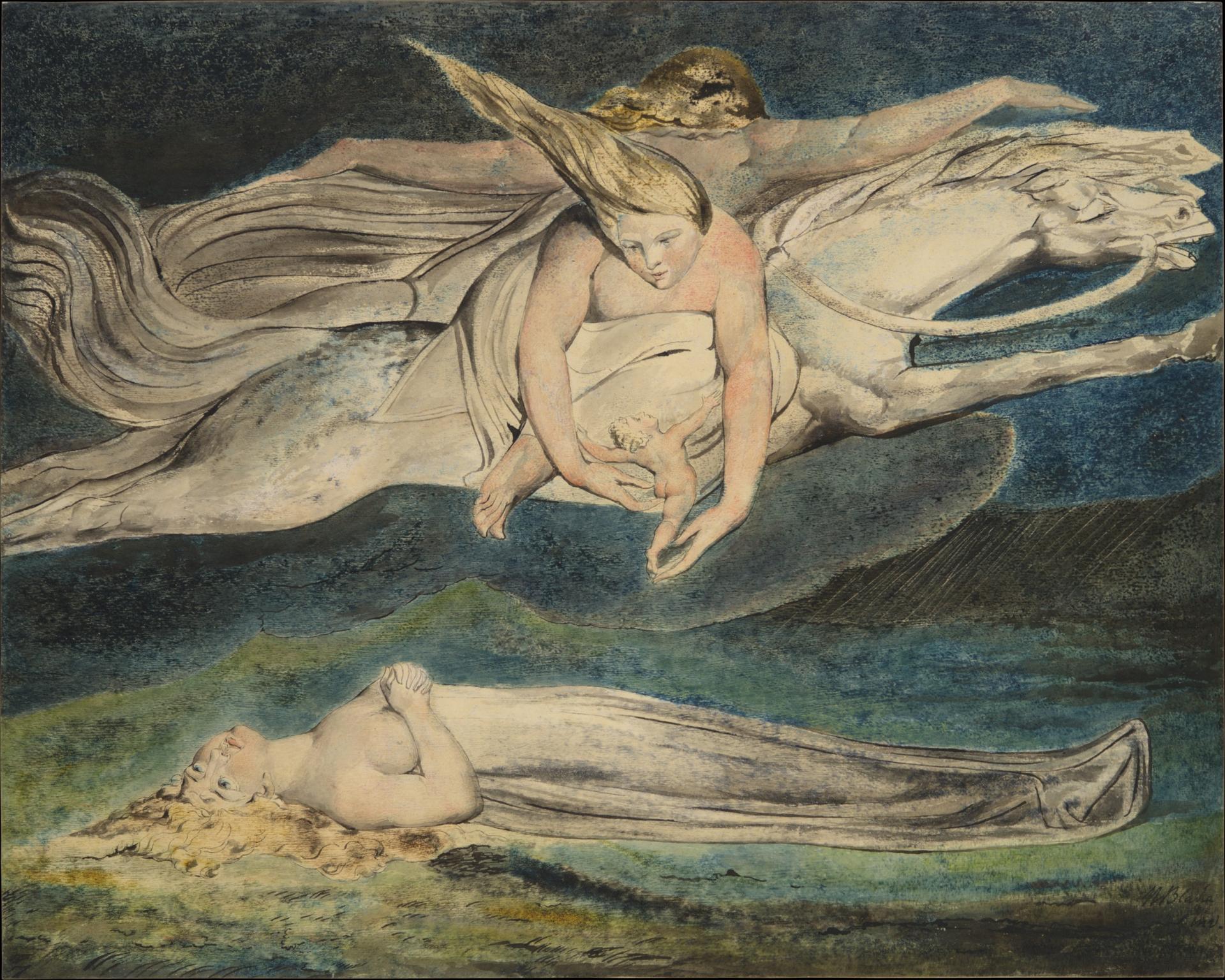
A female figure rides a flying horse straight over a woman lying on the ground — that image anchors William Blake's relief etching Mitleid, made around 1795. Printed in color and then reworked with pen, ink, and watercolor, the sheet belongs to the works in which Blake fuses printmaking with painting.
Description
Streaming garments and outstretched limbs define the rider's pose as she sits astride the flying horse. The flowing cloth and the extended arms and legs heighten the sense of motion. Beneath the horse a female figure lies motionless on the ground, a wolf-like animal standing beside her. Muted blues and grays dominate, producing a somber mood; the background stays dark and undefined.
Context
During the 1790s Blake produced numerous illuminated prints, and this work is one of them. It illustrates a passage from Shakespeare's Macbeth (Act I, Scene VII), where pity is described as a naked, newborn child riding on a storm. To join text and image in a single print, Blake used the relief etching technique he developed himself. The sheet belongs to a series of color prints conceived as individual plates.
Impact
The subdued palette and the dynamic arrangement give rise to a melancholy, almost dreamlike atmosphere. Attention settles on the emotional tension of pity, which grows out of the asymmetry between the hovering figure and the woman lying below.
Technique
The basis is relief etching, developed by Blake, in which lines and areas are etched in relief. The printing was done in color; afterward Blake reworked the sheet with pen and ink and watercolor to strengthen details and nuances of color.
AI-generated description text
Source: Metropolitan Museum of Art · Public Domain (CC0 1.0)