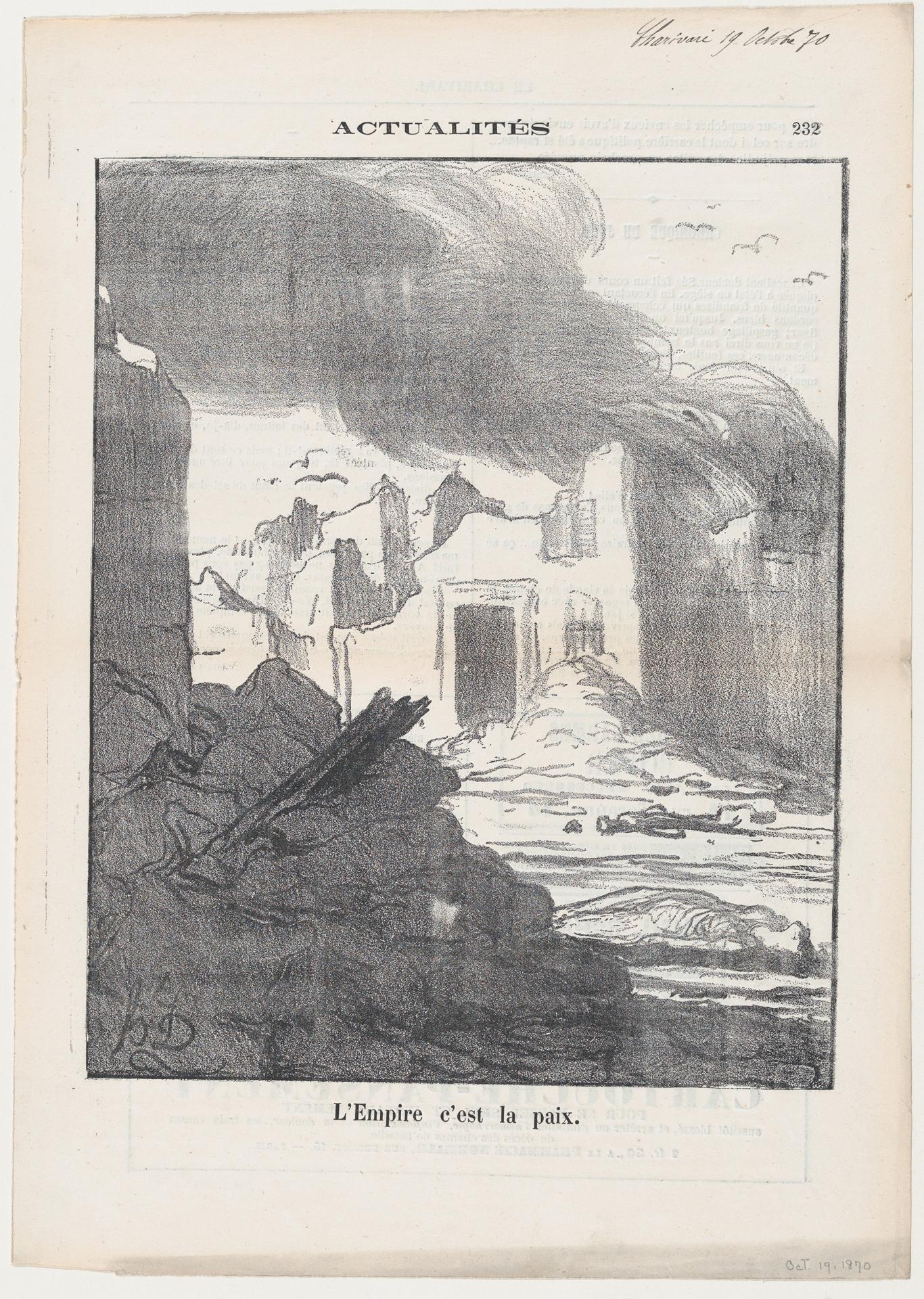
The Empire means Peace
Original title: The Empire means Peace, from 'News of the day,' published in Le Charivari, October 19, 1870
kurzbeschreibung
Honoré Daumier made this lithograph on 19 October 1870, presenting a view of a city scarred by war. The sheet belongs to the series "News of the day" and appeared in the journal Le Charivari. Its sarcastic caption stands in sharp contrast to the devastation visible in the image.
Description
The viewer's eye is drawn first to a motionless soldier lying on the ground in the foreground, while behind him rubble piles up before a damaged building. Further ruins and a collapsed tower fill the background, where birds circle and smoke rises. Dark, somber tones dominate the whole view and reinforce its desolation. Along the lower edge runs the inscription "L'Empire c'est la paix".
Context
The print was made during the Franco-Prussian War, while Paris was under siege. Daumier placed it in the satirical journal Le Charivari, known for its political criticism. The title takes up a famous phrase of Napoleon III, who praised peace as the achievement of the Empire. Three states of the lithograph exist; this impression is the second.
Impact
A sense of oppression sets in at the sight of the debris, the rising smoke and the lifeless figure in the foreground. The ironic caption sharpens the contradiction between official peace propaganda and the reality of war. The viewer is confronted with the brutality of destruction, which gives the lie to the rhetoric of peace.
Technique
For reproduction Daumier used lithography on newsprint, which allowed fast and inexpensive production. The drawing stays in black and white and records the ruins in detail and true to life. That the sheet survives in the second of three states points to reworking of the stone.
AI-generated description text
Source: Metropolitan Museum of Art · Public Domain (CC0 1.0)