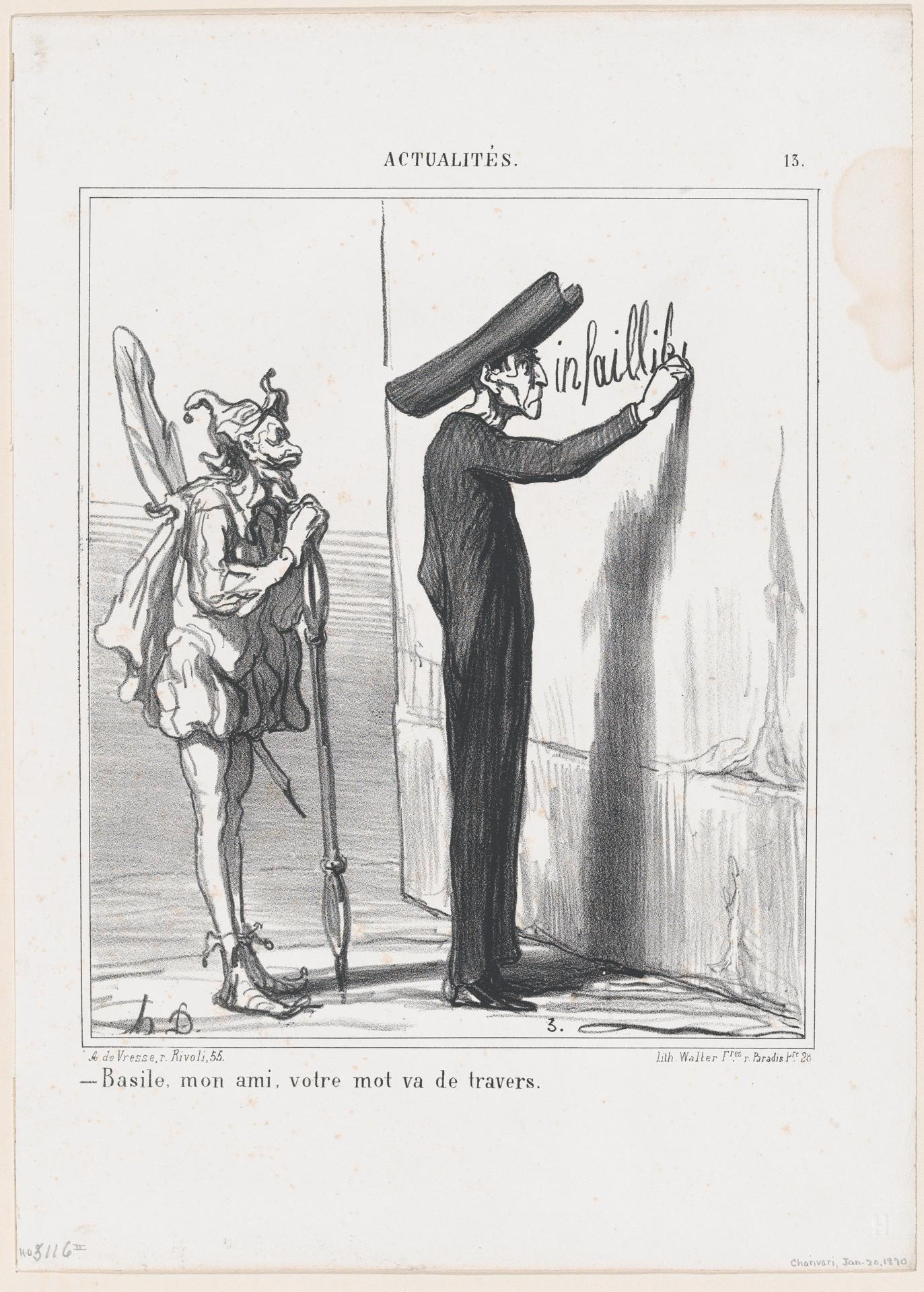
Basile, my friend, your word is going to be askew, from 'News of the day,' published in Le Charivari, January 20, 1870
Original title: Basile, my friend, your word is going to be askew, from 'News of the day,' published in Le Charivari, January 20, 1870
kurzbeschreibung
Honoré Daumier drew two figures in an interior in 1870, capturing them as a lithograph on wove paper. On the left, a clownish actor with a feather in his hair and a stick meets a figure in a dark suit and broad hat who presents a sign reading 'infaillible'. This is the second of two states according to Delteil; the print appeared in Le Charivari.
Description
Two clearly separated figures dominate the layout: on the left the clown with a feather in his hair, holding a stick and looking pensive; on the right the person in a dark suit and broad hat, raising a large sign with the word 'infaillible'. A wall with a window and part of the window lintel form the background. Below the figures runs the French sentence 'Basile, mon ami, votre mot va de travers.' The sheet remains black and white throughout, as lithography dictates.
Context
On 20 January 1870 the satirical magazine Le Charivari published this print; Daumier had been drawing political and social caricatures for it for years. It belongs to the series 'News of the day' (Actualités), which commented on daily events and contemporaries. The title echoes Basile from 'The Barber of Seville', a stage figure associated with intrigue and deception. The sign with 'infaillible' (infallible) can be read as an allusion to political or ecclesiastical claims to authority that were hotly debated at the time.
Impact
The print works humorously and ironically, mainly through the contrast between the clownish actor and the serious-looking person with the sign. Clean lines and a spare arrangement direct the eye straight to the central message. The text beneath the figures sharpens the satirical point and prompts reflection on the authority being paraded.
Technique
Printed by lithography on wove paper: the drawing is made with greasy chalk on a stone and then pulled. The present impression is the second state of two, as recorded in Delteil's catalogue raisonné. The image measures 24 × 20.5 cm, the sheet 36.1 × 25.8 cm.
AI-generated description text
Source: Metropolitan Museum of Art · Public Domain (CC0 1.0)