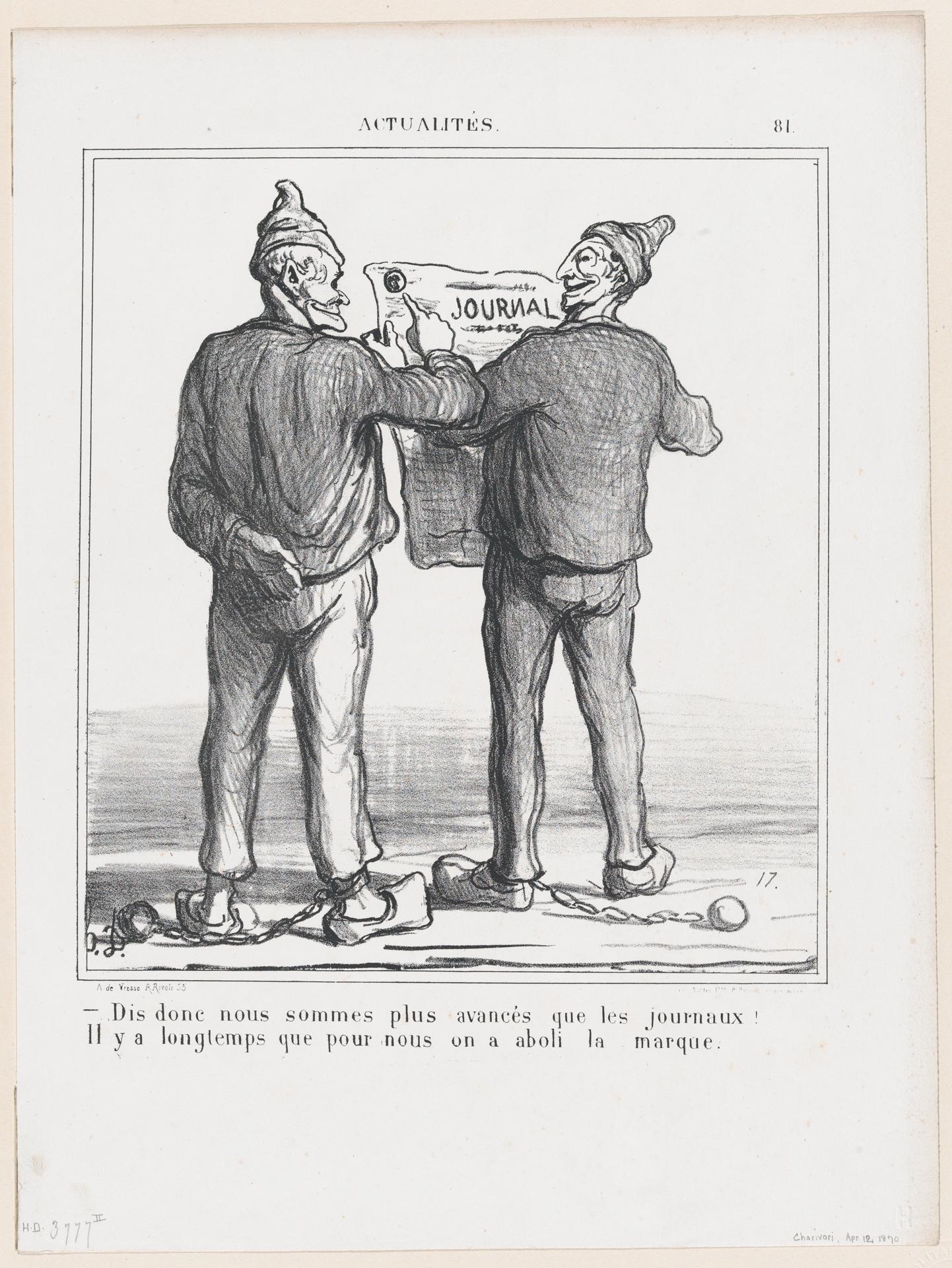
I say, we are more advanced than the newspapers…. They stopped branding our kind years ago, from 'News of the day,' published in 'Le Charivari'
Original title: I say, we are more advanced than the newspapers…. They stopped branding our kind years ago, from 'News of the day,' published in "Le Charivari"
kurzbeschreibung
Unlike many prints of its day, which treat newspaper reading as a matter of bourgeois routine, this 1870 lithograph by Honoré Daumier puts two men in rough work clothes and hooded caps into conversation. The one on the left holds up a sheet marked 'JOURNAL', while the other recoils in surprise. The image belongs to the series 'Actualités' and appeared in 'Le Charivari'.
Description
Two figures face each other, both in simple working dress and hooded caps. The man on the left thrusts a paper inscribed 'JOURNAL' toward his companion, who lifts his hands and leans his upper body slightly backward, as if taken aback or at a loss. The ground stays flat and undefined, with no landscape at all. Across the top runs the word 'ACTUALITÉS', and below is a French quotation. Layout and sightlines keep the focus entirely on the two men and the sheet between them.
Context
Daumier drew this sheet for the satirical paper 'Le Charivari', to which he regularly contributed political and social caricatures. It appeared on April 12, 1870, only a few months before the Franco-Prussian War. The dialogue alludes to the branding of convicts, abolished in France in 1832, and so indirectly criticizes the failure to reform the justice system. The 'Actualités' series took up current events and social grievances.
Impact
Because the figures are drawn so sparely and look each other straight in the eye, the print feels immediate and insistent. A satirical tension builds between the printed newspaper title and the ironic exchange of words. The plain visual language directs attention to the statement and the social comment.
Technique
The image was made as a lithograph on wove paper, in the second state of two (Delteil). The process allows fine lines and shading, used here for the figures' expressions and clothing. The printing plate was evidently worked with chalk or ink, producing soft transitions and a lively rendering.
AI-generated description text
Source: Metropolitan Museum of Art · Public Domain (CC0 1.0)