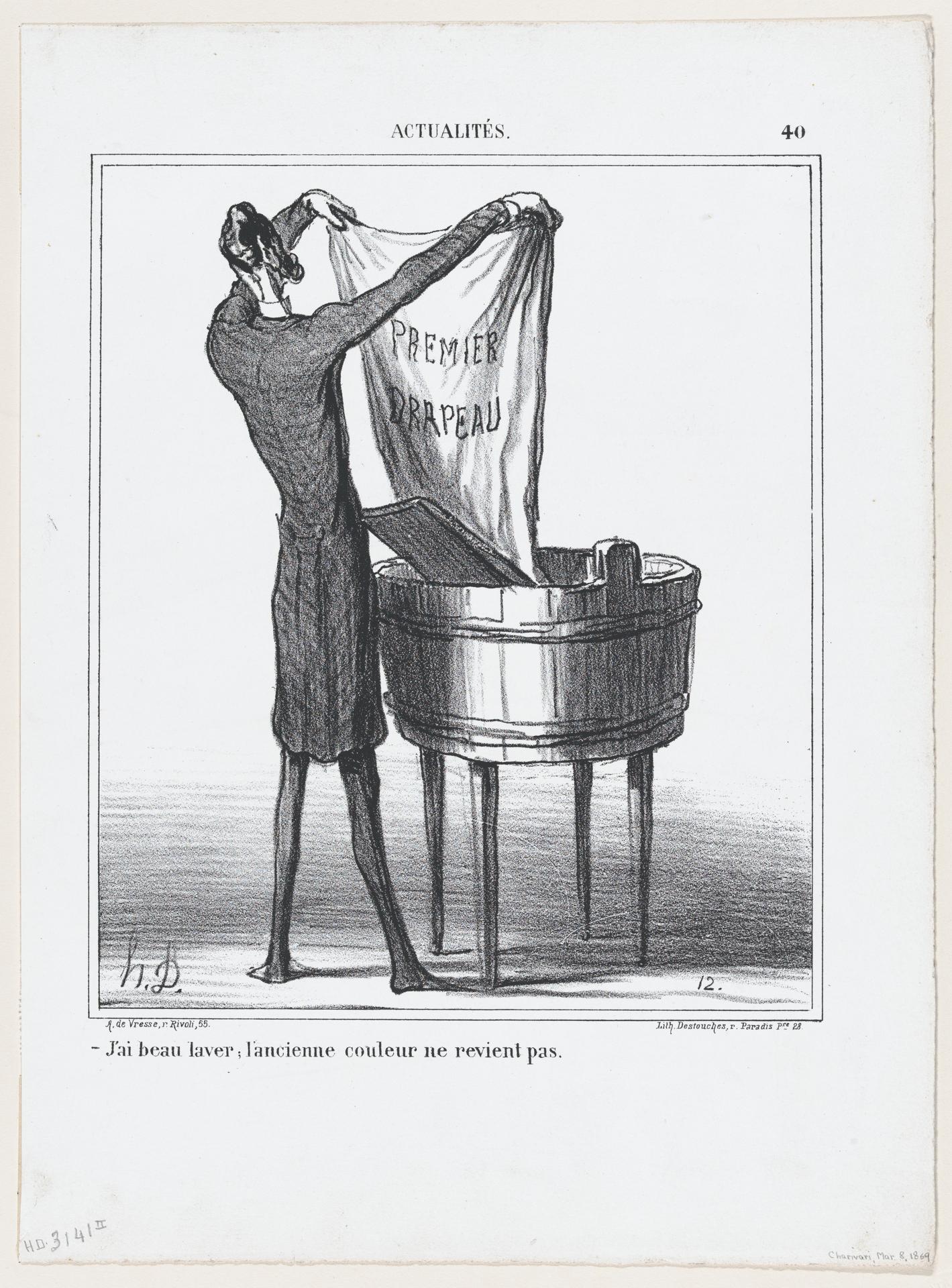
I can wash as much as I want, the old color won't come back, from 'News of the day,' published in "Le Charivari"
Original title: I can wash as much as I want, the old color won't come back, from 'News of the day,' published in "Le Charivari"
kurzbeschreibung
Honoré Daumier's lithograph of 1869 shows a man washing a cloth marked 'PREMIER DRAPPEAU' in a basin. The print belongs to the 'Actualités' series and appeared on March 8, 1869, in the satirical journal 'Le Charivari'. It is the second state of two (Delteil).
Description
At the left, a man holds up a cloth inscribed 'PREMIER DRAPPEAU' and dips it into a three-legged basin filled with water. A plain dark ground throws the figure and the vessel into relief. At the top one can make out the words 'ACTUALITÉS' and the number '40'. Beneath the scene runs the French sentence 'J'ai beau laver; l'ancienne couleur ne revient pas.'
Context
The lithograph was made for the satirical daily 'Le Charivari', known for its political and social caricatures. The caption alludes to futile attempts to restore an old colour — whether political or social. The work dates from the Second Empire under Napoleon III, a period marked by strict censorship and political tension.
Impact
The raised hand and the cloth catch the eye first, then the basin and the figure. The spare arrangement and dark ground concentrate attention. The hopeless washing gesture creates a mood of resignation, which the ironic caption reinforces. Clean lines and the direct approach to the subject make the message immediately legible.
Technique
The lithograph on wove paper depends on a printing process in which a grease crayon is drawn on stone and then printed. Fine hatching and high-contrast areas characterise Daumier's handling. The sheet survives in the second of two states, which points to later reworking of the printing stone.
AI-generated description text
Source: Metropolitan Museum of Art · Public Domain (CC0 1.0)