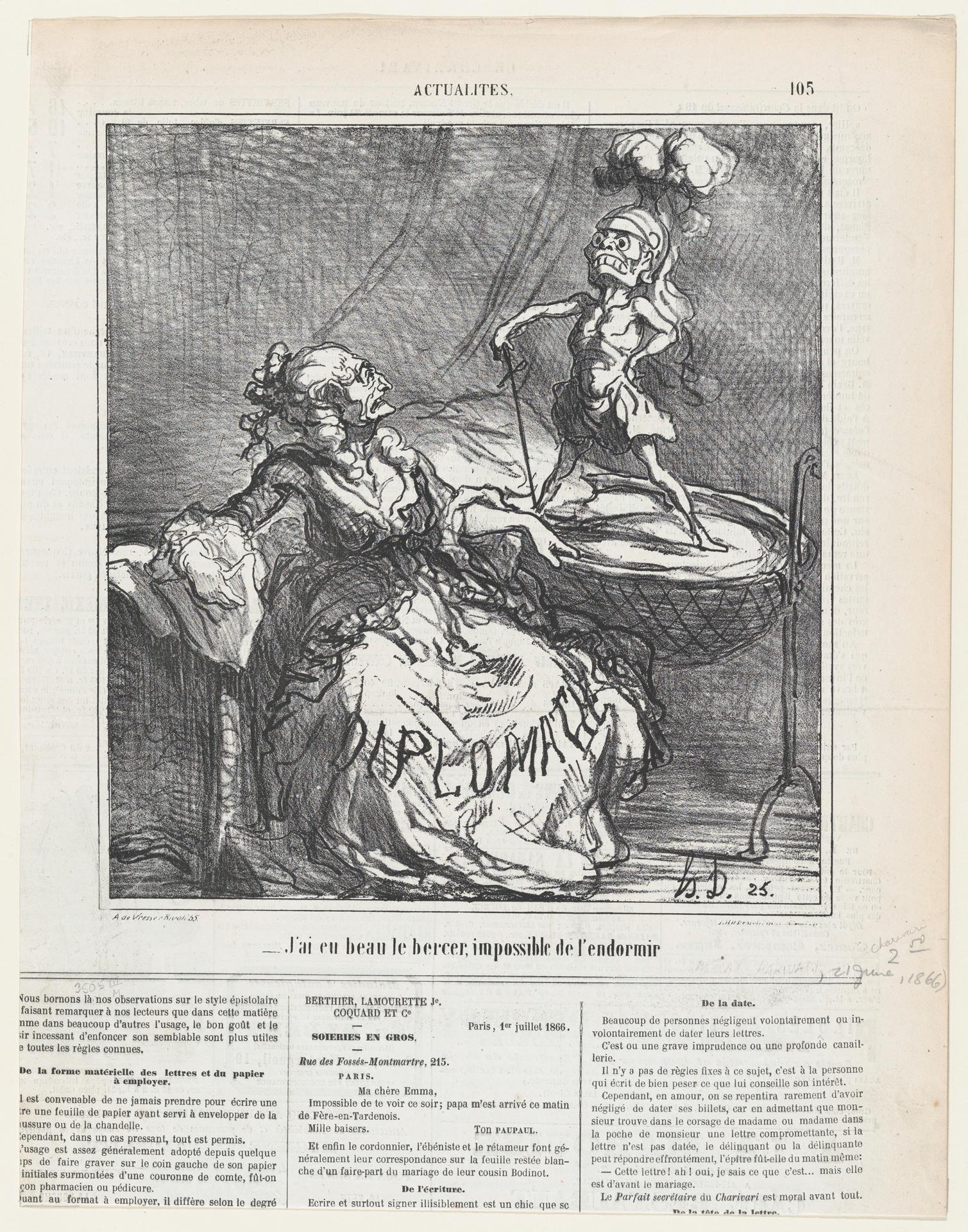
No matter how much I rock him, it is impossible to make him fall asleep, from 'News of the day,' published in Le Charivari, June 21, 1866
Original title: No matter how much I rock him, it is impossible to make him fall asleep, from 'News of the day,' published in Le Charivari, June 21, 1866
kurzbeschreibung
A restless child who refuses to fall asleep no matter how much it is rocked: that is the title of Daumier's 1866 lithograph. A woman lies on a bed, pressed by a skeletal child holding a stick or cylinder. On her garment appears the word 'DIPLOMATIC', which can be read as a satirical jab at diplomacy.
Description
A woman reclines on a bed while a child of skeletal appearance harasses her, grasping a stick or cylinder. A curtain frames the room. The black-and-white lithograph uses line and shading to model the bodies. The arrangement is restless and draws the eye to the interplay between the woman and the skeleton child.
Context
This sheet appeared on 21 June 1866 in the satirical newspaper Le Charivari as part of the series 'News of the Day'. The skeleton child and the inscription 'DIPLOMATIC' on the woman's garment point to a political caricature engaging with diplomatic questions of the time. The print is the third of four states (Delteil) and was made on newsprint, a common process for the mass distribution of satirical sheets.
Impact
The grotesque figure of the skeleton child, contrasted with the woman's calm, creates a disturbing yet amusing effect. The satirical exaggeration invites the viewer to decipher the allusion to diplomacy.
Technique
For the lithograph, the motif was drawn on a stone and then printed on paper. Printing on newsprint was customary at the time for distributing satirical images cheaply. Fine lines and shading give the figures a sense of volume.
AI-generated description text
Source: Metropolitan Museum of Art · Public Domain (CC0 1.0)