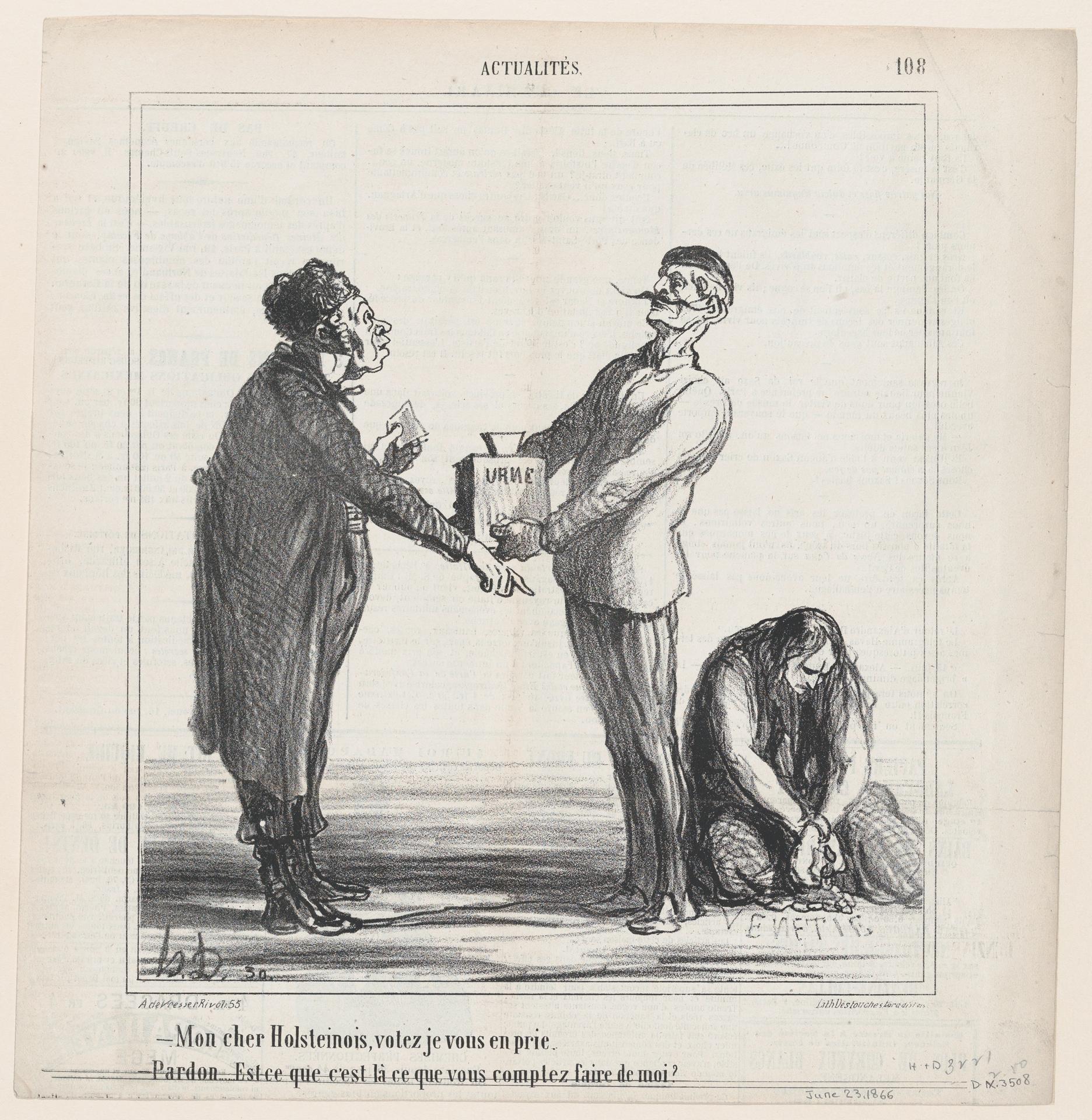
My dear Holsteiner, I urge you to vote. – Pardon me, but am I going to end the same way as this one?, from "News of the Day"
Original title: – My dear Holsteiner, I urge you to vote. – Pardon me, but am I going to end the same way as this one?, from "News of the Day"
kurzbeschreibung
Honoré Daumier's 1866 lithograph is a political caricature featuring three figures: two men at a ballot box and a third kneeling on the ground, bound. The print belongs to the 'News of the Day' series and was produced as a lithograph on newsprint.
Description
Two standing men lean over an urn: the one on the left holds it, the one on the right gestures. Below, a third figure kneels with arms tied behind his back, head lowered. Black-and-white figures with exaggerated, caricatural features. A plain background with a ground line focuses attention on the interaction. The text 'Mon cher Holsteinois, votez je vous en prie. Pardon... Est-ce que c'est là ce que vous comptez faire de moi?' is integrated into the image.
Context
Created in June 1866, when Daumier was regularly drawing political and social satires for the French press. The print refers to the politics of the day, likely to Prussia's annexation of Schleswig-Holstein after the Second Schleswig War. Daumier often took up current events—here electoral manipulation and the helplessness of smaller states before the great powers.
Impact
The polite call to vote and the brutal reality of the bound man stand in ironic tension. The contrast between the upright figures and the kneeling one, reinforced by the stylized drawing, sharpens the political message. Viewers are prompted to reflect on power relations and sham democracy.
Technique
Daumier used lithography, a common printing process at the time that allowed quick and inexpensive editions. The print on newsprint shows the typical grainy texture and high contrast of lithography. Executed in black and white, with fine hatching and clear contours that emphasize the caricature.
AI-generated description text
Source: Metropolitan Museum of Art · Public Domain (CC0 1.0)