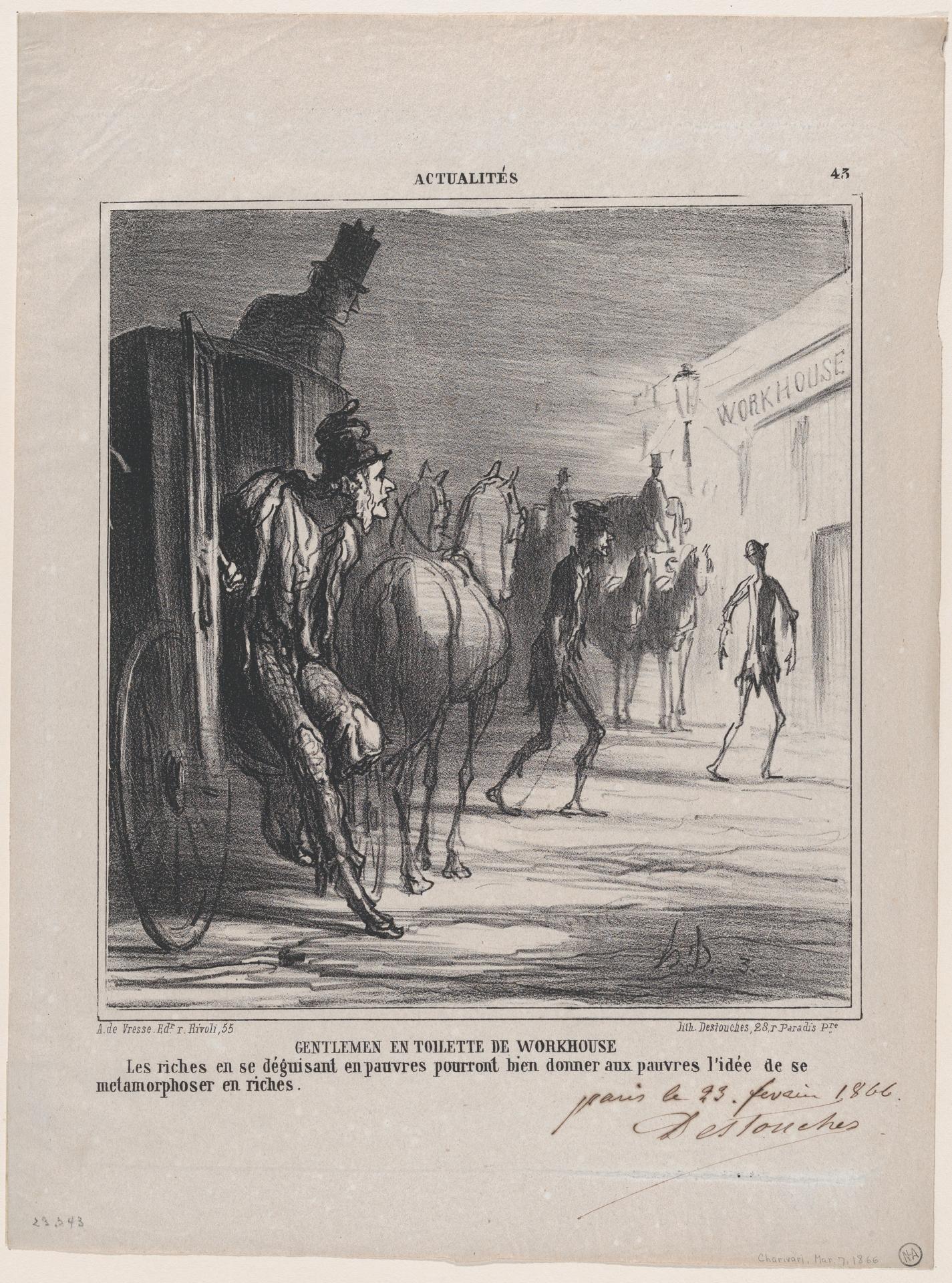
Gentlemen in workhouse clothes: If the rich are disguising themselves as poor, one might get the idea that the poor might transform themselves into the rich, from 'News of the day'
Original title: Gentlemen in workhouse clothes: If the rich are disguising themselves as poor, one might get the idea that the poor might transform themselves into the rich, from 'News of the day'
kurzbeschreibung
Two gentlemen in fine coats and top hats stand in a workhouse in 1866, while figures in plain clothes busy themselves behind them. Honoré Daumier caricatures the swapping of social roles in this lithograph. The impression is a proof of the second state and stages the poor and the rich trying on each other's lives.
Description
A bare interior announces itself as a workhouse. Up front, two men in frock coats and hats turn to leave or say goodbye. Behind them, several figures in unadorned, almost destitute clothing are in motion. The layout is lopsided: the two gentlemen on the left, the working people on the right. Light stays flat and shadowless, as was usual for lithographs of the period.
Context
Daumier made this lithograph for the series 'News of the Day,' published in the satirical journal Le Charivari. It carries the date March 7, 1866, from a period when he repeatedly targeted social contrasts and the double standards of the upper class. The caption pushes the irony to its limit: if the rich dress as the poor, the poor might get the idea of turning into the rich. That points to conditions under the Second Empire. The artist was known for biting caricatures that exposed political and social ills.
Impact
The clash between elegant tailoring and the plain garb of the workhouse gives the image its satirical edge. The ironic tone of the caption sharpens the picture and prompts reflection on social roles. A certain distance in the arrangement asks the viewer to examine it critically.
Technique
In lithography, the printing surface is neither raised nor incised but treated chemically. The drawing is applied to the stone with greasy chalk, which is then worked with acid and gum. During printing, ink adheres only to the drawn areas, allowing fine lines and gradations.
AI-generated description text
Source: Metropolitan Museum of Art · Public Domain (CC0 1.0)