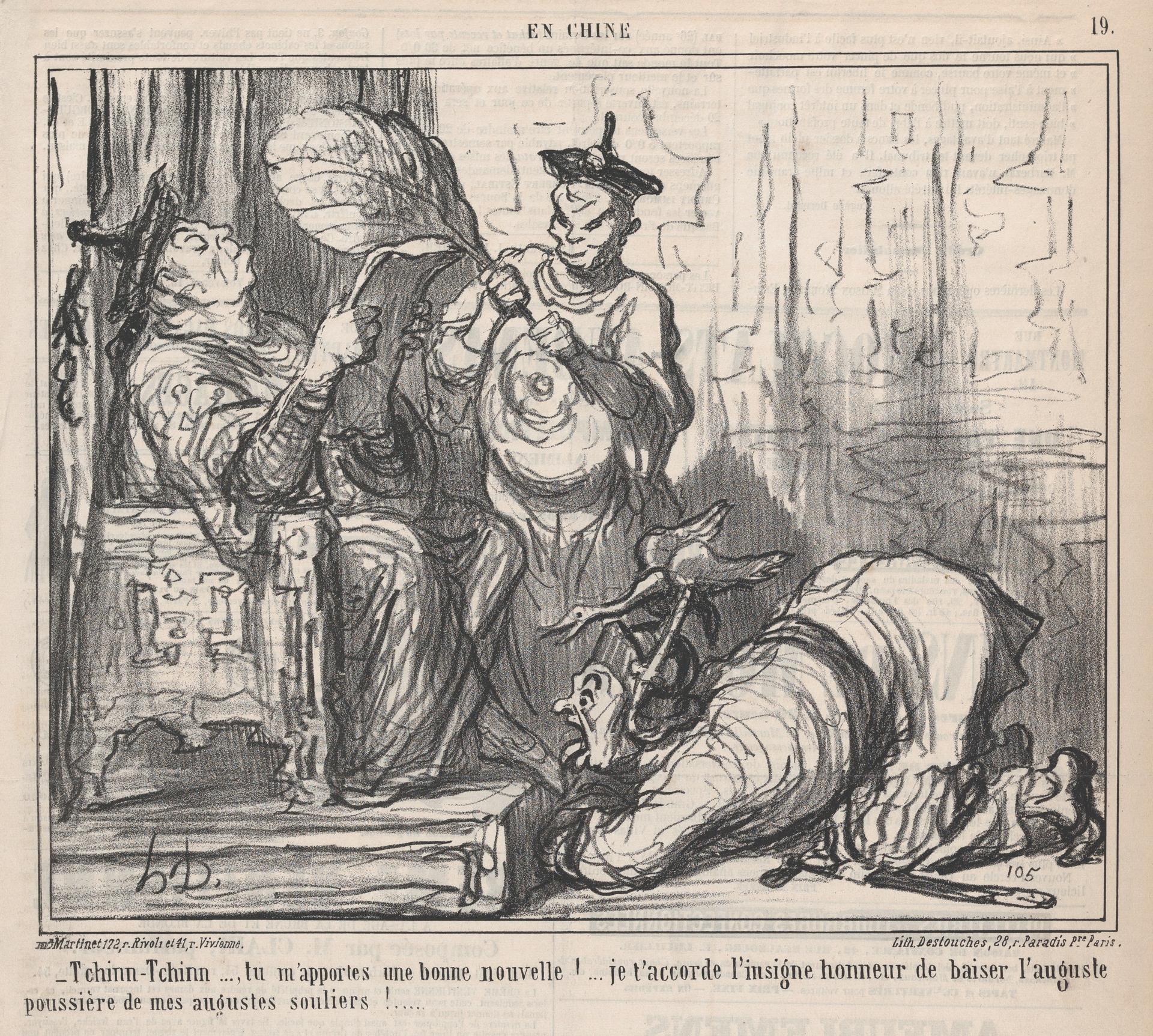
Tchinn-Tchinn..., tu m'apportes une bonne nouvelle! .... je t'accorde l'insigne honeur de honneur de baiser l'auguste poussière de mes augustes souliers!...., from En Chine, published in Le Charivari, December 7, 1859
Original title: Tchinn-Tchinn..., tu m'apportes une bonne nouvelle! .... je t'accorde l'insigne honeur de honneur de baiser l'auguste poussière de mes augustes souliers!...., from En Chine, published in Le Charivari, December 7, 1859
kurzbeschreibung
Honoré Daumier made this lithograph in 1859 for his series En Chine, and it appeared in Le Charivari on 7 December 1859. The print on newsprint survives as the second of three states described by Delteil. Its subject is a satirical encounter staged among Chinese figures.
Description
One figure in traditional Chinese dress lies stretched out flat on the ground, looking exhausted or beaten. A second figure, dressed the same way, stands over him holding a large wing-like object that suggests a feather boa or a plumed hat, and seems to touch the fallen man with it. A third person sits on a chair further back, a similar feathered thing in hand. The drawing stays sketchy and monochrome, lit evenly and without shadow, as lithography tends to be.
Context
The caricature belongs to the years of the Second Opium War (1856–1860), when Britain and France fought China. Across En Chine, Daumier mocked European stereotypes and the frequently arrogant stance taken toward Chinese culture. The caption parodies the condescending language of colonial encounters. Le Charivari, the satirical paper he worked for regularly, published the series.
Impact
The exaggerated gestures and the absurd ceremony come across as funny and critical at once. A flat, sketchy style sharpens the ironic tone and underlines how ridiculous the exchange looks. The viewer is left watching a grotesque performance of power.
Technique
Daumier drew this lithograph on newsprint with greasy chalk on stone before it was printed. The method let him work fast and precisely, which suits the sketchy character of a caricature. This impression is the second of three states, pointing to later reworking of the stone.
AI-generated description text
Source: Metropolitan Museum of Art · Public Domain (CC0 1.0)