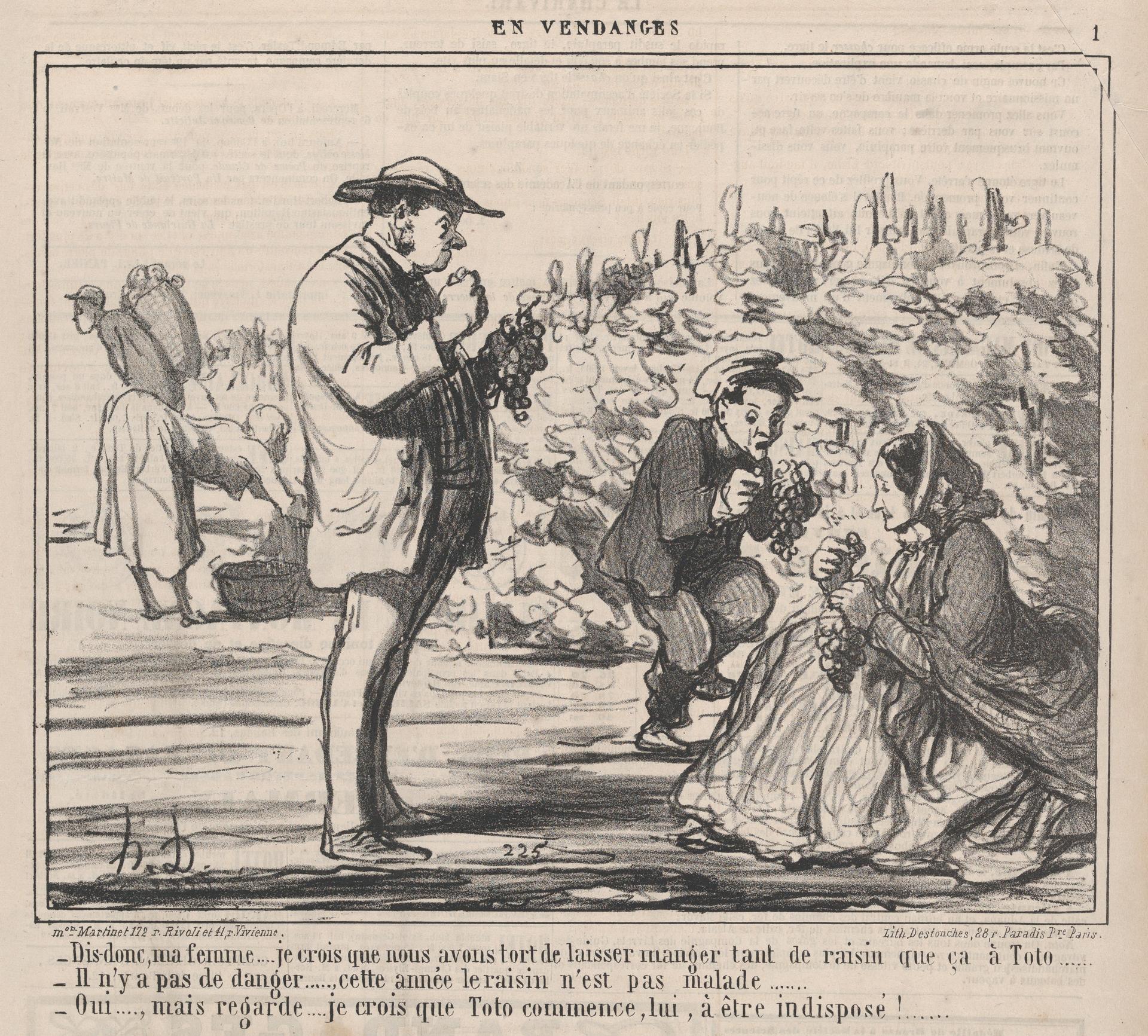
Dis-donc, ma femme.... je crois que nous avons tort de laisser manger tant de raisin que ça à Toto ....., from En Vendanges, published in Le Charivari, September 21, 1859
Original title: Dis-donc, ma femme.... je crois que nous avons tort de laisser manger tant de raisin que ça à Toto ....., from En Vendanges, published in Le Charivari, September 21, 1859
kurzbeschreibung
Honoré Daumier's 1859 lithograph, part of the series En Vendanges, takes place during the grape harvest. A man, a woman, and a child stand in the foreground, while other figures can be seen picking grapes behind them. The print appeared in the satirical magazine Le Charivari.
Description
A man holds a bunch of grapes in his hand; beside him stand a child and a woman, also carrying grapes. Behind this group, more people are busy with the harvest. The setting is a rural vineyard, and the layout stretches horizontally. The figures wear clothing of the period, and the print remains in black and white. Light is distributed evenly, without strong shadows or dramatic contrasts.
Context
On September 21, 1859, Daumier published this lithograph in the Parisian satirical magazine Le Charivari. The series En Vendanges used humor to capture everyday life during the grape harvest. The work dates from the second half of the 19th century, when Daumier became known for his socially critical and comic caricatures. The caption mockingly comments on parental worry about the child Toto's excessive grape consumption.
Impact
The caricatural style and the humorous portrayal of an everyday family scene make the print immediately accessible. The calm, balanced arrangement draws the eye to the interaction between the figures, while the satirical undertone creates a critical distance from bourgeois concerns about child-rearing.
Technique
The lithograph is in the second state of two (after Delteil; Hazard & Delteil). The printing process allows for fine lines and an accurate rendering of the figures. The image measures 21.7 × 26.8 cm, the sheet 30.2 × 30 cm. The monochrome black-and-white execution is typical of Daumier's printmaking.
AI-generated description text
Source: Metropolitan Museum of Art · Public Domain (CC0 1.0)