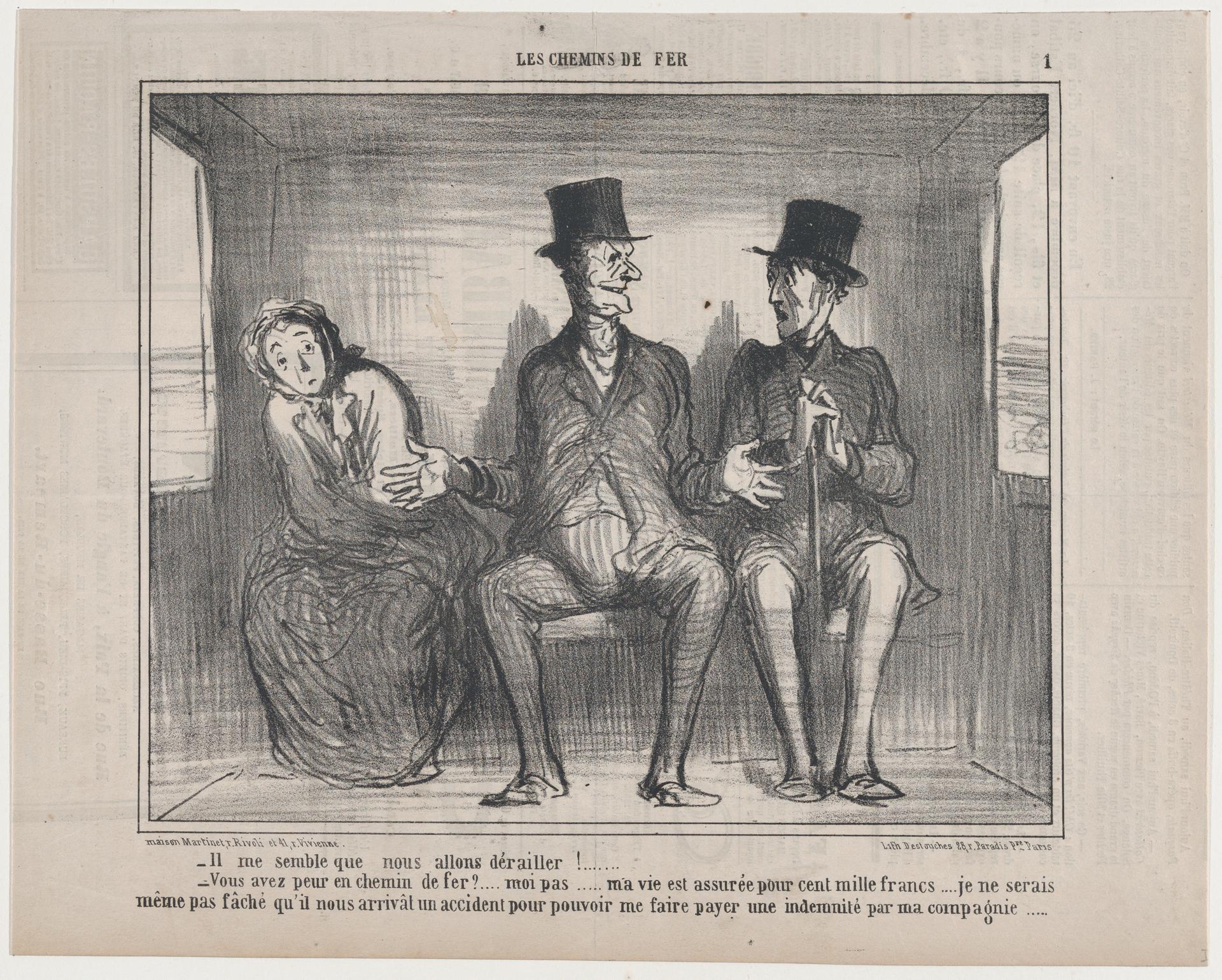
Il me semble que nous allons dérailler..., from Les Chemins de Fer, published in Le Charivari, December 19, 1857
Original title: Il me semble que nous allons dérailler..., from Les Chemins de Fer, published in Le Charivari, December 19, 1857
kurzbeschreibung
Three passengers in a train compartment are thrown into a panic, as if there had been a crash. Honoré Daumier captured this scene as a lithograph in 1857. It belongs to the series “Les Chemins de Fer” and appeared in the satirical magazine “Le Charivari” on 19 December 1857. The sheet was printed in black and white on newsprint.
Description
Inside a carriage sit three people. On the left, a woman in a dress and head covering, her eyes wide with alarm, one hand at her head. Beside her, two men in suits and top hats, equally rattled; the middle one also clutches his head, the right one holds a cigar and a cane. Windows and fittings make the setting legible as a railway compartment. Beneath the image, the figures' dialogue sits in a caption box. Everything stays monochrome, with shading that suggests light falling in from outside. The expressions are exaggerated and caricatural, which gives the whole a comic edge.
Context
Railways were rapidly gaining importance in France at the time and were a new, unfamiliar experience for many travellers. Daumier published the “Les Chemins de Fer” series in “Le Charivari,” a magazine known for its social criticism. The print takes up travellers' fears and unease about the new technology. This is the second of two states (Delteil 2447), printed as a lithograph on newsprint.
Impact
The overwrought faces and the figures' violent reaction come across as funny and expose the fear of new technology as absurd. At the same time the image stays close to its people, because the panic is caught in an everyday moment. Lively and memorable, the sheet never tips over into the grotesque.
Technique
Daumier worked in lithography: a drawing is made with greasy chalk on the stone and then transferred to paper. Printing was done on newsprint, as was usual for “Le Charivari” and allowed cheap reproduction. The graded shadows and lines show a confident command of the process, which permitted nuanced expressions and effects of light.
AI-generated description text
Source: Metropolitan Museum of Art · Public Domain (CC0 1.0)