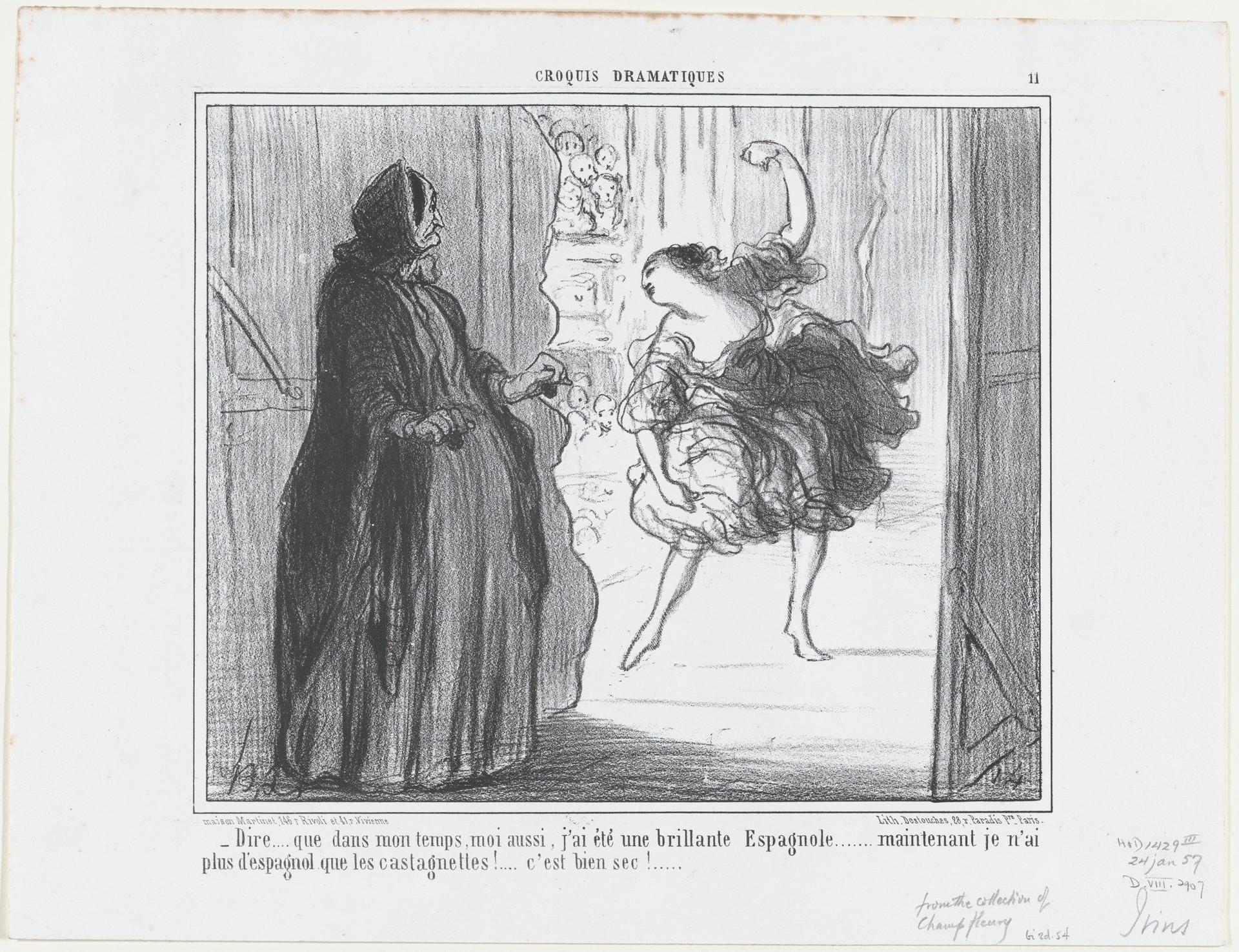
Dire que dans mon temps, moi aussi..., from Croquis Parisiens, published in Le Charivari, January 24, 1857
Original title: Dire que dans mon temps, moi aussi..., from Croquis Parisiens, published in Le Charivari, January 24, 1857
kurzbeschreibung
Honoré Daumier's lithograph "Dire que dans mon temps, moi aussi..." ("To think that in my day I too..."), dated January 25, 1857, belongs to the Croquis Parisiens series and stages two women of different ages in an interior. The younger one moves as if dancing while the older one watches. The print is the third state of three and appeared in Le Charivari.
Description
Up front a young woman turns in a conspicuously flowing dress, one arm raised, caught mid-movement. Behind her, seen from the back, stands an older woman in dark, traditional clothing, holding a stick or cane. A shelf crowded with assorted objects, among them a doll-like figure, fills the background. The layout is lopsided: the younger woman anchors the image while the elder is pushed toward the edge. Light falling from the front illuminates both figures evenly, and the lithograph stays within shades of grey.
Context
Daumier drew this lithograph for Croquis Parisiens, a series that began appearing in the satirical paper Le Charivari in 1856. The series took aim at everyday Parisian life, above all the social types and manners of the day. The caption touches on the conflict between generations and on how people register change, a recurring theme in Daumier's work. It was published on January 24, 1857, in Le Charivari; the lithograph itself carries the date January 25, 1857.
Impact
What makes the scene immediately readable is the contrast between the younger woman's exuberant motion and the older woman's static pose. Daumier's line gives the picture a caricatural lightness and reinforces the humorous undertone of this slice of daily life. The viewer becomes a witness to a quiet moment that invites a smile.
Technique
The work was executed as a lithograph, a printing process that relies on the repulsion of grease and water. With delicate drawing Daumier built up contours and shadows in the manner typical of his prints. The sheet exists in the third state of three, which points to reworking of the printing plate.
AI-generated description text
Source: Metropolitan Museum of Art · Public Domain (CC0 1.0)