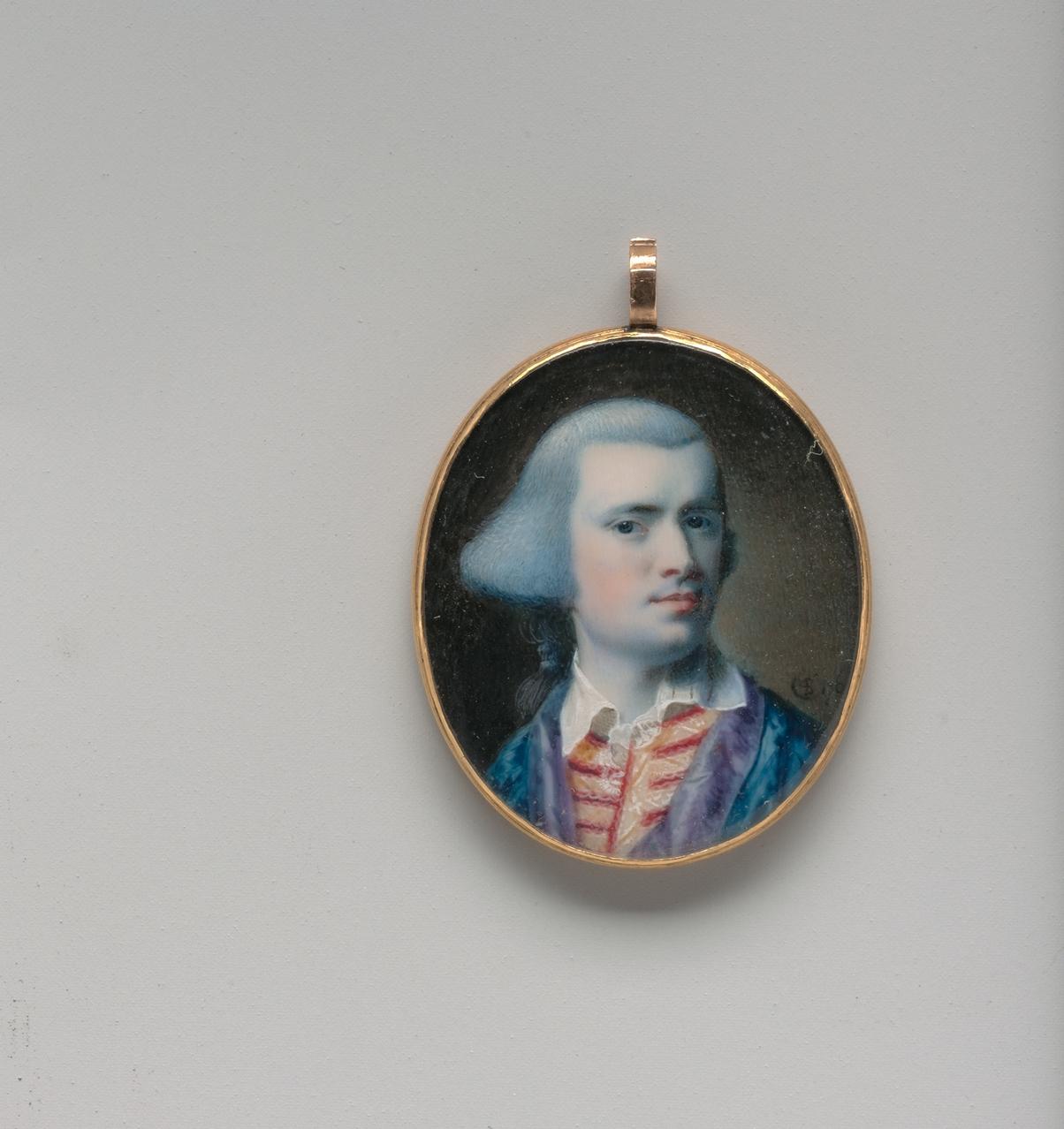
Self-portrait
Original title: Self-portrait
kurzbeschreibung
In 1769 John Singleton Copley painted this self-portrait as a miniature in watercolor on ivory. The artist appears in the oval format characteristic of 18th-century portraiture, set within a gold frame.
Description
A figure with white hair falling loosely to one side is shown. He wears a shirt with a brightly striped collar and a blue jacket over it. The dark, undefined background makes the figure stand out. A small hook on the gold frame allows it to be hung from a chain. Blues and reds dominate the palette; the light is evenly distributed, with no visible shadows.
Context
Copley made this self-portrait in 1769 in Boston, where he worked as the leading portrait painter of the American colonies. Ivory miniatures were popular keepsakes at the time and were often worn as jewelry. By portraying himself in this intimate genre, Copley emphasized his artistic skill and social standing.
Impact
The delicate execution and luminous colors, which stand out especially on ivory, give the miniature a precious quality. The dark background and precise facial features create an intimate, concentrated presence.
Technique
Copley worked with watercolor on a thin ivory panel. This method demands great precision because mistakes are hard to correct. The ivory acts as a bright support that makes the colors glow. The oval gold frame protects the fragile work and also served as an ornament.
AI-generated description text
Source: Metropolitan Museum of Art · Public Domain (CC0 1.0)