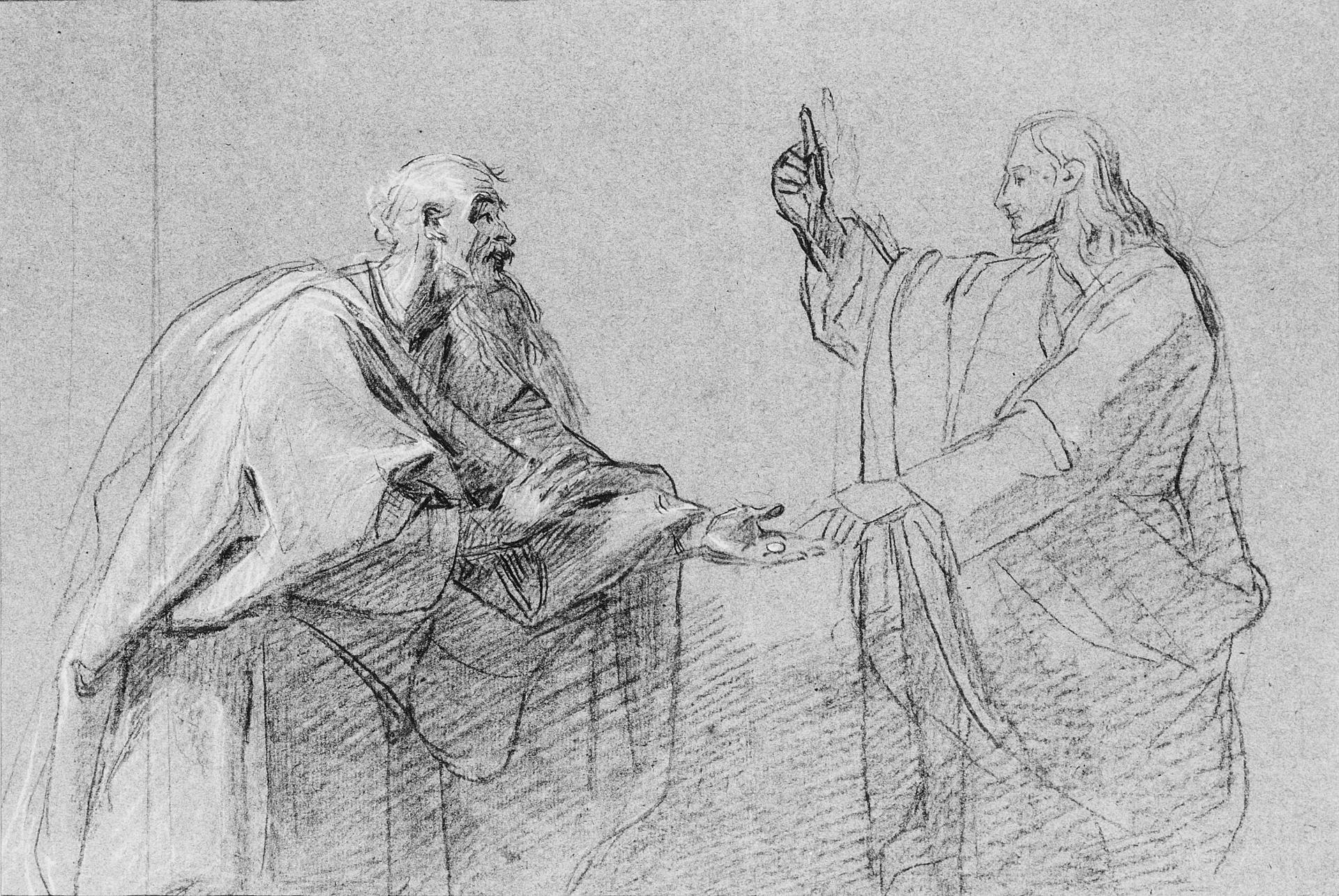
Study for "The Tribute Money"
Original title: Study for "The Tribute Money"
kurzbeschreibung
John Singleton Copley drew this study in 1782 as a preparatory work for his painting 'The Tribute Money'. On blue laid paper, using black chalk and white heightening, he captured two figures in historical dress engaged in a gestural exchange.
Description
Two men face each other. The older, bearded man is seated on the left, his right hand raised in a gesture, his left resting on a table. Opposite him stands a younger man with long hair, whose left hand lifts as if to emphasize an argument. Long robes, reminiscent of past eras, envelop both. The background remains largely empty, so that the viewer's attention is drawn entirely to the dialogue. Fine, varying densities of hatching shape texture and movement.
Context
Copley made this study in London, where he had moved from the American colonies in 1774. The related painting 'The Tribute Money' arose from a church commission and treats the biblical episode in which Jesus responds to a question about taxes with a coin. With this study, Copley prepared the arrangement of his figures; it demonstrates how thoroughly he engaged with history painting after his arrival in Europe.
Impact
The clear, almost mirror-like arrangement and the precisely placed gestures give the sheet a calm yet subtly tense atmosphere. Because color and background recede, the posture and facial expressions of the two men come to the fore; the conversation between them thus becomes immediately comprehensible.
Technique
Black chalk meets white heightening applied on blue laid paper, as was customary for study drawings in the 18th century. Dense, finely placed hatching creates the shadows, while the white chalk sets bright accents on garments and faces. The blue tone of the paper acts as a middle value, sharpening the contrast between light and shadow.
AI-generated description text
Source: Metropolitan Museum of Art · Public Domain (CC0 1.0)