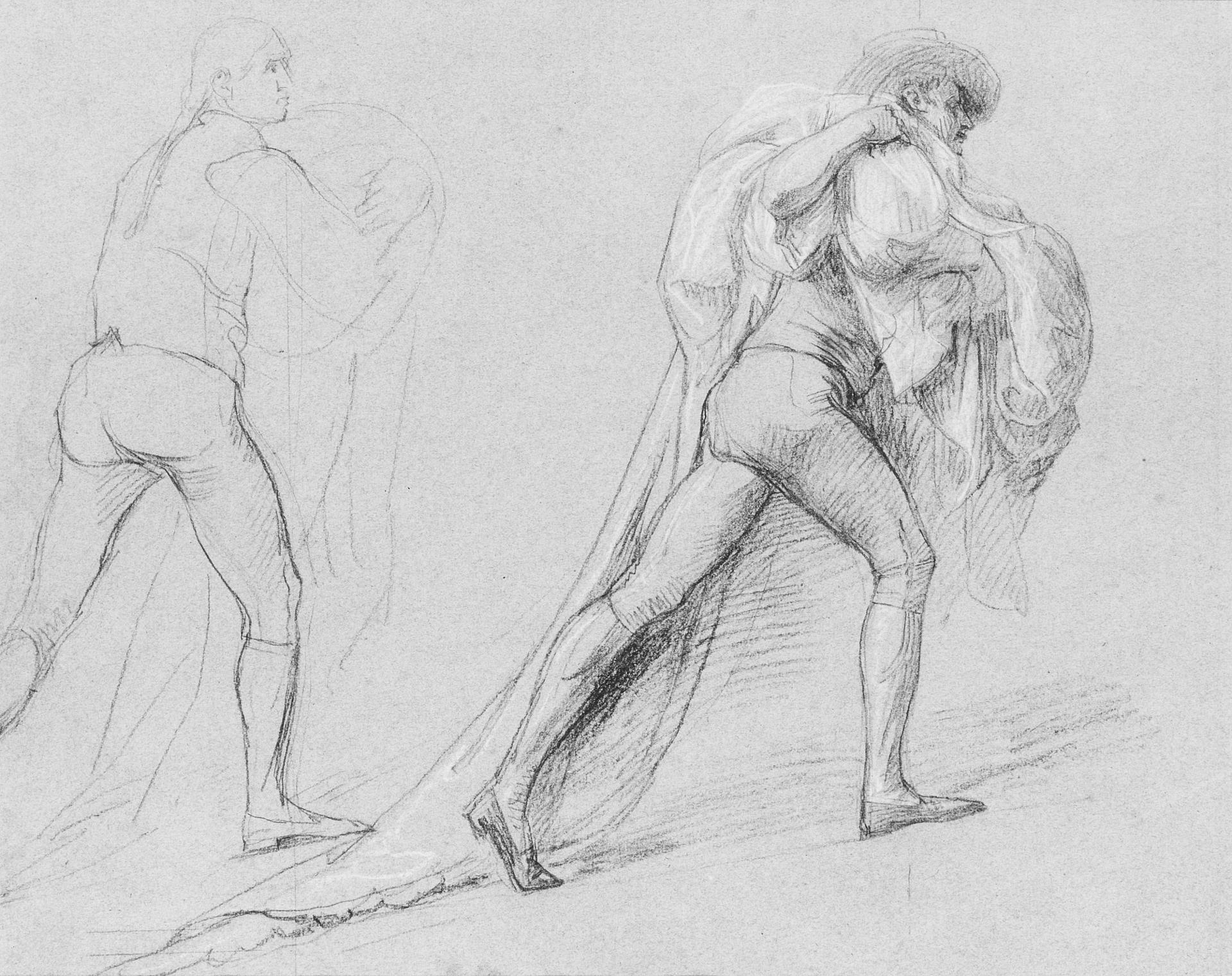
Study for "The Surrender of the Dutch Admiral De Winter to Admiral Duncan, October 11, 1797": Three Figures Raising the Colors
Original title: Study for "The Surrender of the Dutch Admiral De Winter to Admiral Duncan, October 11, 1797": Three Figures Raising the Colors
kurzbeschreibung
John Singleton Copley's 1798 study sheet sets down three flag-raising figures. Executed in black and red chalk with white heightening on blue laid paper, it belongs to the preparations for his history painting 'The Surrender of the Dutch Admiral De Winter to Admiral Duncan'. Muscular figures in historical dress dominate, their poses animated and charged with tension.
Description
Two figures command the foreground: the one on the left, seen from behind, holds a shield, while the right figure leans forward and swings a cloak over his shoulder. A third figure, also with a shield, is sketched to the side in the background. The layout is asymmetrical, bodies pointing in different directions to create drama. Grey tones prevail, modelled by varying chalk pressure and white heightening. Light stays flat, without strong shadows.
Context
Copley made this study as preparatory work for his large history painting. The painting depicts the surrender of the Dutch admiral De Winter after the naval battle of Camperdown on 11 October 1797. That British victory fell within the coalition wars against revolutionary France. Copley was known for careful preliminary studies, with which he set historical events before the viewer precisely and to powerful effect.
Impact
The animated poses and irregular arrangement of the figures generate immediate tension. Finely graded chalk modelling and white heightening on blue paper give the bodies plastic presence. Despite its status as a study, the sheet feels energetic and demonstrates Copley's feel for movement and drama in economical lines.
Technique
Black and red chalk, along with white chalk heightening, were used here on blue laid paper. The chalk technique allows fine transitions from light to shadow, while the white heightening places deliberate highlights on the muscular bodies. The blue tone of the paper acts as a middle value and holds the drawing together optically.
AI-generated description text
Source: Metropolitan Museum of Art · Public Domain (CC0 1.0)