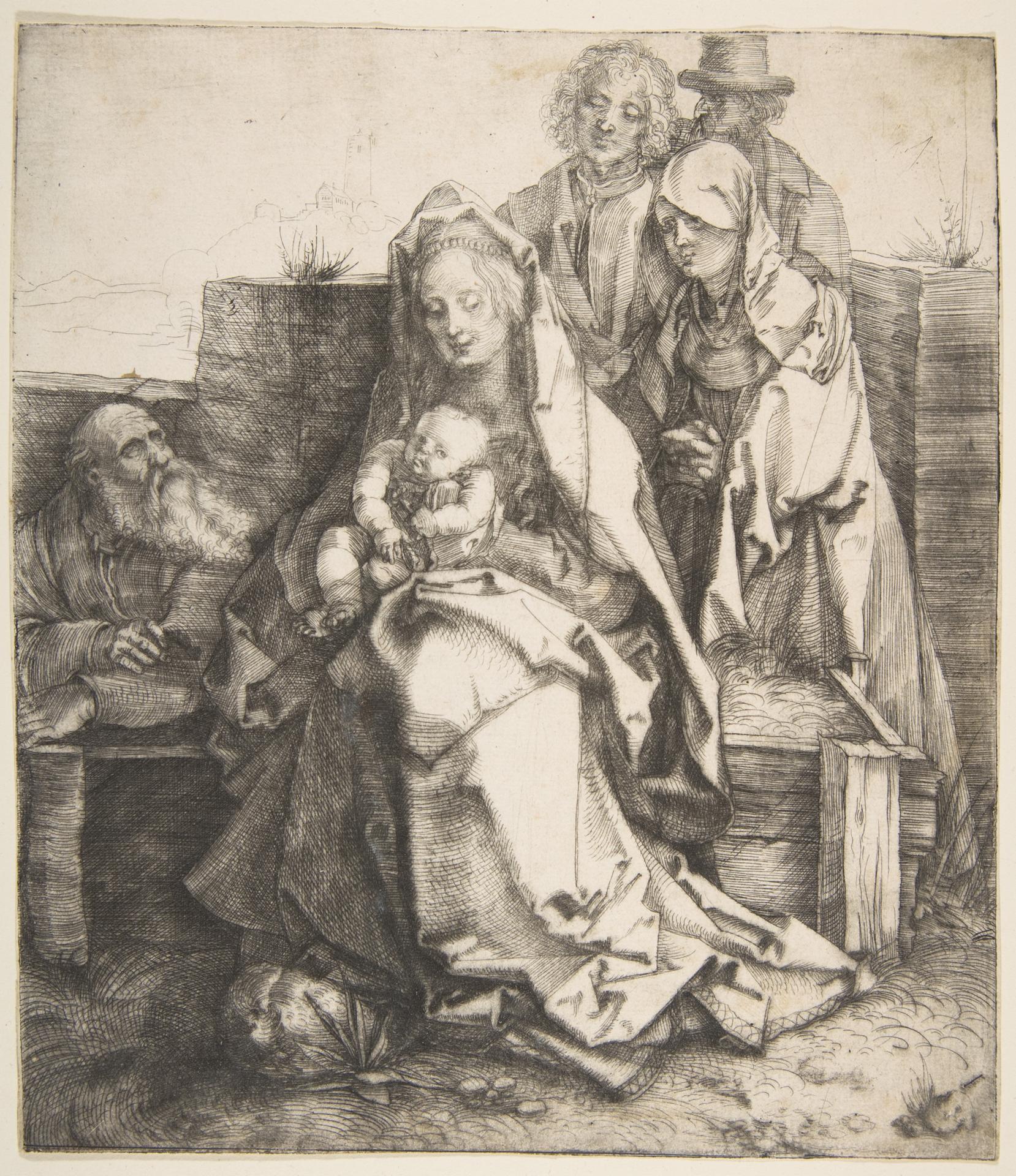
The Holy Family (1512–13, Met-Objekt 275)
Original title: The Holy Family
kurzbeschreibung
Mary cradles the Christ child while Joseph stands beside her, and other figures gather around them in a landscape. This is Albrecht Dürer's Holy Family, a drypoint from 1512–13. The upright sheet exploits the burin technique, which allows for delicate, painterly linework.
Description
A seated woman with a child on her lap forms the focal point, flanked by a bearded older man and a woman leaning forward in a headscarf. Mary wears a light, long-sleeved garment and a head covering; the child is also wrapped in pale fabrics. Behind the group, partially obscured figures appear before a landscape with a wall and tower. Frontal light picks out the contours and the folds of the drapery.
Context
Dürer made this work in Nuremberg during a phase of intensive experimentation with printmaking. Drypoint was still new at the time; Dürer used it for only a few sheets. In the early sixteenth century, the Holy Family was among the most widespread subjects in Christian art, intended for private devotion.
Impact
The delicate lines of the drypoint give the scene a soft, almost drawing-like quality that underscores the intimate mood of the gathering. Fabrics and facial features are rendered with great care, creating a calm, devotional atmosphere that invites quiet contemplation.
Technique
In this drypoint, the design is scratched directly into the copper plate with a needle, producing soft lines with a fine burr that print with a velvety tone. Through dense hatching and cross-hatching, Dürer builds these incised lines into gradations of light and shade, so that the translucent garments and the modelling of the faces emerge from the varying density of the strokes. Light appears to fall from the front, and the etched lines define the contours of the figures and the folds of their drapery.
AI-generated description text
Source: Metropolitan Museum of Art · Public Domain (CC0 1.0)