Knight, Death and the Devil
Original title: Knight, Death and the Devil
kurzbeschreibung
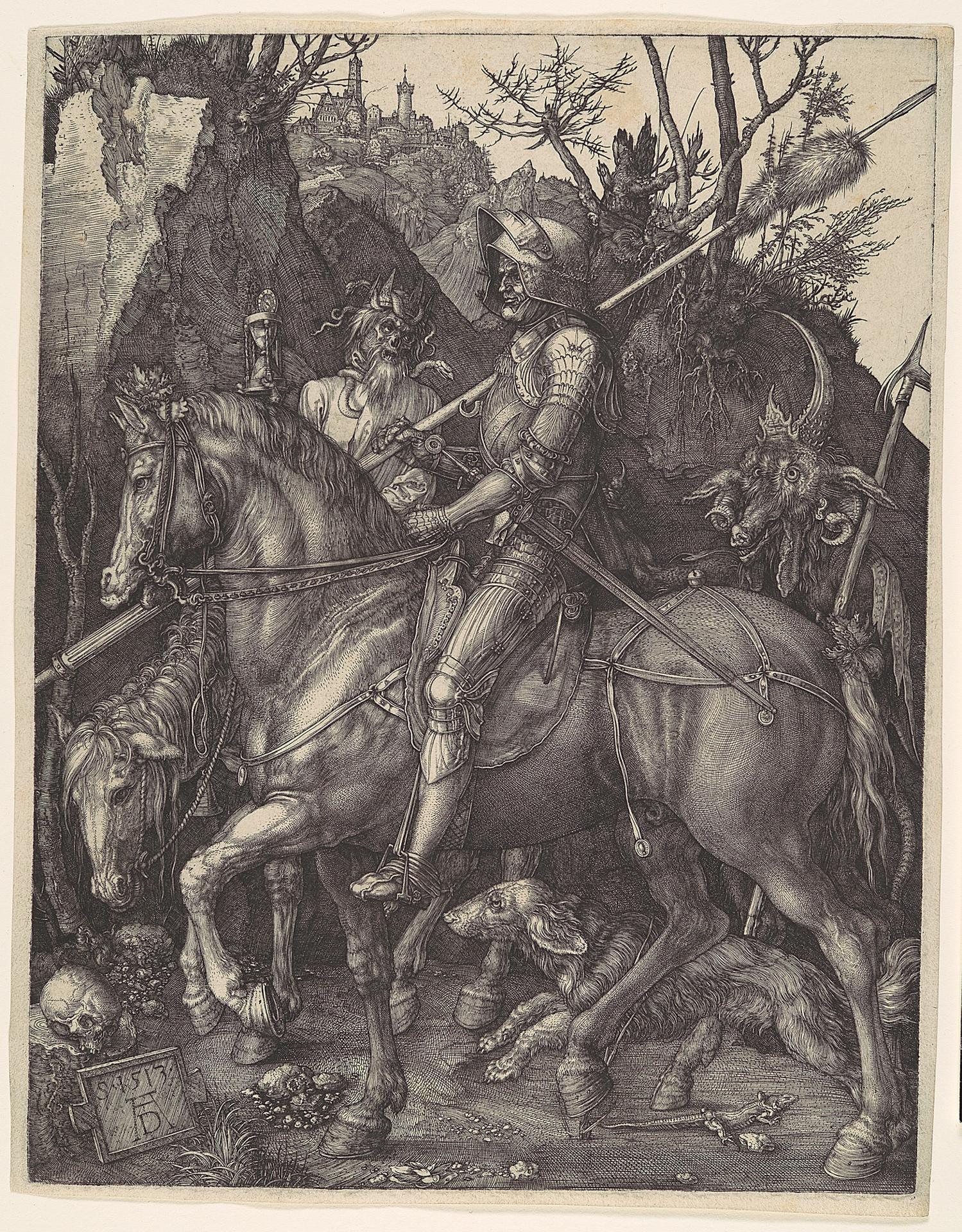
Knight, Death and the Devil is an engraving by Albrecht Dürer, dated 1513. It depicts a fully armored knight riding through a narrow valley, flanked by the figures of Death and the Devil. The work is a masterful example of Renaissance printmaking, rich in allegorical detail.
Description
The composition centers on a knight in full armor and helmet, seated on a horse, his posture upright and resolute. To the left, Death appears as a gaunt human figure holding an hourglass, while the Devil, with horns and a beard, lurks on the right. A dog runs at the horse's feet, and a skull lies on the ground in the foreground, reinforcing the theme of mortality. The background features a rugged landscape with trees, a mountain, and a castle, all rendered in fine, precise linework typical of engraving.
Context
Dürer created this engraving in 1513, during a period when he was producing some of his most celebrated prints in Nuremberg. The work is often interpreted as a moral allegory, possibly inspired by Erasmus's 'Enchiridion militis Christiani' (1503), which urged the Christian knight to persevere against worldly temptations. It embodies the Renaissance fascination with classical themes and the human condition, reflecting both religious and humanist ideas of the era.
Impact
The engraving's meticulous detail and dramatic contrasts of light and shadow give it a powerful, almost theatrical presence. The knight's stoic determination amidst the looming figures of Death and the Devil creates a sense of tension and moral resolve. The work invites viewers to contemplate the fragility of life and the steadfastness required to face its trials.
Technique
This is an engraving, a technique where the image is incised into a metal plate with a burin, then inked and printed. Dürer's mastery of this medium is evident in the fine, varied linework that models forms and textures, from the horse's mane to the armor's reflections. The monochromatic print relies on the interplay of black ink and paper to achieve a wide tonal range, from deep shadows to delicate highlights.
AI-generated description text
Source: Metropolitan Museum of Art · Public domain (CC0)