The Turkish Family
Original title: The Turkish Family
kurzbeschreibung
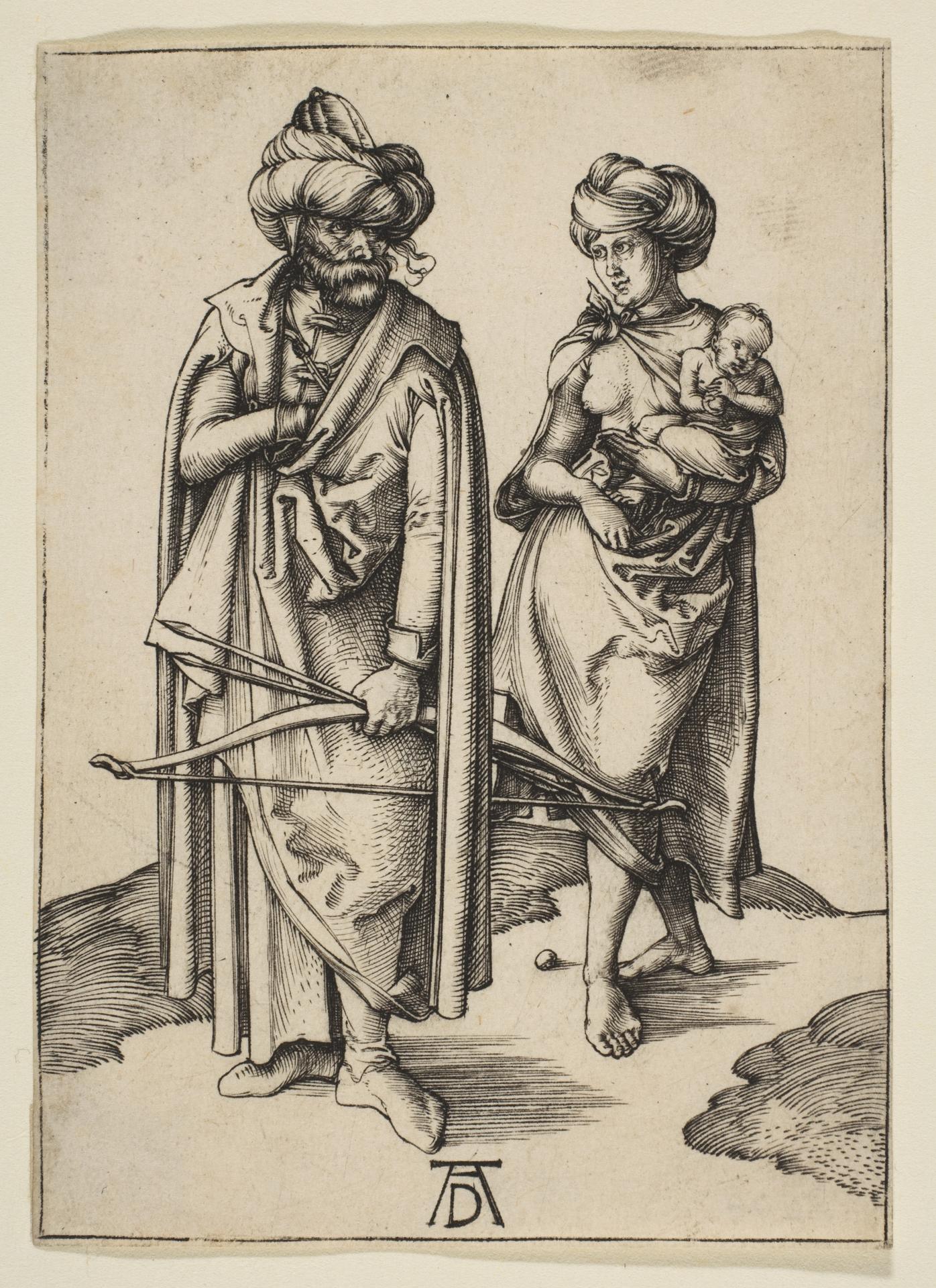
The Turkish Family is an engraving by Albrecht Dürer, dated around 1496. It depicts a Turkish man, a woman, and two children in a simple landscape. The work is a fine example of early Dürer printmaking.
Description
The composition centers on three figures: a man in a long coat and traditional Turkish headgear holding a bow, and a woman with a head covering and a simple garment that leaves her breasts exposed. She holds one child in her arms while another child stands beside her. The background shows a low hill and a single tree, keeping the focus on the figures. The engraving uses monochrome gray tones with fine lines and cross-hatching to model textures and shadow. The artist's monogram 'JDA' appears at the bottom of the print.
Context
Dürer created this engraving around 1496, during a period when he was increasingly interested in depicting foreign peoples and cultures. The image reflects European curiosity about the Ottoman Empire, which was a major political and military power at the time. Dürer likely based the figures on sketches or descriptions from travelers, as he never visited the Ottoman lands himself. The work is one of several prints from this era that explore non-European subjects.
Impact
The print conveys a sense of quiet dignity and foreignness, with the man's bow and attire emphasizing his Turkish identity. The woman's exposed breast adds an ethnographic, almost documentary quality, inviting viewers to observe an unfamiliar way of life. The stark black-and-white composition gives the scene a timeless, monumental feel.
Technique
This is an engraving, a technique in which the artist carves lines into a metal plate with a burin, then inks and prints it. Dürer's mastery is evident in the delicate hatching and cross-hatching that create volume and depth. The fine lines allow for detailed rendering of fabric, hair, and the landscape, typical of his early printmaking style.
AI-generated description text
Source: Metropolitan Museum of Art · Public domain (CC0)