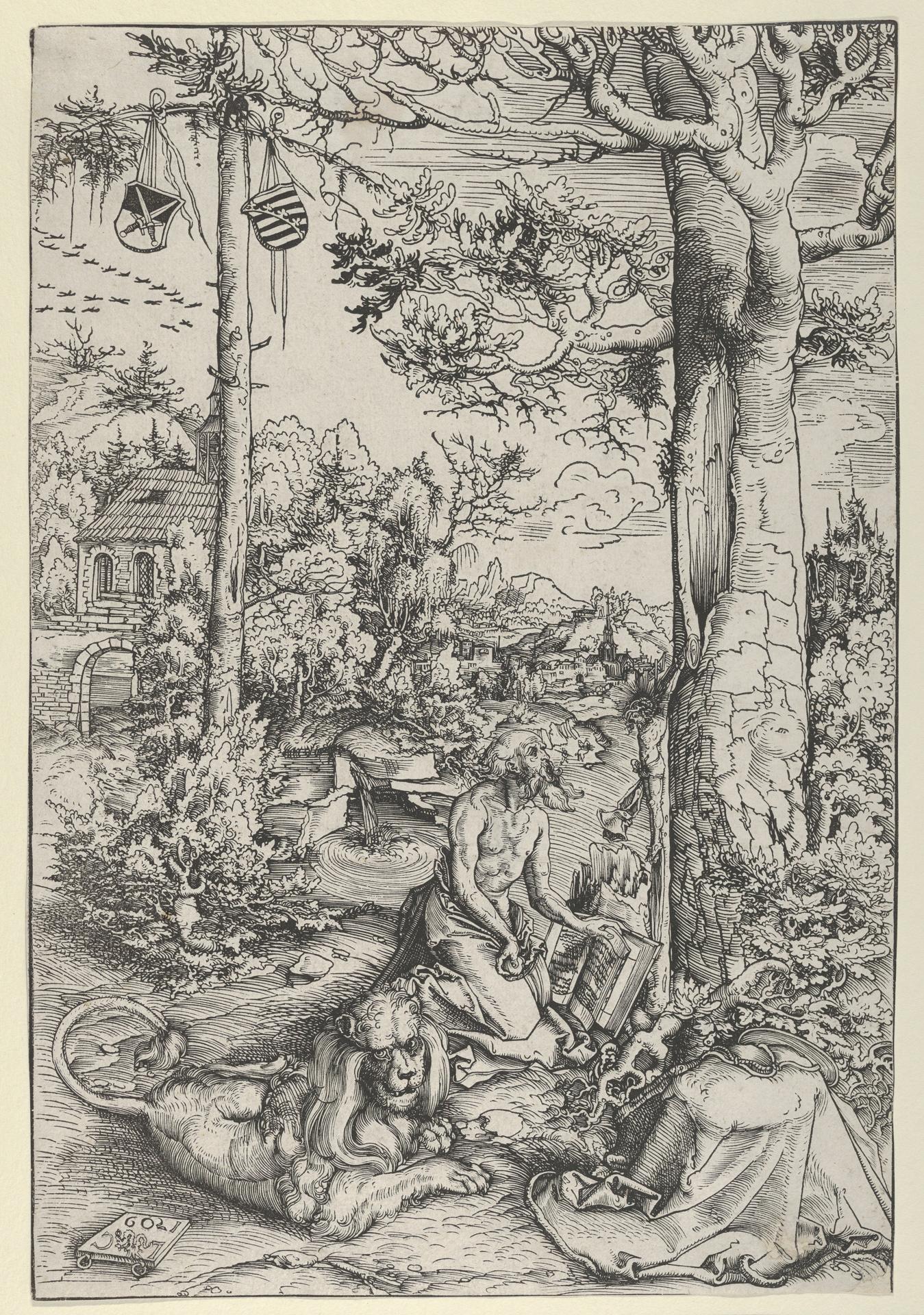
St. Jerome in the Wilderness (1509, Met-Objekt 2366)
Original title: St. Jerome in the Wilderness
kurzbeschreibung
Saint Jerome sits barefoot on the ground in a sparse landscape, wearing only a loincloth, and reads from a book; a lion rests beside him. Lucas Cranach the Elder made this scene as a black-and-white woodcut in 1509, measuring 33.4 x 22.6 cm.
Description
A bearded, barefoot man in a loincloth squats in the foreground on the bare earth, an open book in his hands—attributes that identify him as Saint Jerome. The lion at his side lies relaxed, its head slightly lowered, paws loosely stretched forward. Behind the two, a landscape opens up with carefully drawn trees, shrubs, and a small building. On some trunks hang a shield with a coat of arms and a flag; further back, groups of trees and a mountain range recede in layers. Even light bathes the whole, giving the image a quiet, peaceful character.
Context
As court painter to the Saxon electors in Wittenberg, Cranach produced this woodcut in 1509. In the Renaissance, the Church Father Jerome was one of the most sought-after subjects, as he could display both asceticism and scholarship. Cranach combined the image of the penitent saint with a richly detailed landscape whose conception recalls the Danube School. The lion is firmly part of the saint's iconography, since legend holds that he pulled a thorn from its paw.
Impact
The calm, almost intimate closeness of saint and lion makes the print both sublime and approachable. Delicately placed lines give the landscape natural liveliness, while the restriction to black and white sustains the contemplative mood. The even light holds figure and nature in harmonious balance.
Technique
Cranach worked in relief printing: the drawing was cut into a woodblock and then pulled onto paper. Precise, thin lines capture the bark of the trees as well as the folds of the loincloth and the lion's fur. The black print on light paper sharpens the contrasts and brings out the graphic design of the sheet.
AI-generated description text
Source: Metropolitan Museum of Art · Public Domain (CC0 1.0)