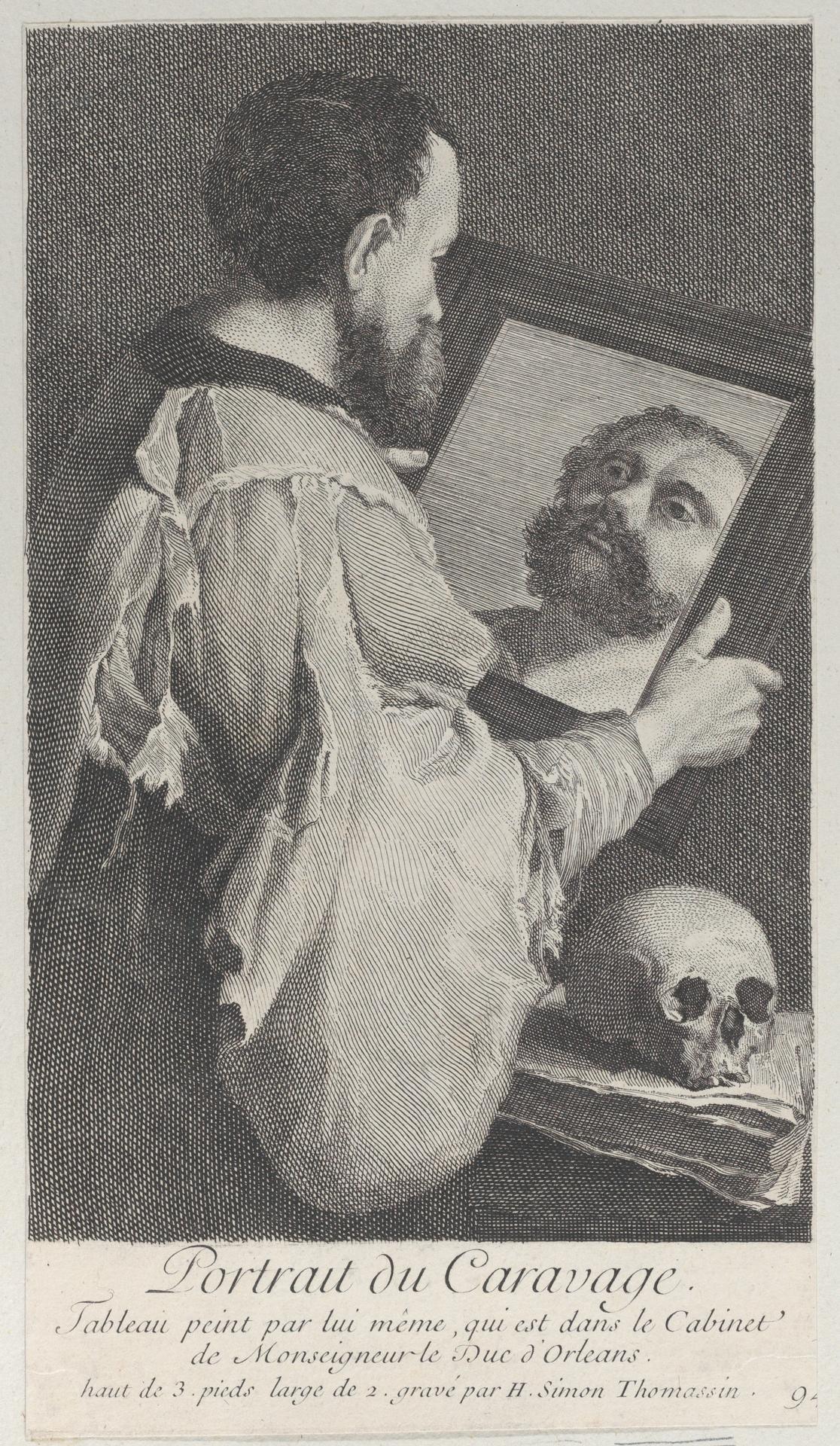
Portrait of Caravaggio, turned to the right and looking at his reflection in a mirror (1707–41, Met-Objekt 2346)
Original title: Portrait of Caravaggio, turned to the right and looking at his reflection in a mirror
kurzbeschreibung
Between 1707 and 1741, Henri Simon Thomassin produced an etching of the painter Caravaggio lost in thought before his own reflection. Graded lines and strong contrasts of light and dark define the sheet, which now belongs to the Metropolitan Museum of Art.
Description
A bearded man with a moustache, wearing a shirt with open sleeves and a sash across his shoulder, tilts his head slightly to the left. His gaze is pensive. The right hand holds a mirror, the left touches its edge. Below, a skull rests on a cloth; the background stays plain and dark. The black-and-white print draws out the details of face and garment through contrasts of light and shadow.
Context
The Frenchman Henri Simon Thomassin worked as a copperplate engraver in the 18th century and was known for reproductive prints. This portrait probably goes back to a painting or drawing by another artist showing Caravaggio in an allegorical pose with mirror and skull. Such vanitas motifs were widespread in the Baroque and warned of the transience of existence. The etching appeared at a time when interest in Caravaggio's work was reviving.
Impact
Gloomy mood and the sitter's thoughtful expression give the image an introspective feel. Light and shadow draw the eye to the face and the mirror, creating a calm, almost meditative atmosphere. The skull heightens the melancholy impression and emphasises the vanitas theme.
Technique
The etching was printed on paper; its fine lines are characteristic of 18th-century technique. By means of etching, the artist rendered details such as hair texture and fabric folds precisely. The trimmed sheet measures 22.2 × 12.4 cm, giving it a narrow upright format.
AI-generated description text
Source: Metropolitan Museum of Art · Public Domain (CC0 1.0)