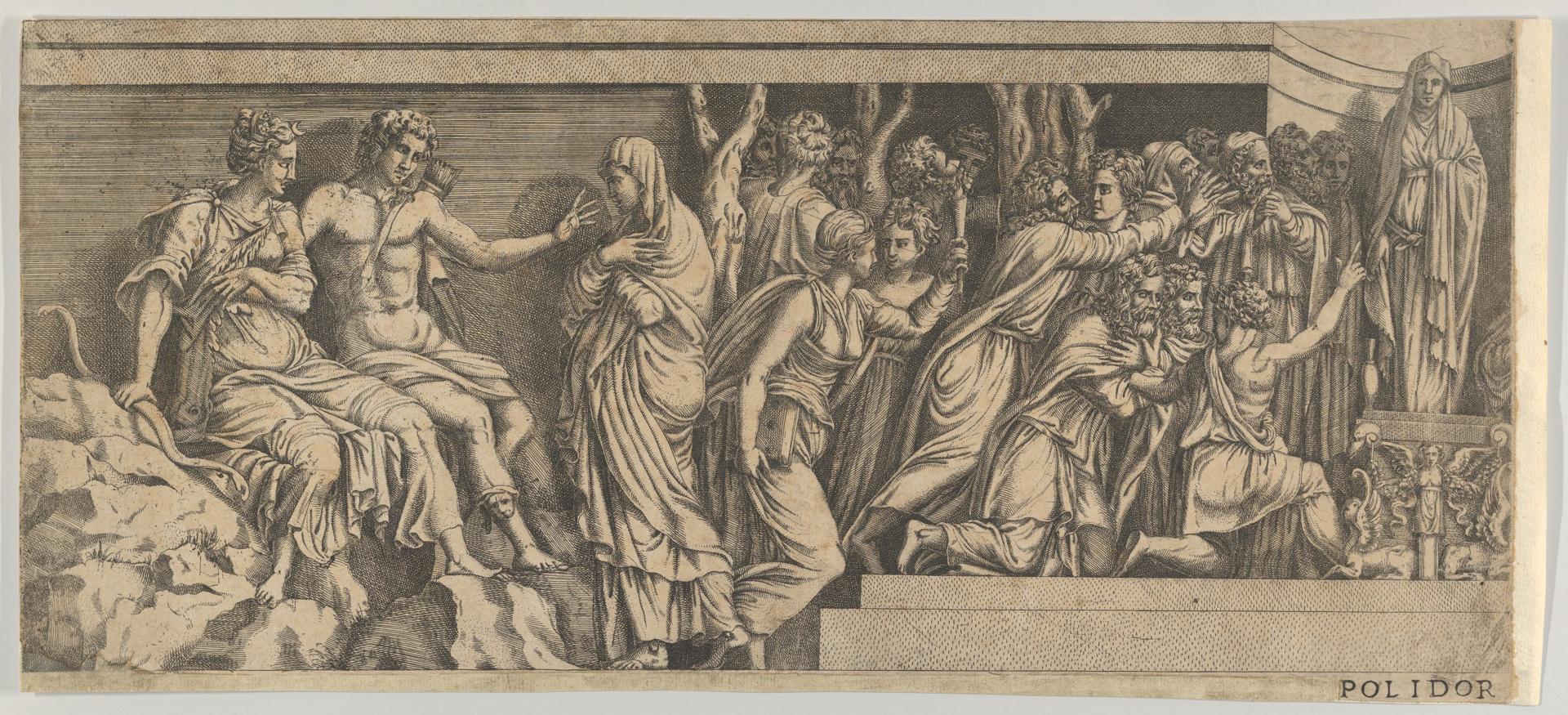
Statue of Niobe and her Worshippers, with Apollo and Diana and other Figures, after Polidoro da Caravaggio (1543–47, Met-Objekt 2342)
Original title: Statue of Niobe and her Worshippers, with Apollo and Diana and other Figures, after Polidoro da Caravaggio
kurzbeschreibung
The tale of Niobe, who boasted against the goddess Leto and was punished with the death of her children, serves as the subject of this anonymous etching from the School of Fontainebleau. Made between 1543 and 1547, the print derives from a design by Polidoro da Caravaggio and shows how classical themes were taken up in the French Renaissance.
Description
Trees and shrubs form a backdrop for a symmetrically ordered group of figures. Two clothed men wearing headgear sit on a rock in the foreground; beside them stands a woman holding a flower. Around them other figures stand or kneel, some barefoot, some with hats. On a raised platform further back a female figure is visible, also with a flower. The monochrome print has even lighting and emphasizes the gestures and interactions of the figures.
Context
The etching comes from the School of Fontainebleau, a group of sixteenth-century artists working under the influence of Francesco Primaticcio and Rosso Fiorentino. The designer Polidoro da Caravaggio was an Italian Renaissance painter known for his facade decorations with antique motifs. The Niobe story was highly popular in the Renaissance and illustrates how strongly classical mythology shaped the art of the period.
Impact
Balanced and classical in feel, the print owes this to its symmetrical arrangement and calm, even distribution of light. The posture and gesture of each figure are recorded in detail, giving the scene narrative depth. The natural setting contrasts with the monumental figure group and underlines its antique character.
Technique
The etching is an intaglio process in which the drawing is bitten into a metal plate. Lines are executed with the finesse and precision typical of Renaissance printmaking. The sheet measures 21.9 × 49.6 cm and is mounted on a larger support.
AI-generated description text
Source: Metropolitan Museum of Art · Public Domain (CC0 1.0)