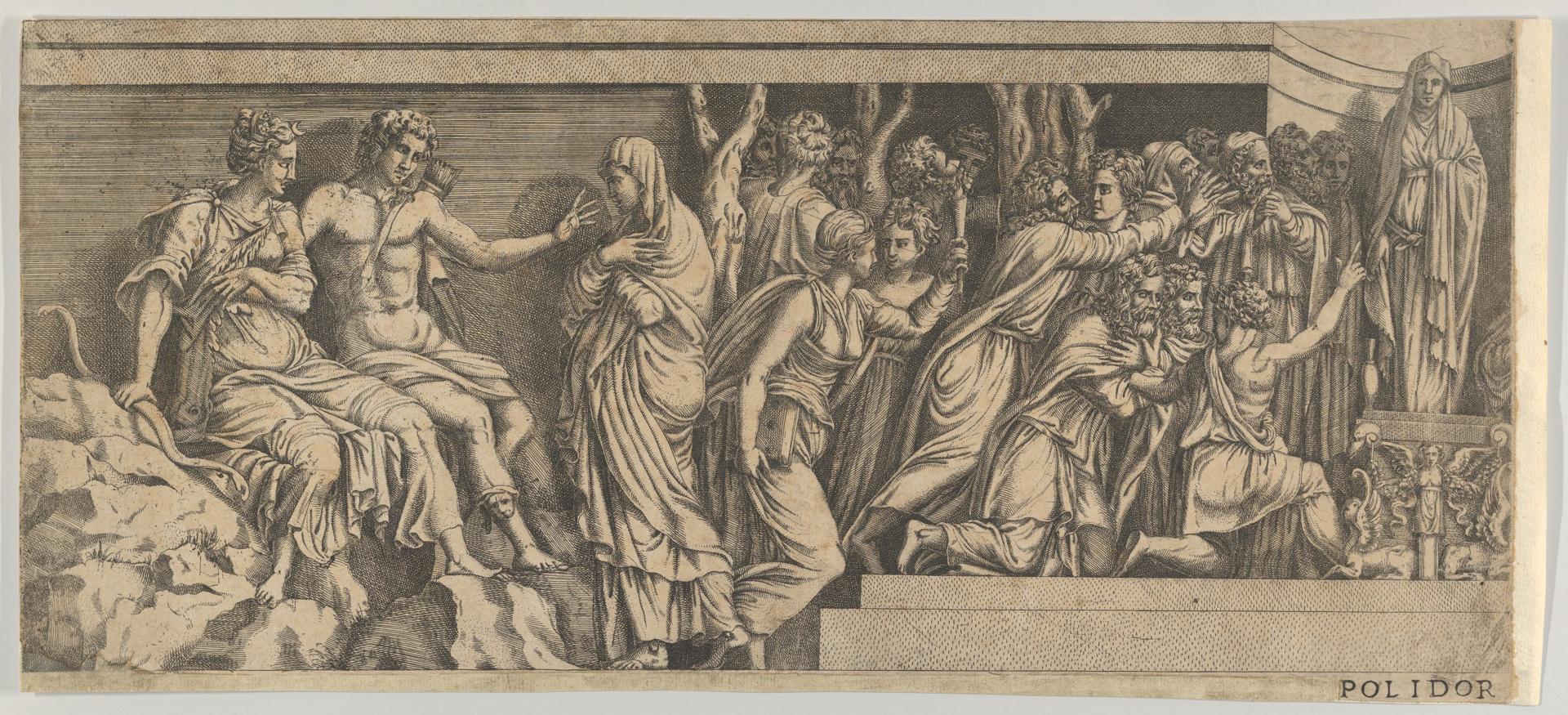
Statue of Niobe and her Worshippers, with Apollo and Diana and other Figures, after Polidoro da Caravaggio (1543–47, Met-Objekt 2341)
Original title: Statue of Niobe and her Worshippers, with Apollo and Diana and other Figures, after Polidoro da Caravaggio
kurzbeschreibung
An etching from the School of Fontainebleau, made between 1543 and 1547, reproduces a crowded scene after a design by Polidoro da Caravaggio. In this horizontal print, a group in antique dress gathers around two seated men on a rock. Mythological motifs are combined with a procession-like arrangement.
Description
Two male figures sit in the foreground on a rock: the left one clothed, the right one nude and in a heroic pose. Several female and male figures in flowing antique garments stand and kneel around them, some holding flowers or wreaths. A single figure rises on a pedestal enclosed by a wall. The scene stretches horizontally and feels like a procession or mourning ceremony. Monochrome and with even light and no visible shadows, the image matches the etching technique.
Context
The etching comes from the School of Fontainebleau, a group of 16th-century artists who worked for the French court and brought Italian Renaissance influences to France. It is based on a design by the Italian painter Polidoro da Caravaggio, known for his facade decorations in Rome. The subject draws on the myth of Niobe, which was treated in art many times in antiquity. The exact function of the print is not recorded; it may have served as a model for other works or as a collector's item.
Impact
Fine lines and the dense figure composition create a calm, almost solemn mood. The heroic pose of the nude figure and the antique garments give the scene a timeless, classicizing elegance. The horizontal spread guides the eye along the procession and emphasizes the narrative density of the myth.
Technique
Etching is recognizable here by fine lines and hatching that model the forms. This technique allows precise details and an even distribution of tone, without shadows or color differences. The sheet is mounted on a larger support, suggesting careful storage.
AI-generated description text
Source: Metropolitan Museum of Art · Public Domain (CC0 1.0)