The Denial of Saint Peter
Original title: The Denial of Saint Peter
kurzbeschreibung
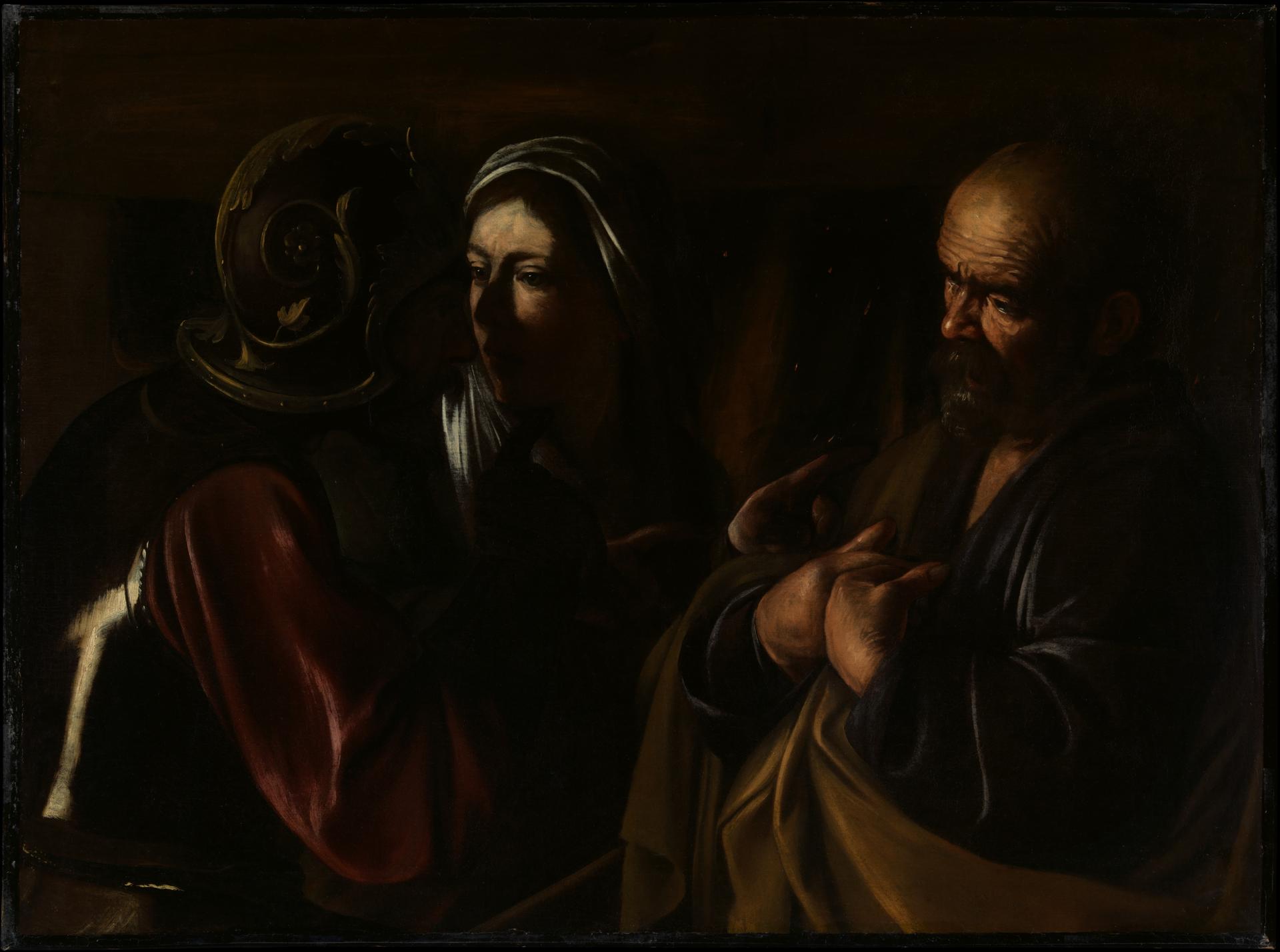
Caravaggio painted The Denial of Peter in 1610, the last year of his life. Oil on canvas, 94 by 125.4 cm, it sets three figures against a hard alternation of light and shadow. The subject is the biblical moment in which Peter betrays his Lord.
Description
Three people crowd into the foreground. At the left stands a man in armor, his head hidden by the gear, and he is Peter. Between them a woman in a plain dress, her face troubled, most likely Mary Magdalene. On the right a bearded older man with a grave expression, Christ. Light falls on the figures from the left and heightens the tension of the instant. Muted dark tones dominate; red glints on the armor, gold passages lie on the garment of the man at the right.
Context
Made in 1610, the year Caravaggio died, while he was staying in Naples. For the Neapolitan Fenaroli family he painted a series of pictures that includes this one. Peter's denial was a common subject of the Counter-Reformation, where repentance and forgiveness were at stake. Caravaggio, himself repeatedly caught up in legal troubles, often took up existential questions in his late work.
Impact
The stark contrast of light and dark creates an immediate, almost intimate suspense. The layout is tight, the figures' gazes meet the viewer directly and pull him into the situation. Dark coloring and a bare setting heighten the expressive force of the moment.
Technique
Oil paint on canvas, worked with strong chiaroscuro. The figures are held with sharp, precise contours, while the background stays almost entirely in darkness. The paint is applied thickly, as is typical of the Baroque, with fine detail in faces and garments.
AI-generated description text
Source: Metropolitan Museum of Art · Public Domain (CC0 1.0)