Roman Procession
Original title: Roman Procession
kurzbeschreibung
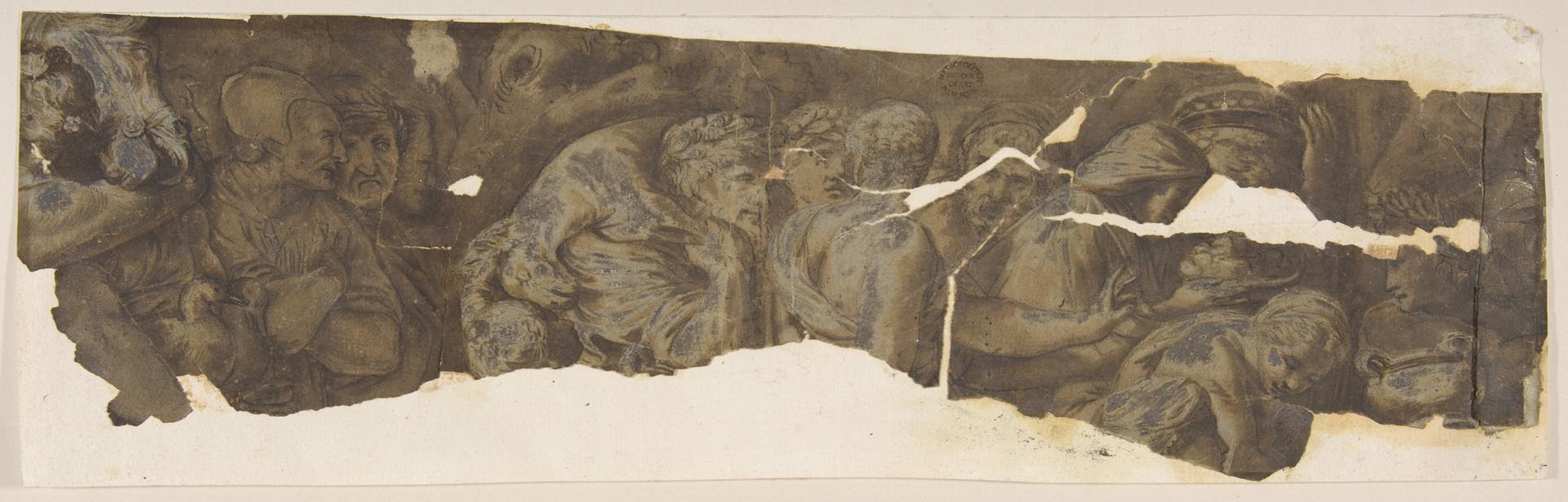
Polidoro da Caravaggio (1499–1543) made 'Roman Procession', a horizontal sheet measuring 10.8 by 39.7 cm, in which a line of figures in robes moves to the right. The drawing is executed in pen and brown ink, with brush and brown wash and white highlights.
Description
The eye is immediately guided by the horizontal format and the steady movement to the right. Each person is captured in detail with careful lines, and their faces bear individual features. In the draperies, brown tones shift from dark to almost white, with white accents providing highlights. The light is distributed evenly, without strong shadows or harsh contrasts, recalling the detailed painting of the Renaissance.
Context
A pupil of Raphael, Polidoro da Caravaggio worked in Rome and became known above all for his façade paintings. The drawing was presumably made in Rome in the first half of the 16th century, an era of intense engagement with antiquity. Processions were highly popular in the Renaissance and often referred to Roman triumphs and ancient reliefs. The sheet may have served both as a preparatory study and as an independent composition for a larger work.
Impact
Calm and dignified, the drawing appears through its fine linework and even lighting. The lined-up figures create a rhythmic procession that leads the viewer along the horizontal. Restricted to brown tones with white accents, the sheet acquires a classical, almost monumental presence.
Technique
Pen and brown ink form the foundation, supplemented by brush with brown wash and white highlights. The interplay of precise pen drawing and soft wash produces sculptural volumes and subtle tonal gradations. The white highlights set accents of light and emphasize the folds of the garments.
AI-generated description text
Source: Metropolitan Museum of Art · Public Domain (CC0 1.0)