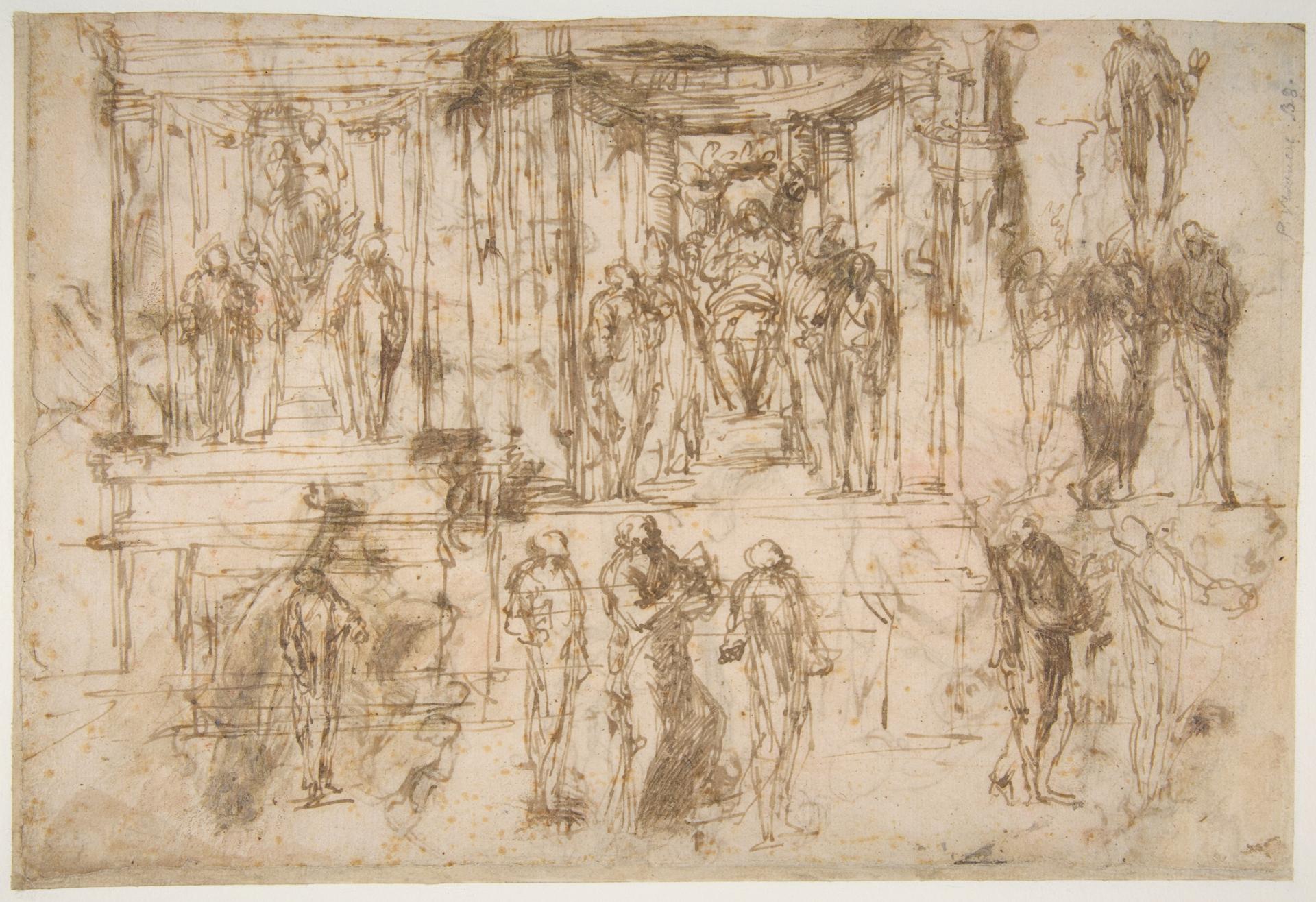
Studies for an Altarpiece with the Virgin Enthroned, Attended by Four Saints (recto); Various Figure Studies, Some Possibly for a Deposition of Christ (verso)
Original title: Studies for an Altarpiece with the Virgin Enthroned, Attended by Four Saints (recto); Various Figure Studies, Some Possibly for a Deposition of Christ (verso)
kurzbeschreibung
Around 1530–35, Polidoro da Caravaggio made this drawing, which presents designs for an altarpiece of the enthroned Virgin with four saints on the recto. Executed in pen and brown ink, with some brush and wash, it is a study for a religious composition.
Description
On the front, several figures stand in varied poses, grouped as if in a procession or assembly. Behind them rises an architectural structure reminiscent of an altar or platform, where more figures have found a place. The forms remain sketchy and plain; the emphasis falls on outline and grouping. Brown and gray tones predominate, with no strong shading or contrast.
Context
Polidoro da Caravaggio, a pupil of Raphael, became known above all for his facade paintings in Rome. This drawing dates from the 1530s, when he was carrying out several church commissions. The verso collects figure studies that may have been intended for a Descent from the Cross; here his design process for larger projects becomes visible.
Impact
The viewer immediately senses an immediate, sketch-like design process. The loose stroke and the unfinished figures let one share in the artist's deliberations. Because the palette is reduced, the formal structure of the image stands out more clearly.
Technique
Pen and brown ink dominate the sheet; in places brush and brown wash are added. This allows both precise lines and soft tonal gradations, as are characteristic of Italian Renaissance drawings. The paper measures about 20 x 30 cm, a common format for a study.
AI-generated description text
Source: Metropolitan Museum of Art · Public Domain (CC0 1.0)