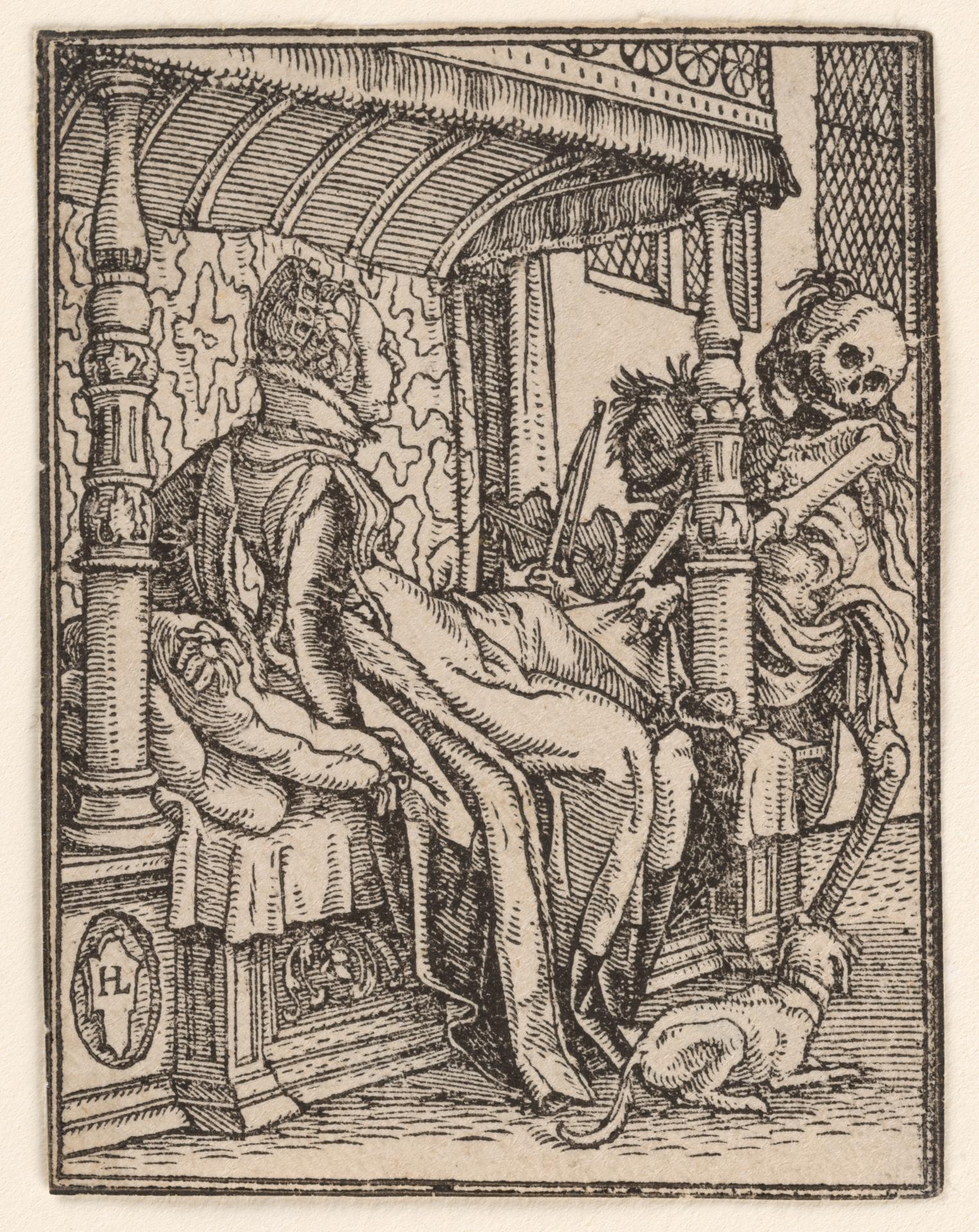
The Duchess, from "The Dance of Death"
Original title: The Duchess, from "The Dance of Death"
kurzbeschreibung
Unlike many Vanitas images of the same period, this sheet from Hans Holbein the Younger's Dance of Death cycle opts for direct confrontation: a duchess in costly dress sits while a skeleton with raised sword steps up beside her. Cut around 1526 and published in 1538, the woodcut keeps the transience of all earthly things before the viewer's eyes.
Description
On the left a seated woman trimmed in fur fills the picture surface, understood as a duchess. Facing her at right stands a bony figure with a sword. The layout is symmetrical, the space bounded by columns and a barred window; at the figure's feet a small dog lies down. A monochrome woodcut with even distribution of light and richly differentiated textures.
Context
The print was made around 1526, while Holbein was staying in England, and appeared in Lyon in 1538. The Dance of Death answers the upheavals of the Reformation era and the constant presence of death. From high nobility down to the simple peasant, Holbein demonstrates that death recognizes no distinctions of rank.
Impact
An oppressive mood arises from the immediate meeting of fullness of life and nearness of death. The calm, symmetrical arrangement underlines the inescapability of the end, while details such as the dog strike an almost familiar note and sharpen the contrast with the threat.
Technique
For printing, the motif was cut into a woodblock and then pulled onto paper. Precise hatching and contours attest to Holbein's skill in this process, which permits the finest structures. The sheet measures only 6.4 x 4.9 cm and belongs to a series of 41 images.
AI-generated description text
Source: Metropolitan Museum of Art · Public Domain (CC0 1.0)