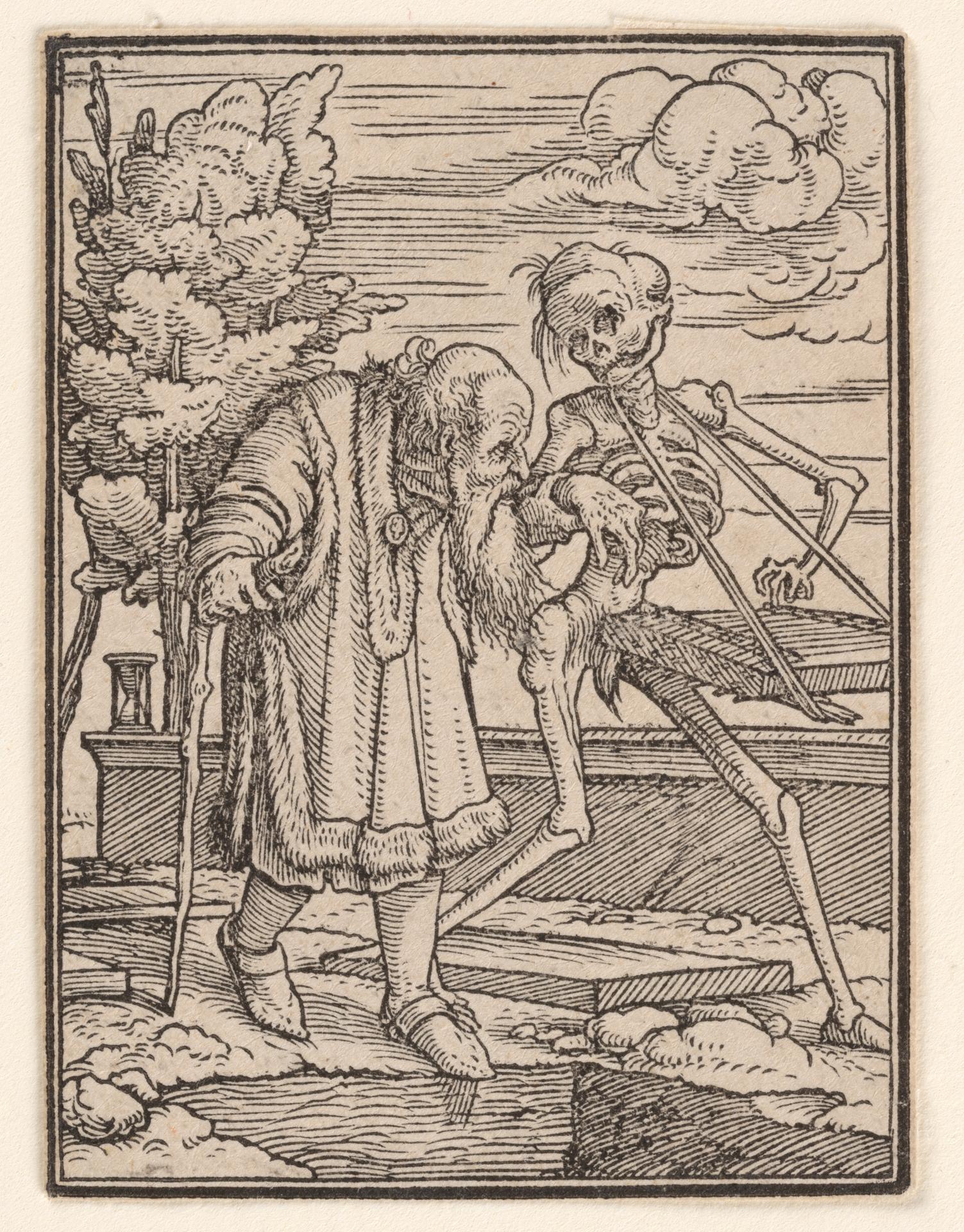
The Old Man, from "The Dance of Death"
Original title: The Old Man, from "The Dance of Death"
kurzbeschreibung
A woodcut by Hans Holbein the Younger, designed around 1526 and published in 1538: an old bearded man in a fur coat stands on a wooden beam, accompanied by a skeletal figure holding a long staff. The sheet belongs to Holbein's Dance of Death cycle, which keeps the finitude of life before the viewer's eyes.
Description
An old man with a long beard and fur mantle, leaning on a stick, occupies the middle of the print. Beside him stands a skeleton, likewise with a long staff, on a wooden beam. Clouds and a flowering plant appear behind the figures, while the ground is strewn with rubble and stones. Fine lines and hatching in black and white bring out the texture of the fur and the articulation of the skeleton's limbs.
Context
The Dance of Death cycle was drawn up after Holbein's designs in the 1520s and first published in 1538. The series took up Reformation debates and presented death as a universal end that claims every station of life equally. The designs were probably made during Holbein's Basel years, among humanist circles. The woodcuts were later printed in Lyon and circulated widely.
Impact
The pairing of living old man and skeleton gives the sheet its insistent memento mori force. Clear lines and a calm, almost symmetrical arrangement lend it a didactic presence. The viewer is reminded of mortality without the image sliding into the morbid.
Technique
Woodcut as a relief process: the design is cut into a block of wood and then printed onto paper. Holbein worked with fine lines and cross-hatching to build shadow and texture. The monochrome palette is typical of this printing method and stresses the graphic clarity of the sheet.
AI-generated description text
Source: Metropolitan Museum of Art · Public Domain (CC0 1.0)