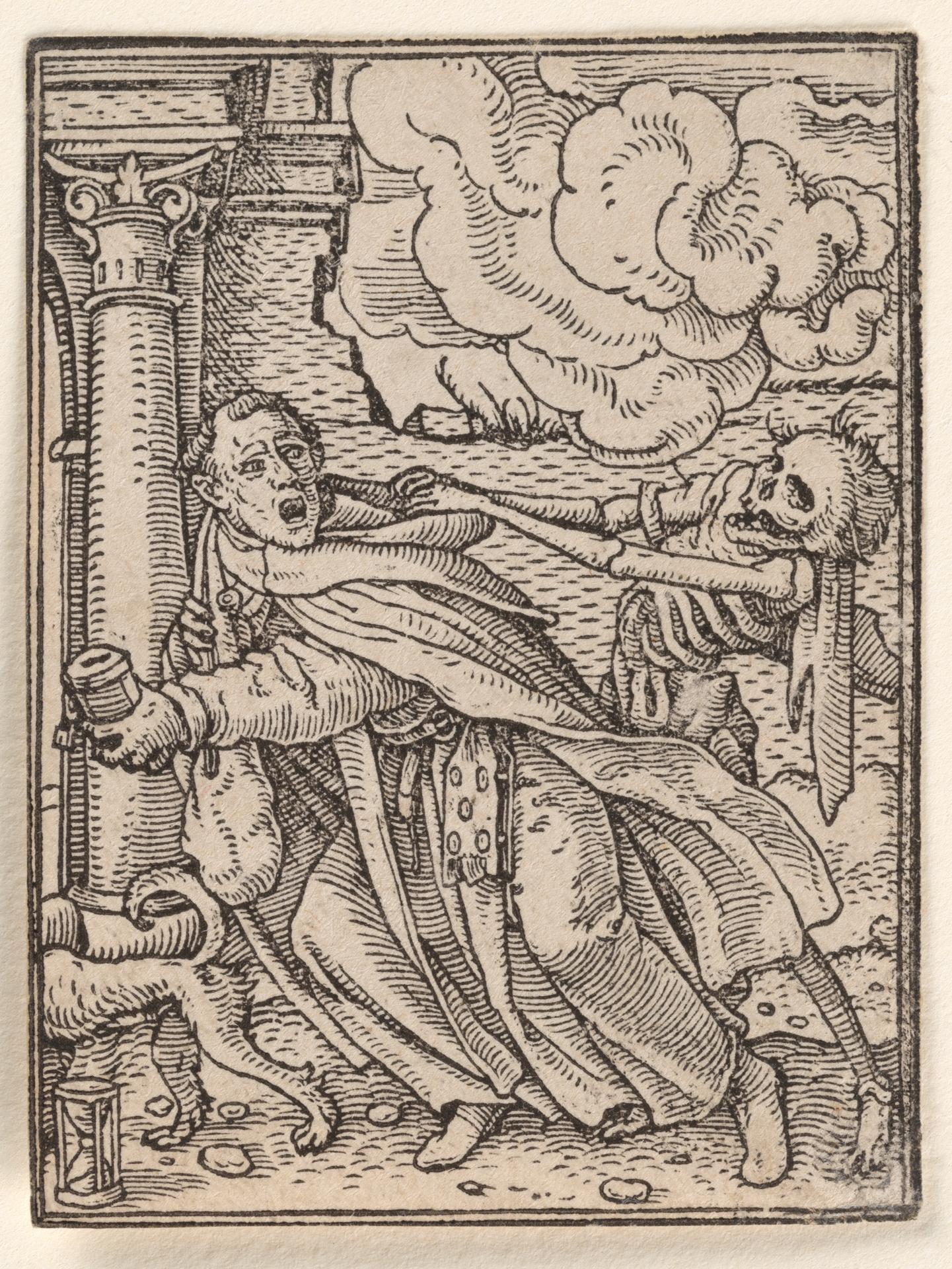
The Monk (or Mendicant), from "The Dance of Death"
Original title: The Monk (or Mendicant), from "The Dance of Death"
kurzbeschreibung
Around 1526 Hans Holbein the Younger designed this woodcut for his Dance of Death cycle; it first appeared in print in 1538. A monk in a long-sleeved cowl is supported and led forward by a skeleton. On a mere 6.5 x 4.8 cm, the small sheet reveals the full mastery of Renaissance printmaking.
Description
A monk in a flowing, belted cowl and shoes, his upper body leaning back, arms spread wide. His right hand holds a skeleton that carries or supports him. Behind them clouds pile up, and a broken column heightens the apocalyptic tone. On the left, a spinning wheel with a whorl can be seen, a hint at the monk's craft. The layout is unbalanced and entirely built around the interplay of monk and death.
Context
The Dance of Death arose in years of religious and social upheaval, between the Reformation and the Peasants' War. From pope to peasant, the series confronts every estate with its mortality and, as a woodcut series, addressed a broad public. The first publication came out in Lyon in 1538, after the cuts had been made around 1526. The designs are by Holbein, the blocks were cut by Hans Lützelburger.
Impact
Precise lines and the insistent confrontation of life and death define the print. The small format demands a close look and rewards it with fine details and strong expressiveness. The scene is immediate and makes the cycle's moral message clearly felt.
Technique
Made by relief printing: the drawing is cut into the woodblock and then printed. Holbein's delicate lines and careful hatching attest to the blockcutter's skill. Monochrome, as was usual for woodcuts of the time, the sheet gains its sculptural effect from the interplay of black and white.
AI-generated description text
Source: Metropolitan Museum of Art · Public Domain (CC0 1.0)