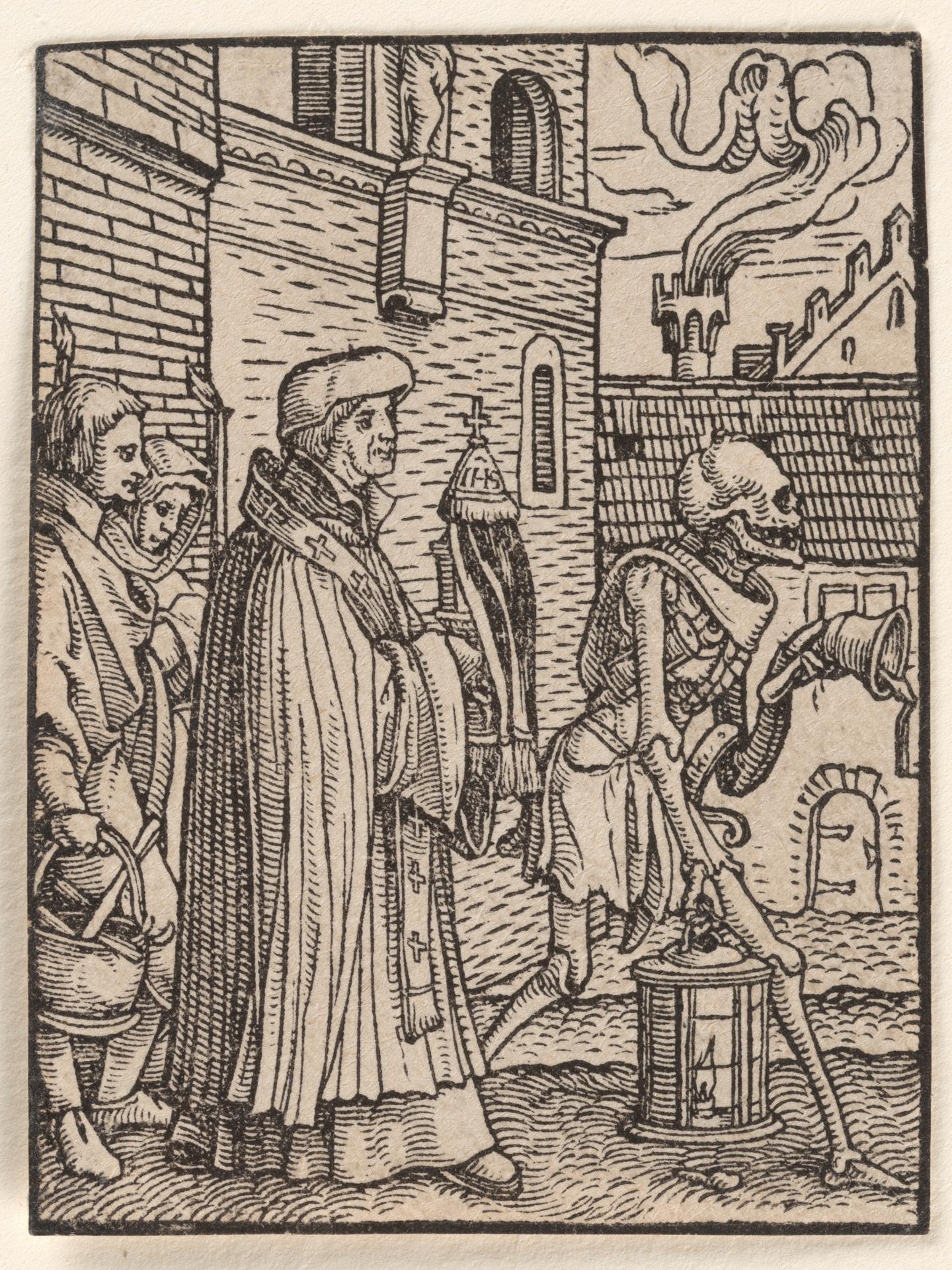
The Priest, from "The Dance of Death"
Original title: The Priest, from "The Dance of Death"
kurzbeschreibung
Unlike many other sheets from Holbein's Dance of Death, this woodcut does not set Death against a single person but lets him accompany a whole group. A priest stands among men in splendid robes; a skeletal figure carrying a lantern and a bowl walks with them. The print was made around 1526 and published in 1538 as part of the famous series.
Description
The layout feels orderly: the skeleton stands in the middle, the men spread out on either side. Cross ornaments mark the traditional vestments of the figures. Behind them rise buildings and a city wall with towers. Even light falls across the monochrome sheet, as was usual for woodcuts of that time. Realistic details combine with symbolic elements.
Context
Holbein made the Dance of Death woodcuts around 1526, while working in Basel; they were printed only in 1538 in Lyon. In a period when the Reformation was making criticism of the Catholic Church loud, Holbein created this series. The priest appears as part of an allegory that shows death makes all people equal. Even during the artist's lifetime the sheets were widely circulated and shaped later depictions of the Dance of Death.
Impact
The richly dressed living and the skeleton as a sign of mortality face each other, and this very contrast makes the sheet compelling. Clear arrangement and precise lines give the image a calm, thoughtful mood. Viewers are reminded that death is inevitable regardless of social rank.
Technique
A woodcut, this sheet belongs to relief printing, in which the design is cut into wood and then printed. With fine lines and hatching, Holbein achieved details and shading. The small format of 6.5 x 4.8 cm demanded particularly careful execution.
AI-generated description text
Source: Metropolitan Museum of Art · Public Domain (CC0 1.0)