The Clergyman, from The Dance of Death
Original title: The Clergyman, from The Dance of Death
kurzbeschreibung
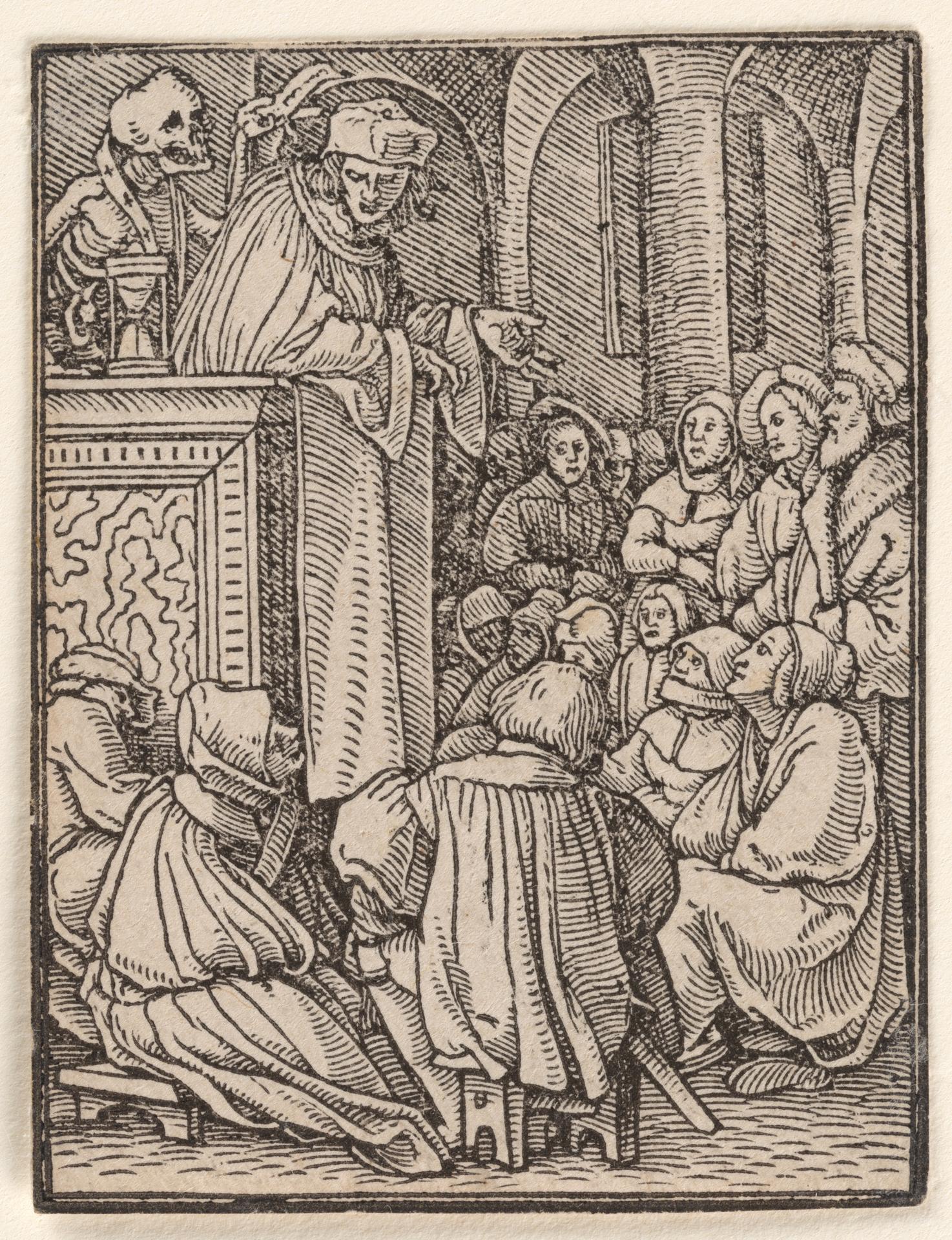
Made around 1526 as one of Hans Holbein the Younger's Dance of Death woodcuts, published in 1538, this print places a clergyman on a raised platform amid a pressing crowd. Above him a skeleton hoists a chalice and a host into the air.
Description
The layout is strictly symmetrical. At the centre stands the priest in a long hooded robe, one hand lifted in a gesture of blessing or speech. Around him people crowd together in varied poses and dress, some seated, others standing. Arches and columns divide the space behind them. A skeleton bearing chalice and host floats directly over the clergyman's head. The image stays monochrome, lit evenly, with dense drawing throughout.
Context
Holbein produced the woodcuts of the Dance of Death series during his years in Basel in the 1520s, prompted by the reforming critique of the Church. The series first appeared in Lyon in 1538 and quickly became widely popular. The clergyman is one of the figures through whom the transience of every estate is demonstrated. As a printmaker Holbein worked for publishers such as Johann Froben, who issued Reformation writings.
Impact
Lines are drawn clearly and precisely, capturing figures and architecture in exact detail. The symmetrical arrangement gives the sheet a calm, almost solemn severity, which the skeleton hovering above the priest undercuts with a note of irony. Death offering up the sacred objects strikes a sobering chord and invites reflection on power and mortality.
Technique
For the woodcut the design was cut into a block of wood and then pulled onto paper. The delicate lines and hatching show Holbein's assured handling of the medium. The small format, roughly 6.4 × 4.9 cm, suggests an edition intended for book illustration or for single sheets.
AI-generated description text
Source: Metropolitan Museum of Art · Public Domain (CC0 1.0)