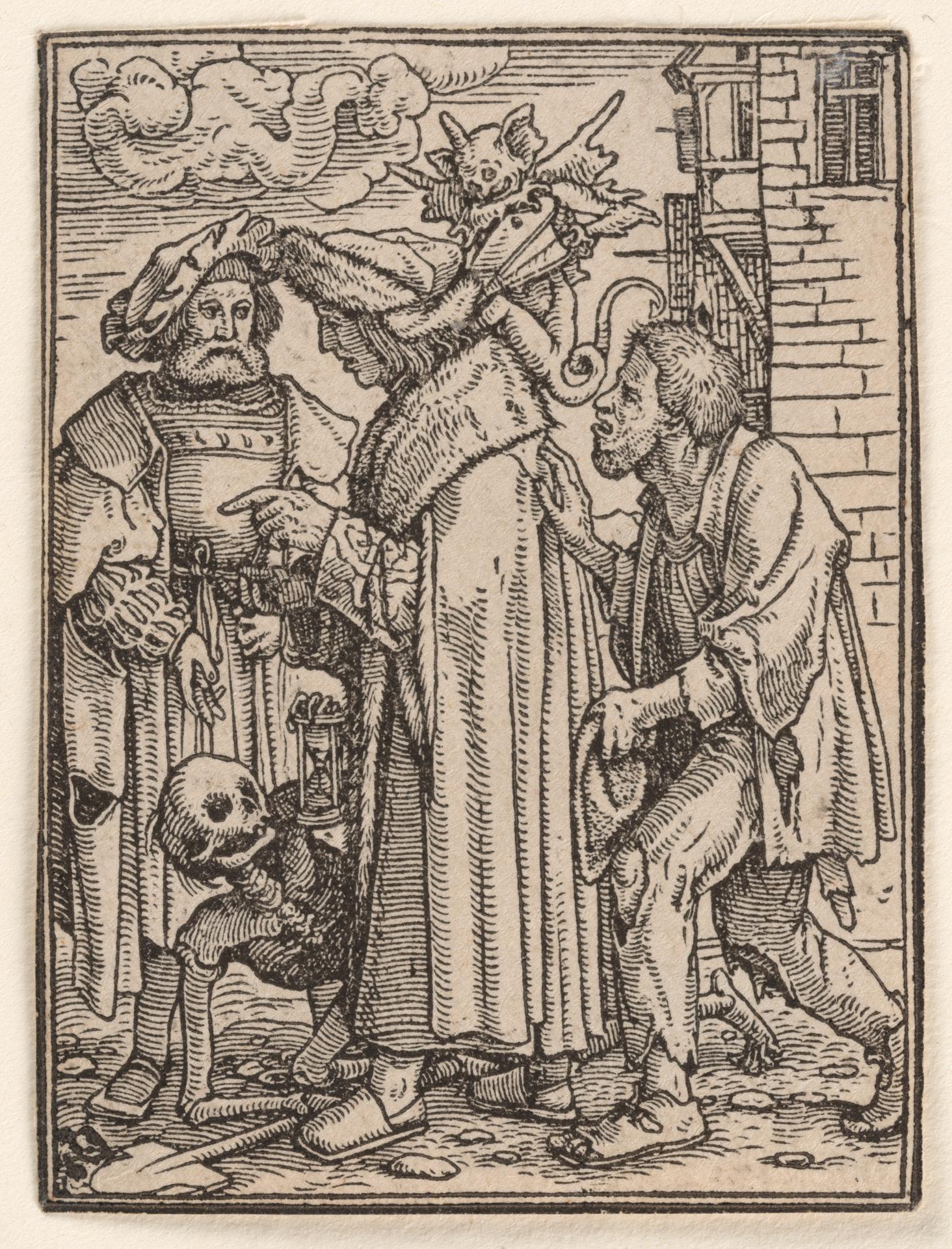
The Councillor, from "The Dance of Death"
Original title: The Councillor, from "The Dance of Death"
kurzbeschreibung
A small-format woodcut by Hans Holbein the Younger, made around 1526 and published in 1538, presents a councillor meeting Death face to face. At roughly 6.5 by 4.9 cm, the sheet belongs to the well-known Dance of Death cycle, which takes the finiteness of human life as its subject.
Description
A skeletal figure wearing a death mask steps forward, carrying an hourglass that points to time running out beyond recall. To its left stands a man in rich traditional dress, read here as the councillor. On the right, another figure in plain clothing is also drawn into relation with Death. A building with windows and a roof gives the image an urban setting, while clouds in the sky add tension. The figures press close together, making the nearness and inescapability of the encounter palpable.
Context
The sheet arose in an age of religious upheaval, as the Reformation gained weight across Europe. Holbein was then working in Basel as a painter and printmaker, and it was there that he created the Dance of Death cycle. The first publication appeared in Lyon in 1538, from where the woodcuts spread widely. That a councillor appears here in particular ties the print to the medieval Dance of Death tradition, which levels every rank alike.
Impact
Clearly ordered arrangement and restrained linework give the sheet a quiet yet insistent presence that prompts reflection on one's own mortality. Because everything stays in black and white, the seriousness of the theme comes through more plainly, and the eye is drawn to emblematic signs such as the hourglass.
Technique
As a relief process, the woodcut requires the drawing to be cut into the wooden block; what remains standing takes up the ink. Fine strokes and hatching produce graduated tonal values here and give the figures bodily weight. The printing plate was presumably pulled in several states, which allowed precise rendering of garments and architecture.
AI-generated description text
Source: Metropolitan Museum of Art · Public Domain (CC0 1.0)