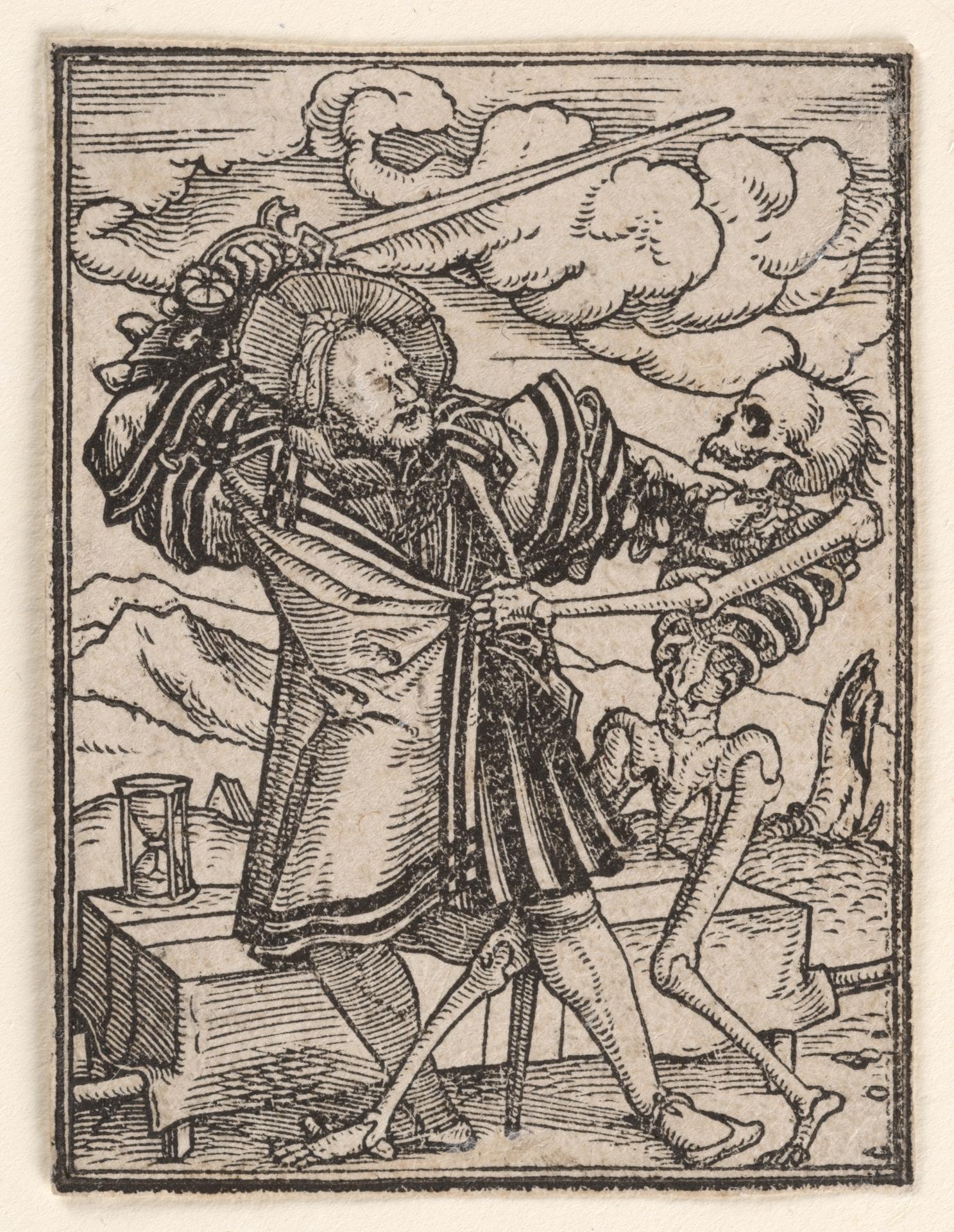
The Nobleman, from "The Dance of Death"
Original title: The Nobleman, from "The Dance of Death"
kurzbeschreibung
This woodcut comes from Holbein's Dance of Death series, made around 1526 and first published in 1538. A nobleman in elaborate armor and robes braces himself against a skeleton, while an hourglass points to the transience of all things.
Description
An armored aristocrat stands on the defensive, his garments billowing, both hands clamped around a long staff that the skeleton also grips. The figure of Death faces him directly, close enough to touch. Clouds and a mountain range along the horizon place the encounter outdoors; an hourglass lies at the bottom of the image. The layout feels balanced, the print monochrome, with crisp, finely observed contours and little use of shading.
Context
Holbein worked on the Dance of Death while Europe was shaken by religious and social upheaval — the Reformation and the Peasants' War fell in these same years. He probably cut the woodcuts in Basel, where he was then active. They first appeared in print in 1538 in Lyon, issued by the printers Melchior and Caspar Trechsel. The sheet showing the nobleman belongs to the memento mori tradition, which held up to every rank the same equality before death.
Impact
A palpable tension builds between the nobleman's readiness to fend off and the inescapable presence of death. Clear outlines and a balanced arrangement give the small format a sense of scale and address the viewer directly.
Technique
For printing, the design was cut into a woodblock and then pulled on paper. Precise details and delicately guided contours show Holbein's sure hand with the cutting tool. The sheet measures only 6.5 × 4.8 cm; the coloring stays monochrome and the light falls evenly.
AI-generated description text
Source: Metropolitan Museum of Art · Public Domain (CC0 1.0)