The Empress, from "The Dance of Death"
Original title: The Empress, from "The Dance of Death"
kurzbeschreibung
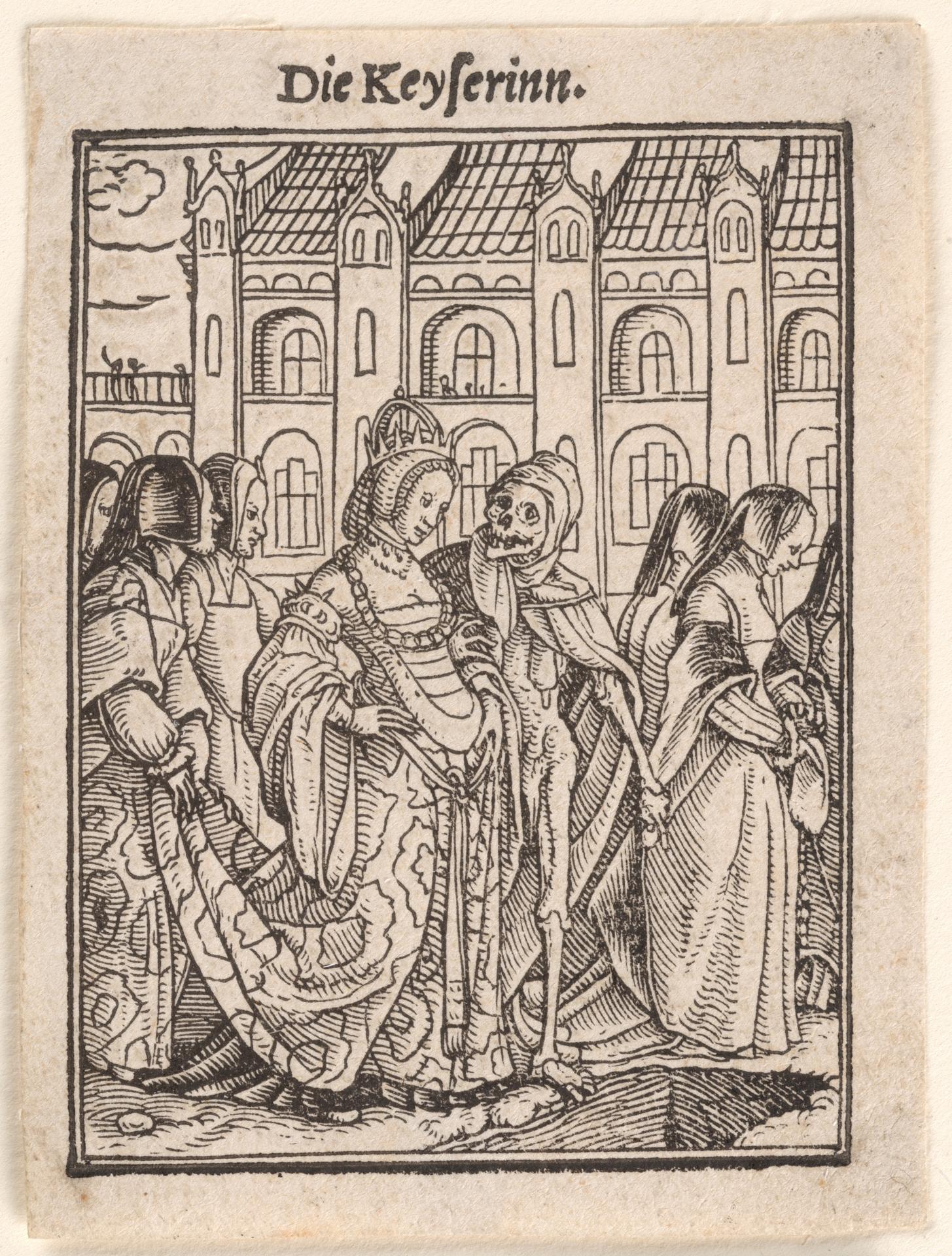
Hans Holbein the Younger made this woodcut around 1526; it was first printed in 1538. It shows an empress encountering Death. The sheet belongs to Holbein's famous cycle 'The Dance of Death' and demonstrates how transient worldly rule is.
Description
An empress wearing a crown and costly garments stands at the centre, surrounded by women in traditional dress. To the left, Death appears as a skeleton with a lance. Behind rises a massive building with windows and towers, reminiscent of a church or town hall. The figures crowd into a tight space, emphasising the meeting of empress and Death. Black-and-white lines of great delicacy trace the details of the clothing and architecture.
Context
Holbein's Dance of Death cycle originated in an era of profound religious and social upheaval – the Reformation and the Peasants' Wars shaped the times. During his stay in Basel, Holbein worked for the publisher Johann Froben and created the woodcuts there. They were first published in Lyon in 1538 and spread quickly. The Empress fits into the medieval tradition of the Danse Macabre, which levels all estates before Death.
Impact
A palpable tension arises between the empress's dignified bearing and the immediate proximity of Death. Despite the small format, the layout feels deep and present, sustained by precise linework and rich architecture. Without a moralising tone, the sheet recalls the finiteness of earthly power.
Technique
For the woodcut, the motif was cut into a wooden block and then printed on paper. This process allows clear contours and fine hatching, as seen in the garments and buildings. At only 7.5 x 5.6 cm, the sheet demanded extremely careful execution.
AI-generated description text
Source: Metropolitan Museum of Art · Public Domain (CC0 1.0)