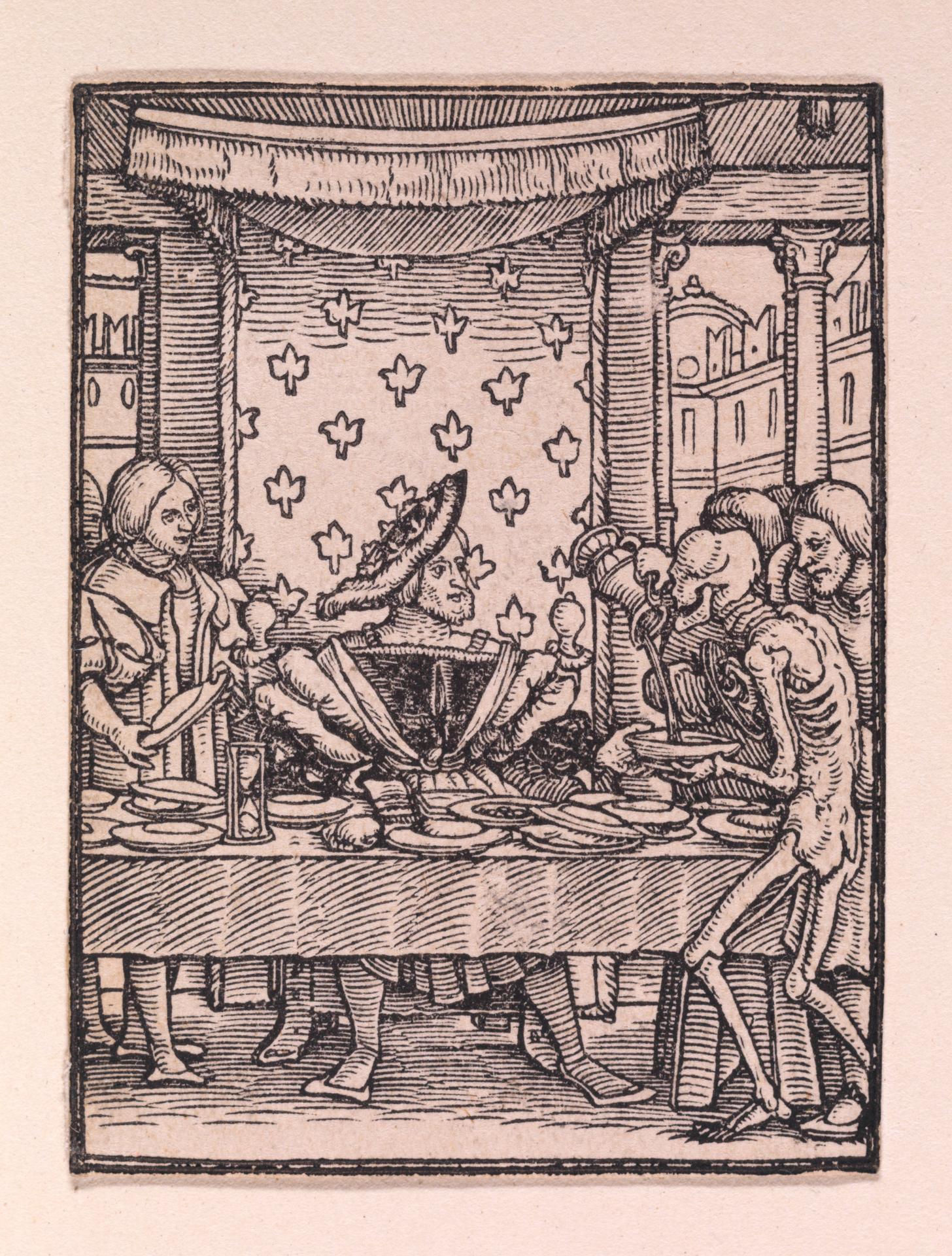
The King, from "The Dance of Death"
Original title: The King, from "The Dance of Death"
kurzbeschreibung
A king sits at a laid table, but a skeleton steps up to him. This woodcut by Hans Holbein the Younger, made around 1526 and published in 1538, belongs to the Dance of Death series. The print brings home how fleeting all earthly existence is.
Description
Your eye goes first to the king, crowned and wearing a broad-brimmed hat, seated behind a table with plates and a jug. To his left stand two figures—a woman with a small plate and a man with a glass—turning toward him. A skeleton in a cowl engages with the king. Behind them is a stage with a curtain and a floral pattern. The woodcut's lines are fine and densely set; hatching models the forms without casting what we would call shadows.
Context
This sheet comes from Holbein's famous Dance of Death series, first published in Lyon in 1538. Created in an era of European upheaval shaped by the Reformation and the Peasants' War, the series pictures the equality of all ranks before death—a theme widespread in the late Middle Ages.
Impact
The viewer immediately feels the contrast between the king's dignity and the unavoidable confrontation with death. The dense linework and wealth of detail hold the gaze longer on the sheet, and in this way convey a memento mori message.
Technique
For printing, the design was cut into a woodblock and then pulled on paper—a process Holbein used with extremely fine lines and precise hatching to create textures and spatial depth, as is characteristic of his prints.
AI-generated description text
Source: Metropolitan Museum of Art · Public Domain (CC0 1.0)