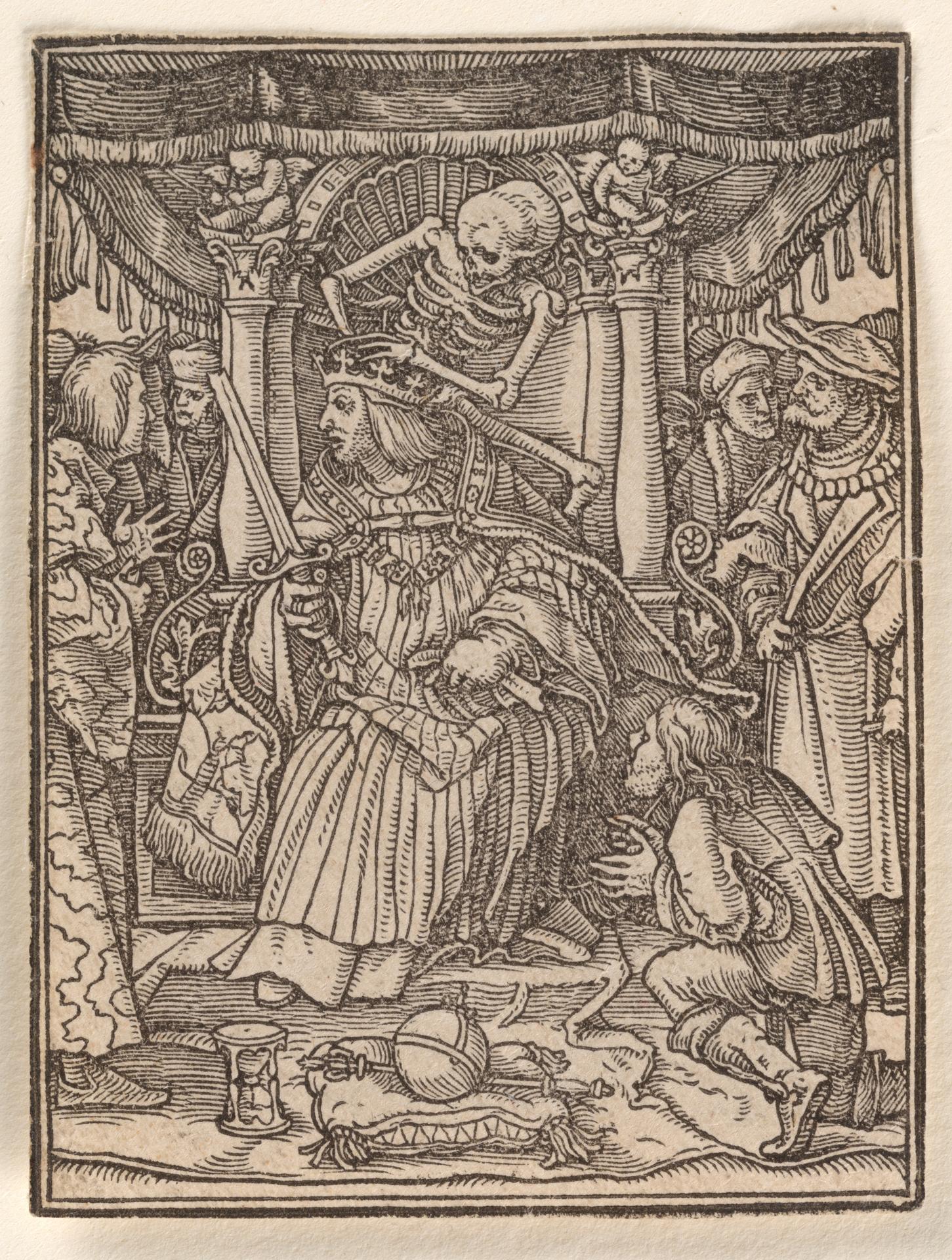
The Emperor, from "The Dance of Death"
Original title: The Emperor, from "The Dance of Death"
kurzbeschreibung
Made around 1526 and first published in 1538, this woodcut by Hans Holbein the Younger belongs to the Dance of Death series. An emperor sits enthroned while Death's skeleton confronts him with a crown; other figures and props, including an hourglass and a cartwheel, frame the action.
Description
A crowned ruler occupies the middle of the sheet, his richly ornamented robe spreading around him. Death's skeleton places a second crown on his head. At right a man sinks to his knees, and at left another bowed figure can be made out; two angels and a further skeleton emerge behind them. A fringed curtain and a cartwheel close off the view, and on a cloth on the floor lie an hourglass and other objects. The arrangement is built symmetrically around Death as its axis, worked in graded greys with precise linework.
Context
The years around 1526 were a time of religious upheaval, as the Reformation gained ground across Europe. Holbein was working in Basel on the Dance of Death series, which first appeared in print in Lyon in 1538. Death, the leveller of every rank, was a widespread motif of the late Middle Ages and the Renaissance, a way of weighing the transience of earthly power.
Impact
A palpable tension arises between the emperor's dignified bearing and the inescapable nearness of Death. The symmetrical layout and delicate lines give the sheet a quiet but insistent gravity that urges reflection on mortality and power.
Technique
Cut into a woodblock and then pulled on paper, the motif allows fine contours and hatching that model garments and figures in shades of grey. At a sheet size of only about 6.5 x 4.9 cm, Holbein's ability to hold a many-figured scene within a tiny format becomes evident.
AI-generated description text
Source: Metropolitan Museum of Art · Public Domain (CC0 1.0)