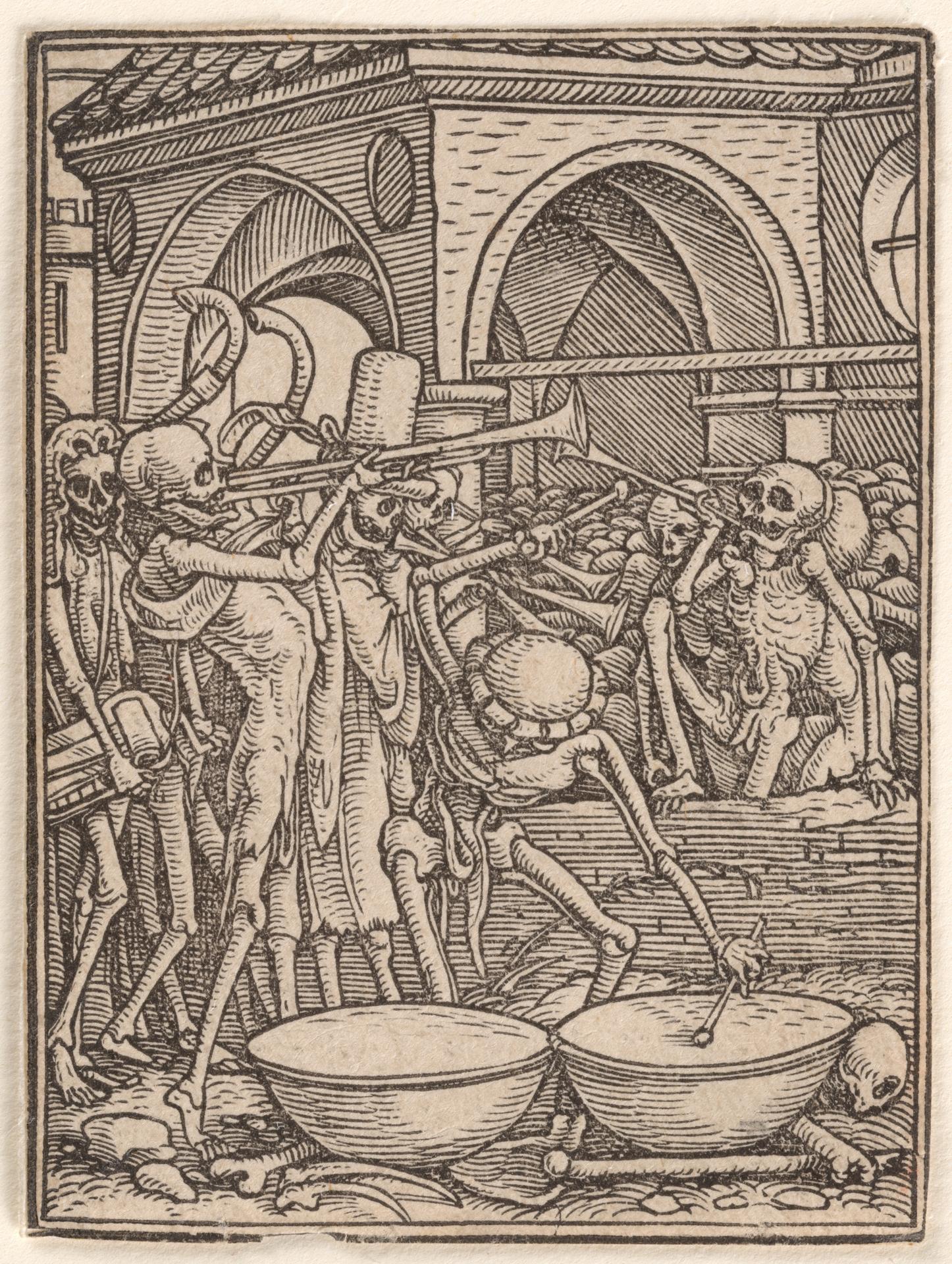
Skeletons Making Music (or the Cemetery), from "The Dance of Death"
Original title: Skeletons Making Music (or the Cemetery), from "The Dance of Death"
kurzbeschreibung
Where many contemporary Dance of Death pictures present death as a lone figure, Holbein's woodcut of 1526, published in 1538 in the 'Dance of Death' series, gathers an entire skeletal band. On this small sheet the bone men make music in a graveyard, an unusual ensemble that holds the viewer through its staged, theatrical character.
Description
Across a stage-like ground bounded at the back by an arcaded structure with a roof, several skeletons are spread out: some squat or sprawl on the floor, others stand and blow trumpets and trombones or beat percussion. In front, two large bowls are handled by another skeleton. The print stays monochrome; delicate lines and hatching model contours and surfaces.
Context
Made in Basel around 1526, the sheet falls in a period when Holbein was deeply engaged with Reformation questions about images. The 'Dance of Death' series first appeared in Lyon in 1538 and became widely known for its blunt confrontation with mortality. Medieval Dance of Death tradition and Renaissance humanist thought meet here.
Impact
With death itself appearing as a music-making collective, an ironic tone arises that also warns. The clear arrangement and precise linework give the sheet a detached, almost cheerful note without obscuring the message of transience.
Technique
For this woodcut the design was cut into a wooden block and then printed. Typical of Holbein's virtuoso handling of the medium are the varied linework and fine hatching. The format of only 6.6 x 4.9 cm demanded the greatest precision in the cutting.
AI-generated description text
Source: Metropolitan Museum of Art · Public Domain (CC0 1.0)