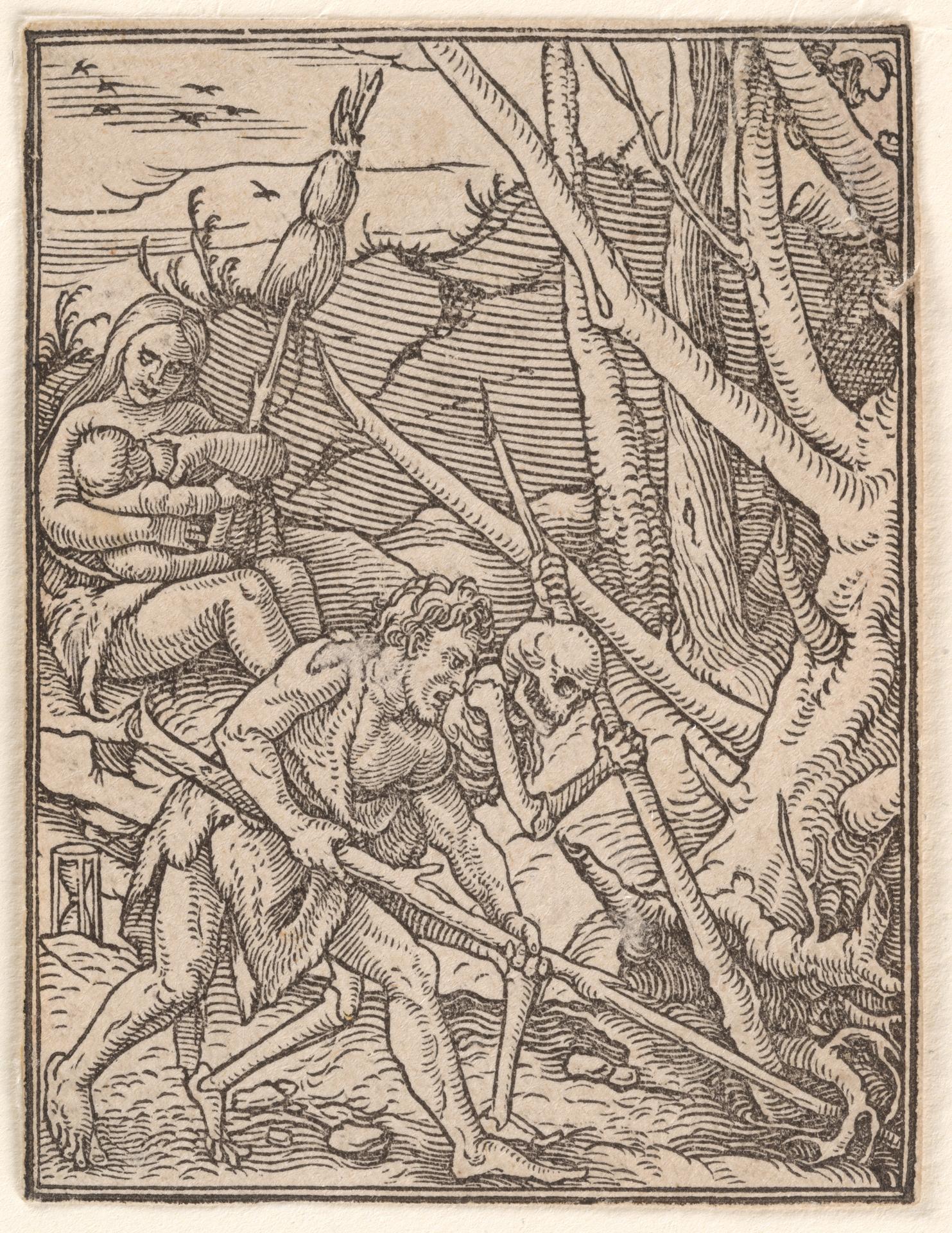
Adam Ploughing, from "The Dance of Death"
Original title: Adam Ploughing, from "The Dance of Death"
kurzbeschreibung
After the Fall, Adam must earn his bread by the sweat of his brow. Holbein turned this Old Testament scene into a woodcut around 1526, published in 1538. A ploughing man labours side by side with a skeleton, while nearby a woman nurses a child. The sheet belongs to the well-known Dance of Death series.
Description
Two figures dominate the foreground: a barefoot woman in coarse, fur-like clothing suckling an infant, and an equally barefoot man in simple trousers at the plough. Beside him, a carefully rendered skeleton with a visible bone structure and mask pushes the plough along. Trees and bushes fill the back space, and a few birds fly above. Fine strokes and hatching build up textures and shadows; everything remains monochrome, without any colour accents.
Context
The woodcuts of the Dance of Death series were made in the 1520s and first made public in Lyon in 1538. They respond to the social and religious upheavals of the Reformation and assert that death makes all people equal. Adam appearing here as a ploughman ties in with the Old Testament curse after the Fall, which includes labour and mortality.
Impact
Rural daily life and the constant nearness of death are tightly bound together in this image; it feels oppressive and at the same time quietly ironic. Thanks to the precise linework and the closely observed skeleton, the small format gains unexpected depth and expressive power.
Technique
The sheet was printed in relief: the image is cut out of a wooden block and then pulled onto paper. With fine lines and cross-hatching Holbein worked out shadows and surface textures, as was customary for sixteenth-century prints. The monochrome look matches the printing practices of that era.
AI-generated description text
Source: Metropolitan Museum of Art · Public Domain (CC0 1.0)