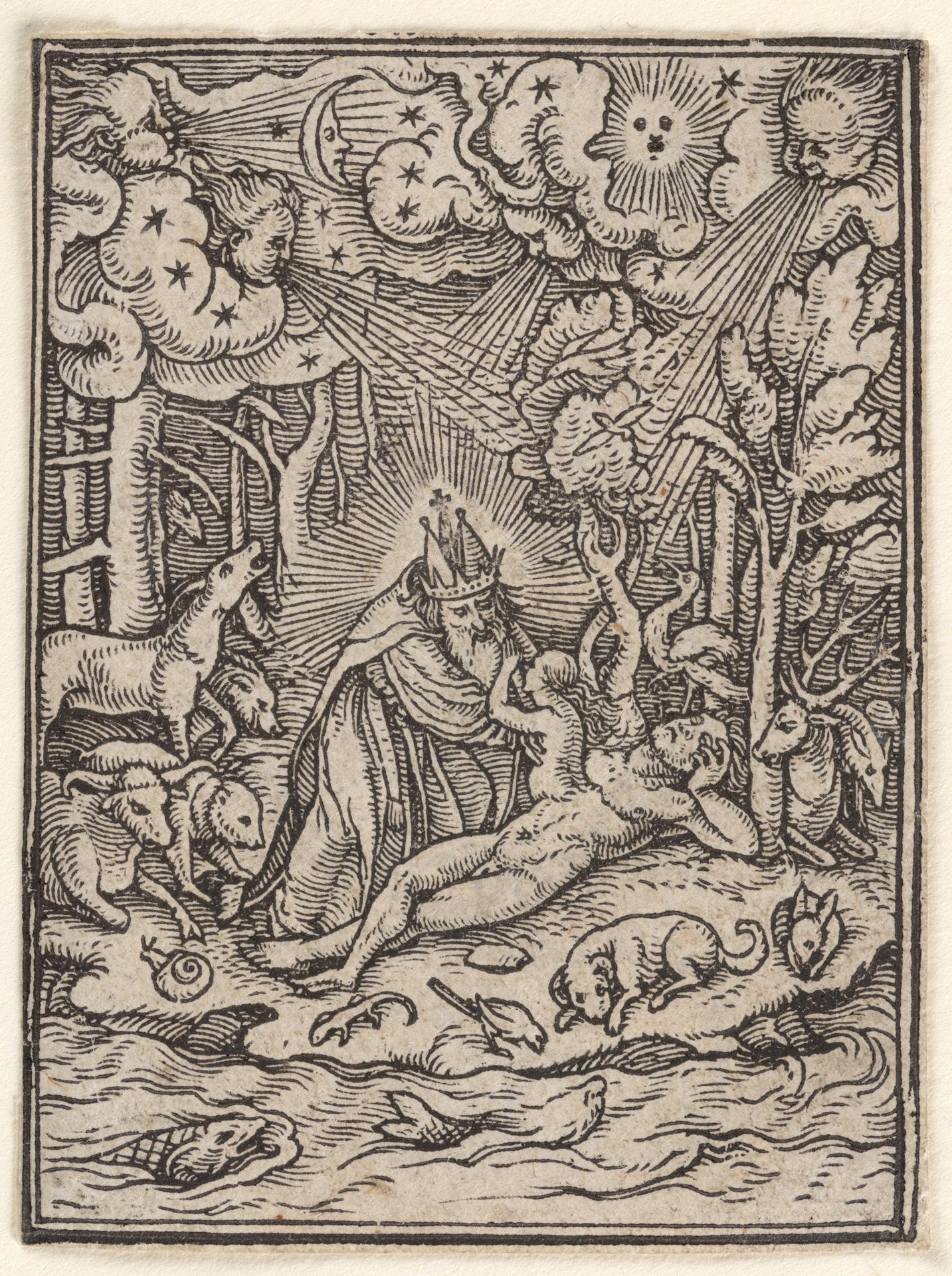
Creation of Eve, from "The Dance of Death"
Original title: Creation of Eve, from "The Dance of Death"
kurzbeschreibung
A divine figure hovers above a naked woman lying on the ground and touches her with one hand. This woodcut by Hans Holbein the Younger, made around 1526 and published in 1538, shows the creation of Eve. It belongs to the series 'Der Totentanz' and is regarded as an outstanding example of Renaissance printmaking.
Description
A male figure, understood as God, stands over the naked woman stretched out on the earth, bending down to lay a hand on her. Animals rest nearby: sheep and fish on the ground around them. Clouds with stars and a moon fill the upper area, crossed by bright light. The dark greys and strong shadows of the woodcut give the mood a somber weight.
Context
Made around 1526, the print did not appear until 1538, when the 'Totentanz' series was printed in Lyon. Holbein was working in Basel at the time and came into contact with Reformation ideas there. It is unusual for the 'Creation of Eve' to open the series, since it brings the Fall and death as its consequence into view. The sheets circulated both singly and in book form and became very popular.
Impact
Clear lines and a dense, almost threatening atmosphere shape the print. The symmetrical arrangement of figures and animals conveys a solemn calm, while the bright light behind contrasts with the dark earth. The restrained grey palette draws the eye to the central event and calls up a reflective mood.
Technique
For this woodcut the design was cut into a block of wood and afterwards printed onto paper. The nuanced shading and precise linework demonstrate Holbein's skill in the medium. The greys come from black ink on light paper, with the density of the lines modeling light and shadow.
AI-generated description text
Source: Metropolitan Museum of Art · Public Domain (CC0 1.0)