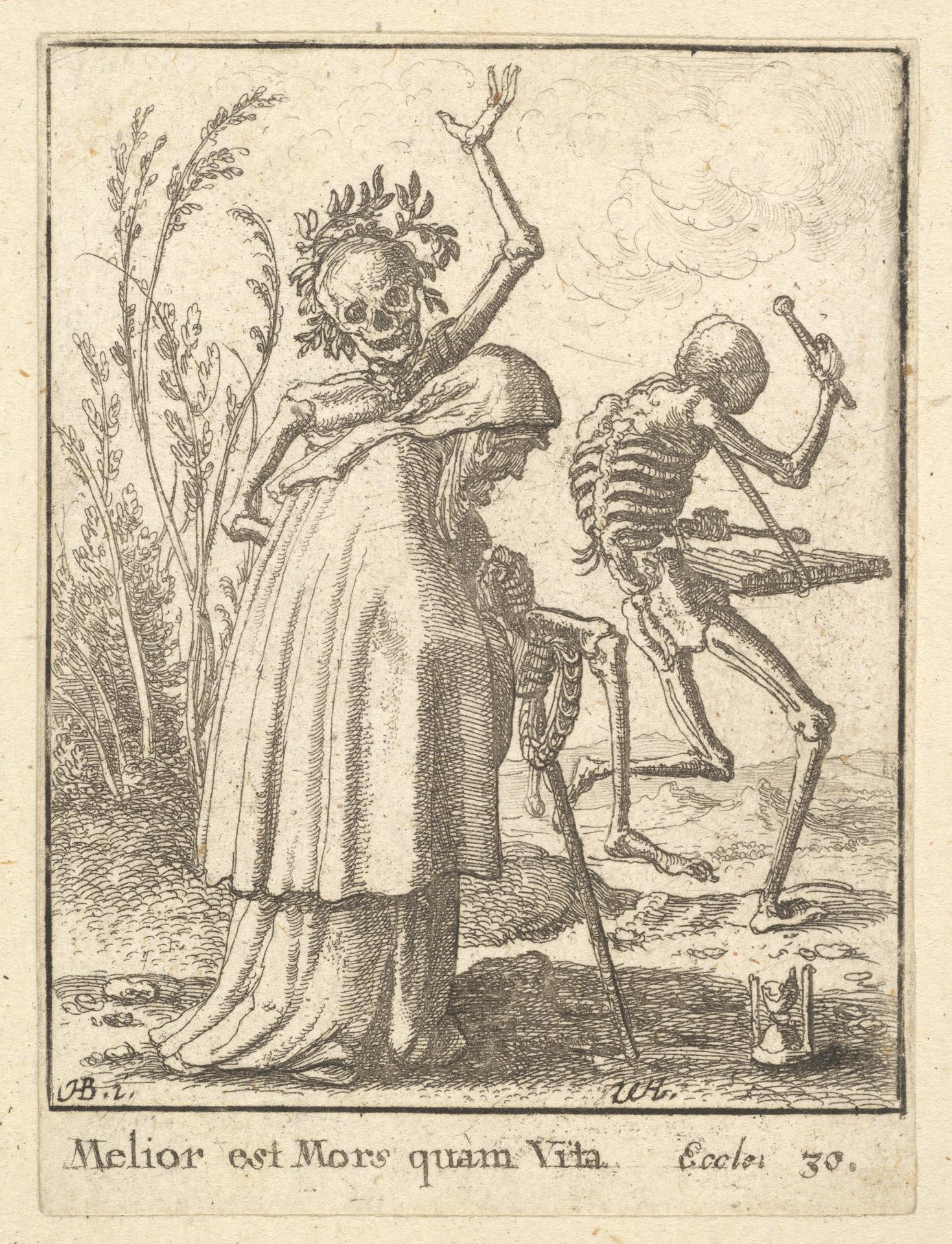
Old woman, from the Dance of Death
Original title: Old woman, from the Dance of Death
kurzbeschreibung
An old woman from the Dance of Death, etched by Wenceslaus Hollar and dated 1651, printed in a late 18th-century edition. The print is a second state of four. The subject belongs to the iconographic tradition of the Dance of Death, in which a skeleton appears as the human's counterpart.
Description
A woman in traditional dress wears a crown of leaves; in her right hand she holds a twig. Facing her stands a skeleton leaning on a staff and holding a pipe or flute in its left hand, caught in a dancing, lively pose. Plants fill the picture space, clouds above, and an hourglass at the lower edge. There too is the Latin inscription 'Melior est Mors quam Vita. Ecclesi 70.'
Context
Hollar etched this print in 1651 as part of a Dance of Death series that draws on older models. A later reprint in the 18th century shows that such moralizing prints remained in demand. The Latin sentence 'Better is death than life' comes from the Book of Ecclesiastes and belongs to Christian vanitas iconography, which keeps the transience of all earthly things before our eyes. Hollar, a Bohemian engraver, worked in London and Antwerp and was known for his detailed prints.
Impact
The eye moves between the old woman and the dancing skeleton, and from this confrontation emerges a forceful memento mori. The calm arrangement and delicate linework soften the motif into an almost elegiac mood that prompts the viewer to reflect on the end.
Technique
The line was drawn into a copper plate, etched out by acid, producing the fine line and precise hatching that characterize Hollar's detailed working method. That the print is in the second of four states reveals the reworking of the plate, which was printed again in the late 18th century.
AI-generated description text
Source: Metropolitan Museum of Art · Public Domain (CC0 1.0)