The Pedlar, from the Dance of Death
Original title: The Pedlar, from the Dance of Death
kurzbeschreibung
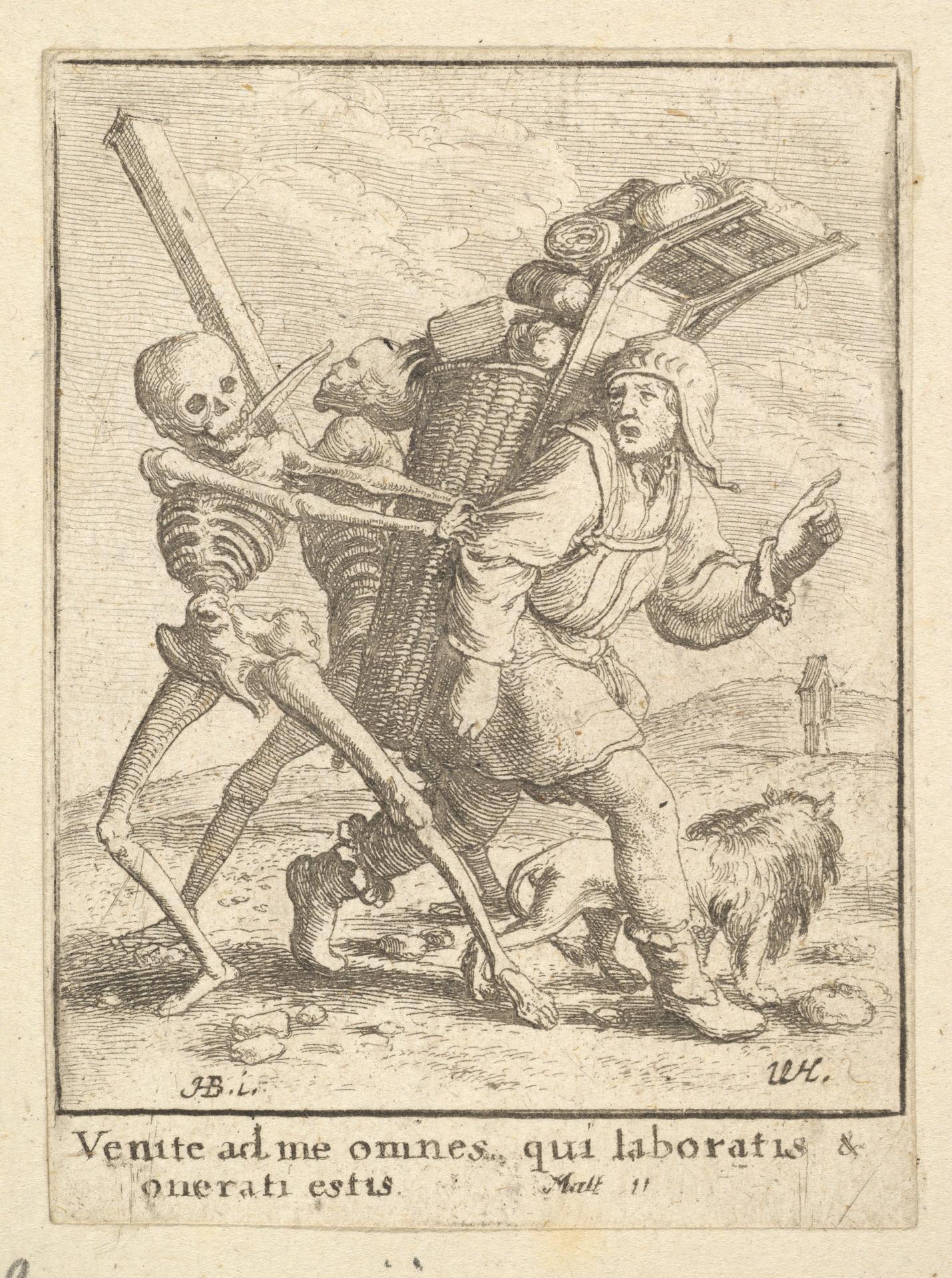
Wenceslaus Hollar's 1651 etching belongs to the motif of the Dance of Death, in which Death leads people of every rank and trade away. A skeleton carries off a frightened peddler with his back-basket; a dog follows the group with a submissive posture. This impression dates from the late 18th century and is the second of four states. The sheet measures 7.6 × 5.6 cm.
Description
A skeleton has shouldered a man whose basket of wares marks him as a peddler; the victim visibly braces against Death's grip. To one side a dog crouches low in submission. Behind the figures a plain village with a small building is suggested. Tonal values stay evenly light, with no strong cast shadows; contours are sharply drawn and the interior lines dense and detailed, as was usual for 17th-century prints.
Context
The Bohemian etcher Wenceslaus Hollar made this sheet in 1651 as a contribution to a series on the Dance of Death — the allegorical motif that holds up the equality of all people before death. In the Baroque, especially in northern Europe, such Dance of Death images enjoyed great popularity. Hollar was known for his detailed prints and worked in England and the Netherlands, among other places. That impressions of his plates still appeared in the 18th century attests to the continuing demand for his work.
Impact
Clear lines and the absence of accessories give the sheet an immediate, insistent presence. The contrast between the active skeleton and the defenseless, frightened peddler creates a tension that feels almost dramatic. Because the background remains sparse, the eye rests entirely on the group of figures — which sharpens the allegorical message further.
Technique
The drawing was etched into a ground layer on a copper plate, with the needle scratching the lines before the bath deepened the exposed areas — an intaglio process. The print reveals fine lines and evenly applied ink characteristic of Hollar's precise working method. This is the second of four states, which documents later reworking of the plate.
AI-generated description text
Source: Metropolitan Museum of Art · Public Domain (CC0 1.0)