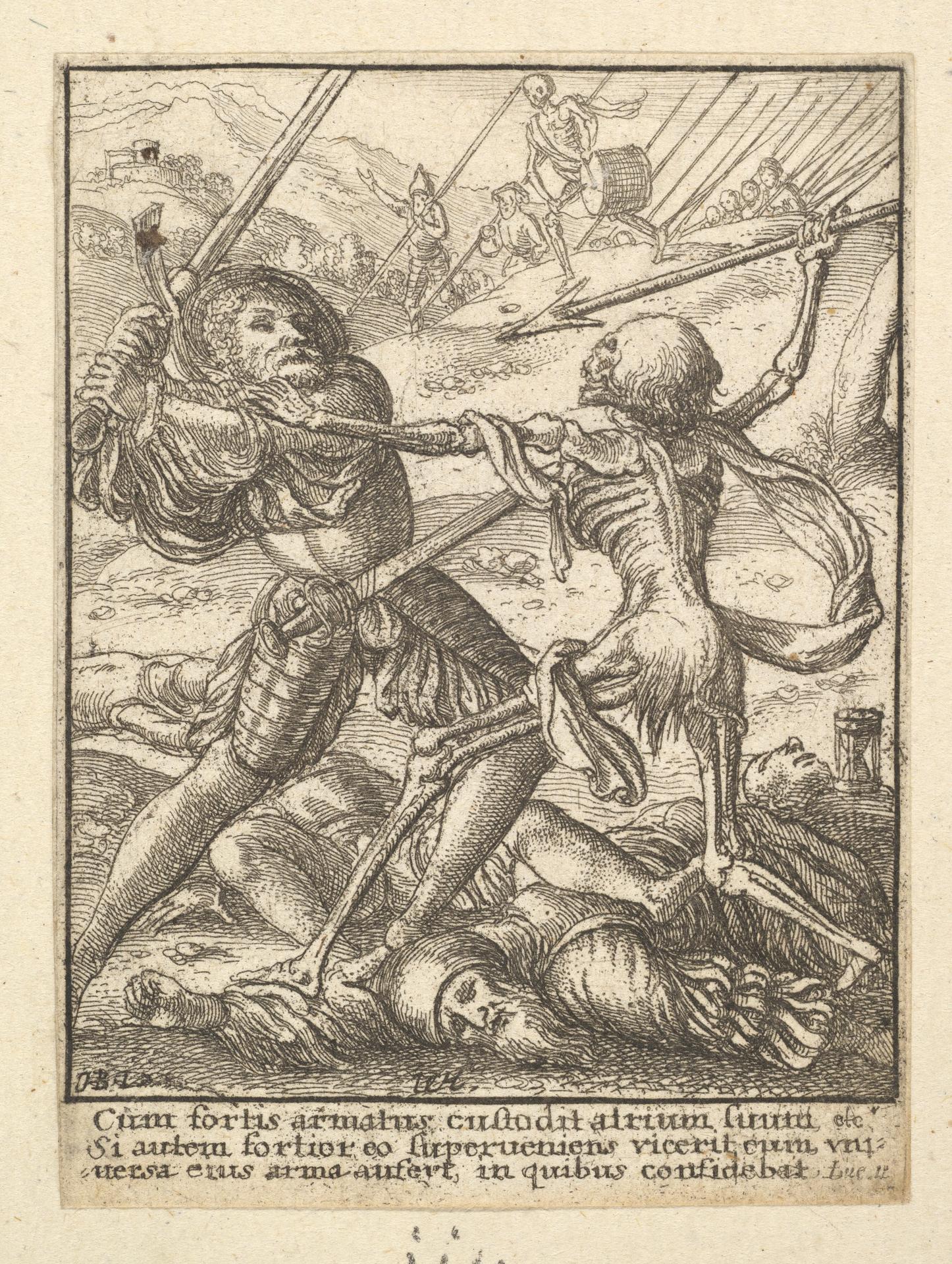
The Knight, from the Dance of Death
Original title: The Knight, from the Dance of Death
kurzbeschreibung
Wenceslaus Hollar made this etching, Der Ritter, around 1651 as a contribution to the allegorical Dance of Death; the impression here was printed in the late 18th century. An armored knight stands against a skeleton, the embodiment of death itself.
Description
Up front an armored man fights a skeleton that thrusts at him with a long staff; shield and helmet are raised in his defense. Behind them other people and skeletons are caught up in the struggle, with a landscape of mountains and a village enclosing the action. Strong lines and deep shading carry the force of the encounter, and where the print works only in grays, sharply cut areas of light and shadow set the contours clearly apart.
Context
The Dance of Death belongs among the allegorical subjects that remind viewers of the inevitability of death and the fleeting nature of life. Hollar, a printmaker from Bohemia, made this sheet in the 17th century as part of a series presenting the ranks of society. That this impression dates only from the late 18th century shows how vividly the motif continued to be received over time.
Impact
From the immediate struggle between knight and skeleton grows a tension that passes to the viewer. Delicately placed lines and a clearly modeled handling of light and dark give the image dramatic depth and draw the eye into its allegorical message.
Technique
The sheet is executed as an etching that works entirely in gray values. In the delicate lines and graduated shadows appears a method that grasps figures and objects precisely. This is the second state of four, a sign of careful work on the printing plate.
AI-generated description text
Source: Metropolitan Museum of Art · Public Domain (CC0 1.0)