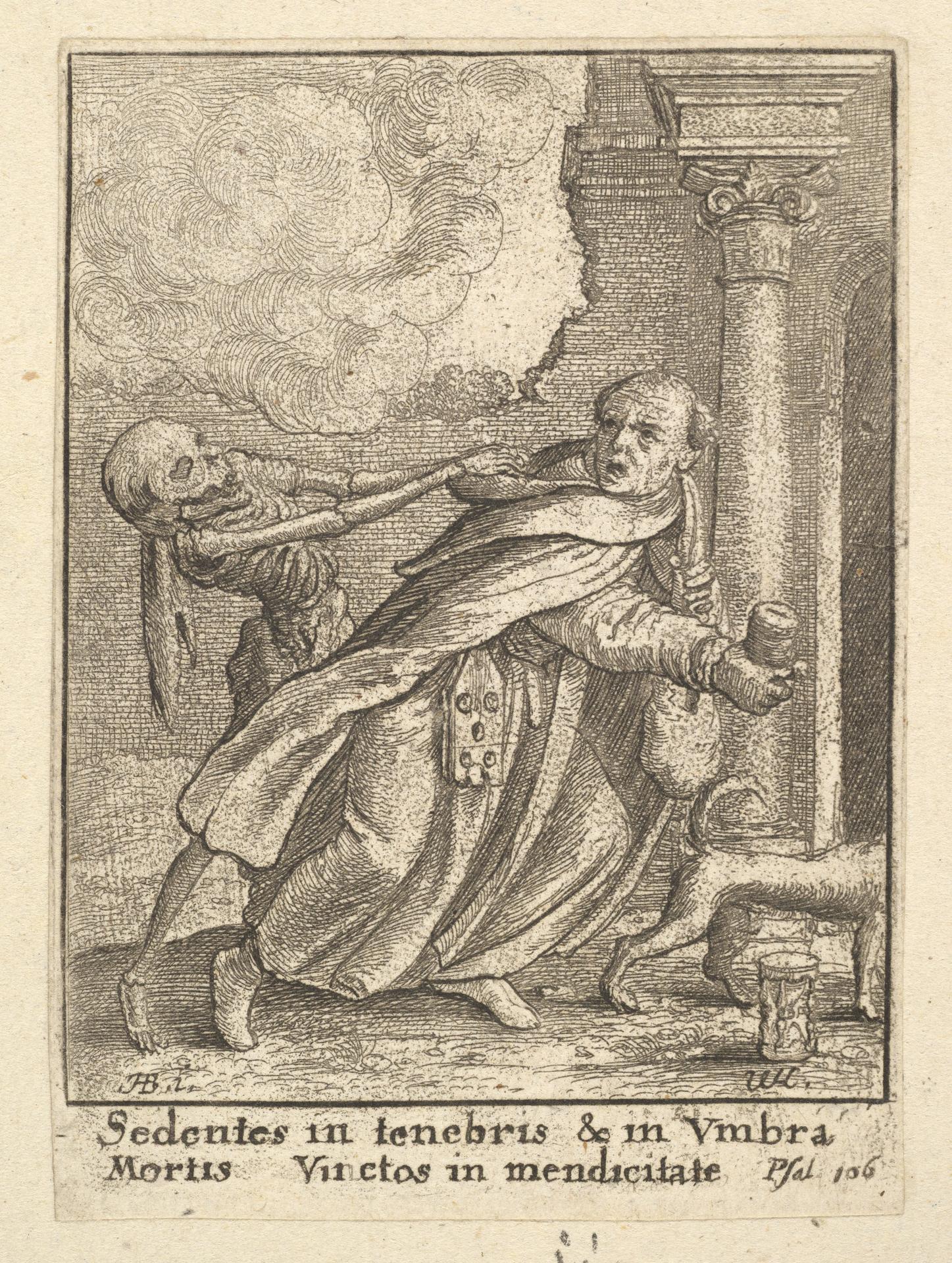
The Monk, from the Dance of Death
Original title: The Monk, from the Dance of Death
kurzbeschreibung
From the series "The Dance of Death" comes Wenceslaus Hollar's "The Monk," created around 1651 and presented here in a late 18th-century printing. A skeleton seizes a monk by the collar and hoists him upward. The etching survives as a second state of four.
Description
A skeleton has grabbed a monk by the collar and pulls him up; the monk remains seated, holding a bowl in one hand. Behind the pair, parts of a classical building with columns can be made out. Wavy lines and hatching cover the surface, creating a restless, chaotic atmosphere. Monochrome in shades of gray, the light feels diffuse and the mood somber. The skeleton's pulling motion gives the layout a sense of dynamism.
Context
Wenceslaus Hollar made the etching series "The Dance of Death" around 1651 during his stay in Antwerp. The series takes up the medieval motif of the dance of death, which emphasizes the transience of life and the equality of all ranks before death. Hollar drew on older models, such as Holbein's Dance of Death, and adapted them for a baroque audience. The prints were reissued later, in the late 18th century, pointing to a continuing demand for such moralizing images.
Impact
The dark hatching and dynamic arrangement create an oppressive mood. The viewer is confronted directly with the power of death, which tears the cleric from his calm. The delicate linework lends the scene an almost elegant precision that aesthetically heightens the horror.
Technique
For this etching, the drawing was bitten into a copper plate. The fine lines and hatching produce nuanced gray tones and sculptural effects. The present impression is a second state, meaning the plate was reworked after the first edition before further prints were made.
AI-generated description text
Source: Metropolitan Museum of Art · Public Domain (CC0 1.0)