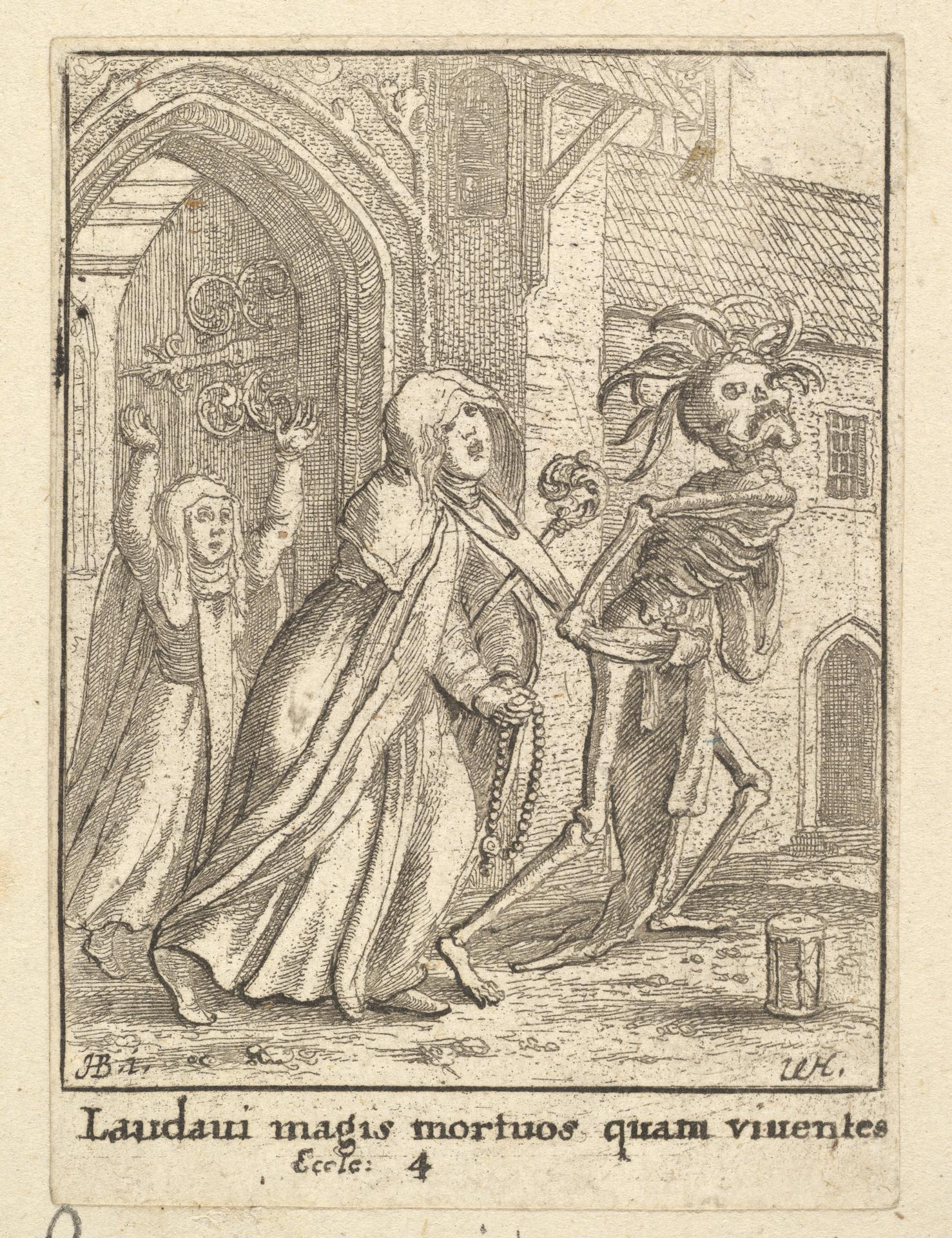
The Abbess, from the Dance of Death
Original title: The Abbess, from the Dance of Death
kurzbeschreibung
Wenceslaus Hollar's etching The Abbess belongs to his Dance of Death series and was made in 1651; this impression is the second of four states, printed in the late eighteenth century. It shows a nun being led by the hand by a skeleton—Death.
Description
A nun in a floor-length habit fingers a rosary bead and turns toward the skeleton, which leads her by the hand with a long staff. At the right, another figure in a long robe raises both arms. Gothic church architecture with a portal and tower fills the background, and the ground is patterned like a carpet. Below runs the Latin text "Laudati magis mortuos quam viventes Eccle: 4," meaning "Praise the dead more than the living."
Context
Hollar made this etching in 1651 as part of his Dance of Death series, an allegorical theme that had addressed the ubiquity of death since the Middle Ages. The series draws on Holbein the Elder's Dance of Death, though Hollar interpreted it independently. The Latin quotation cites a verse from Ecclesiastes (Eccle: 4) that sets the dead against the living. The second of four states points to a later edition.
Impact
Fine linework and high-contrast hatching create a somber, contemplative mood. The nun's calm bearing and the insistent skeleton convey an eerie composure that reinforces the moralizing character of the subject.
Technique
The design was incised into an etched plate and then printed on paper—an etching. The second of four states means the plate was reworked after the first printing to achieve finer details or contrasts. The small format, roughly 7.5 × 5.5 cm, demands precise linework, visible in the hatching of the garments and the architecture.
AI-generated description text
Source: Metropolitan Museum of Art · Public Domain (CC0 1.0)