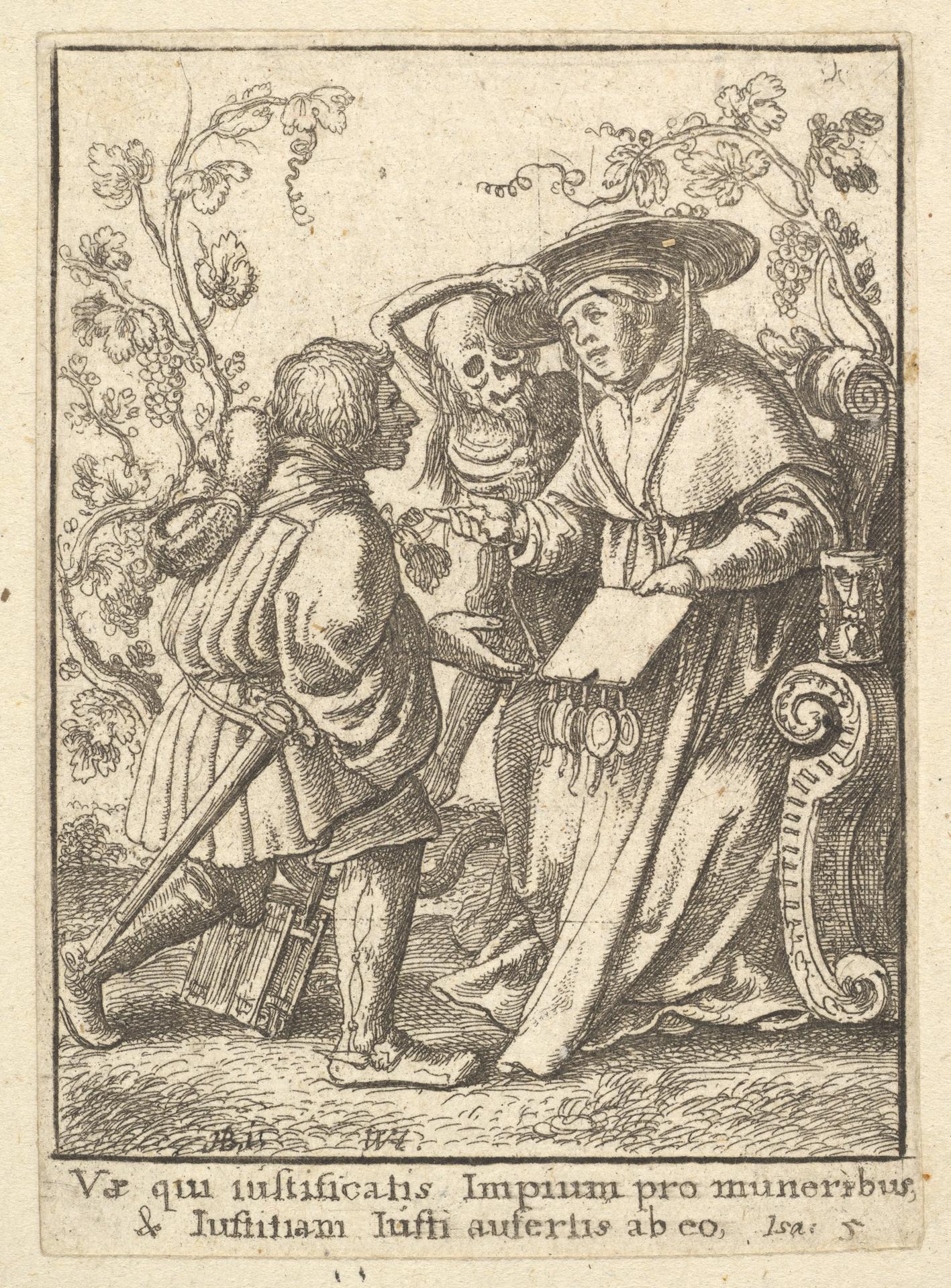
Cardinal, from the Dance of Death
Original title: Cardinal, from the Dance of Death
kurzbeschreibung
Wenceslaus Hollar etched Cardinal, from the Dance of Death in 1651 as part of a series on the theme. Death, pipe in hand, meets a cardinal and a second figure. This impression comes from a late eighteenth-century reprint of the plate.
Description
A figure identifiable as Death dominates the middle of the sheet: a skull hangs above a shovel, and Death holds a pipe. Two more characters join him, one in traditional dress and headgear, the other carrying a sack and a weapon. Their postures suggest a bargain or an exchange. Stylized leaves and branches behind them may hint at the passage from life to death. The layout is asymmetrical, and Death draws the eye more than anything else.
Context
The 1651 etching belongs to a Dance of Death sequence that takes up the medieval Danse Macabre. The subject was widespread in European art and stressed the transience of life and the equality of all ranks before death. Hollar, a Bohemian printmaker, worked in England and was known for his detailed prints. That the sheet was printed again in the late eighteenth century points to continued demand for such moralizing images.
Impact
A somber, reflective mood comes off the etching, reinforced by its monochrome execution and delicate linework. Death approaches the cardinal as an equal partner in conversation, which makes the moral lesson of mortality plain. The detailed treatment of the figures and the setting draws the viewer into the scene and invites reflection on life and death.
Technique
The print was made as an etching: the drawing was bitten into a copper plate to allow impressions to be pulled. This is the second state of four, which points to later reworking of the plate. The small sheet (7.4 × 5.3 cm) shows the usual traits of Baroque printmaking, with fine lines and precise hatching.
AI-generated description text
Source: Metropolitan Museum of Art · Public Domain (CC0 1.0)