Empress, from the Dance of Death
Original title: Empress, from the Dance of Death
kurzbeschreibung
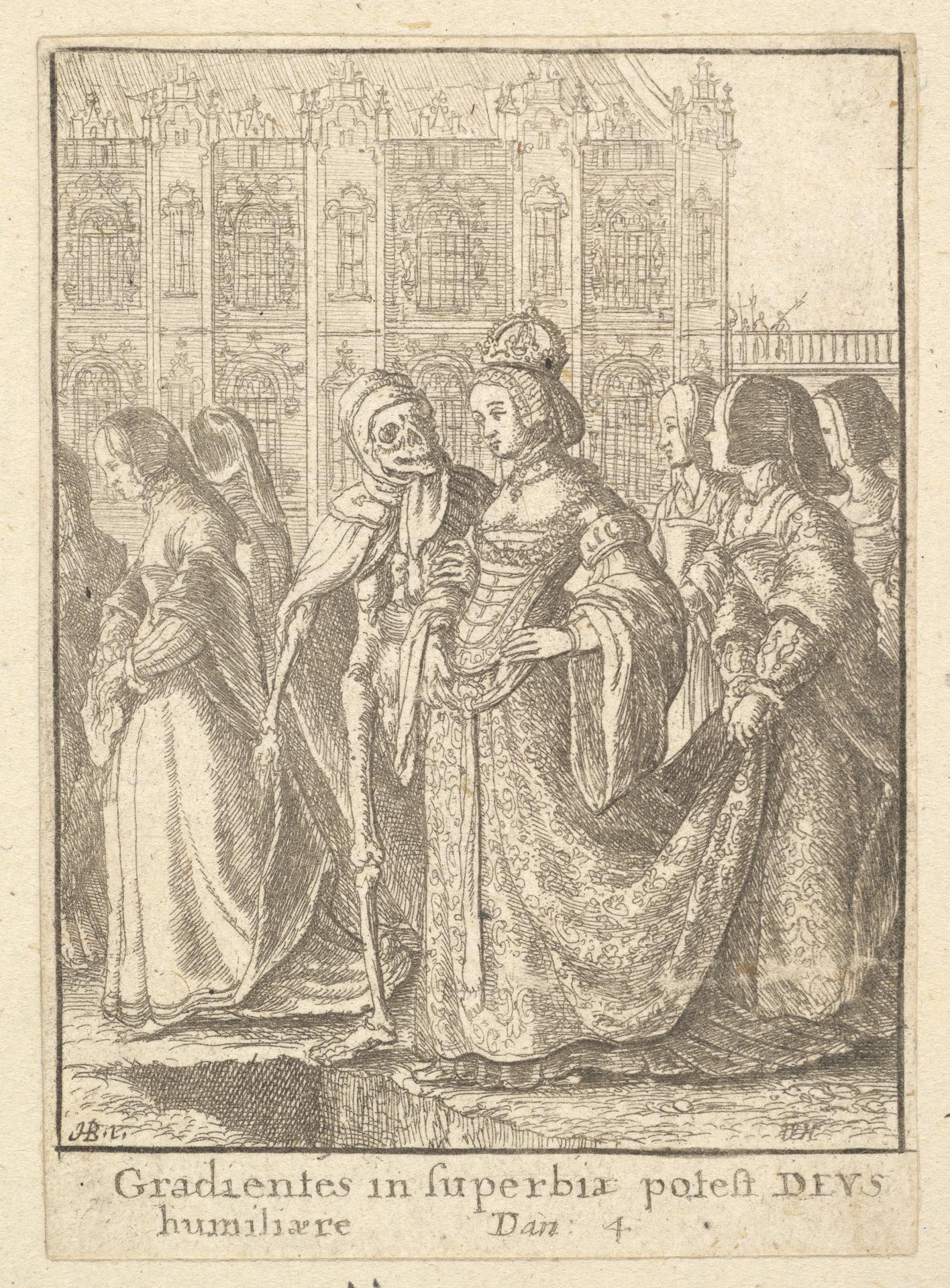
Unlike many related Dance of Death depictions, Wenceslaus Hollar's etching 'Empress, from the Dance of Death' (1651, printed in the late 18th century) centers on a crowned ruler engaged in conversation with a skeleton. The print thus exposes the transience of worldly power.
Description
A queen in rich regalia and crown stands facing a skeleton that seems to be addressing her. Behind her rises a palace with towers and windows, while several women in traditional dress observe the encounter. The layout thrives on delicate lines and hatching; the black-and-white reproduction is rich in detail.
Context
Hollar created this etching as part of a Dance of Death series, a motif widespread in the 16th and 17th centuries. Older examples that used the dance of the dead as a socially critical parable served as models. The Bohemian engraver worked in England and on the Continent and was regarded as a master of precise reproductions. The Latin inscription at the lower margin quotes Daniel 4:34 and underscores the humiliation of the proud.
Impact
The contrast between royal dignity and the bare skeleton acts as a forceful reminder of mortality. The calm arrangement and fine linework lend the scene a detached, almost courtly elegance that highlights the tension between earthly splendor and ephemerality.
Technique
The etching was made by biting lines into a metal plate; the impression was pulled on paper. The sheet measures approximately 7.3 × 5.3 centimeters. In the second of four states, the plate shows reworking, with details such as shading refined.
AI-generated description text
Source: Metropolitan Museum of Art · Public Domain (CC0 1.0)