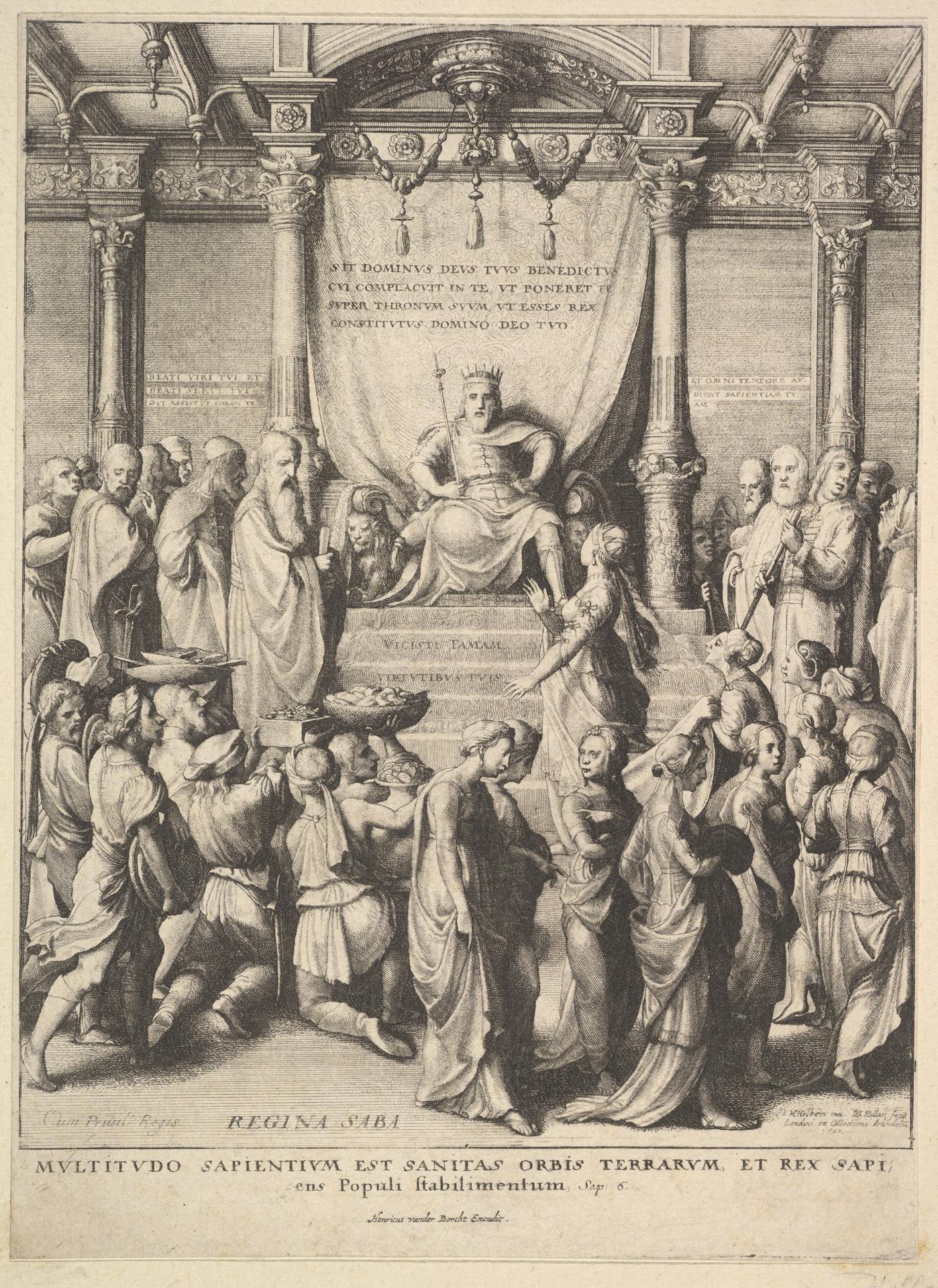
Solomon and the Queen of Sheba (1642)
Original title: Solomon and the Queen of Sheba
kurzbeschreibung
Wenceslaus Hollar etched the meeting of King Solomon and the Queen of Sheba in 1642. The image draws on an invention by Jan van de Velde the Younger and treats an Old Testament subject. This impression is the third state of three.
Description
Solomon sits enthroned at the center on a richly ornamented seat, surrounded by figures who admire his wisdom and rule. To the left stands the Queen of Sheba in a precious gown that signals her wealth, holding a crown in her hand. To Solomon's right are priests and retainers in reverent posture. The layout is symmetrically aligned on the two main figures, who wear clothing typical of the period. Black-and-white gradations and fine hatching create spatial depth.
Context
The Bohemian engraver Wenceslaus Hollar made this print in 1642 in Antwerp, where he worked on commission for publishers. The etching reproduces a model by Jan van de Velde the Younger, a Dutch painter and draughtsman known for biblical and historical subjects. Reproductive prints of this kind were common in the seventeenth century and allowed pictorial ideas to circulate across borders. Hollar was regarded as a master of precise technique and faithful detail.
Impact
Clear lines and a calm, dignified account of the biblical encounter define the sheet. The symmetrical arrangement and nuanced shading give it a monumental presence that emphasizes the significance of the moment. The multitude of figures and the ornamental treatment of the throne evoke an atmosphere of court ceremony and lofty solemnity.
Technique
For this etching, the drawing was bitten into a copper plate, which was then inked and printed on paper. Hollar used fine parallel lines and cross-hatching to model light and shadow with plasticity. The third state suggests reworking or strengthening of the plate, as was customary for later impressions.
AI-generated description text
Source: Metropolitan Museum of Art · Public Domain (CC0 1.0)